
www.industryemea.com
02
'26
Written on Modified on
Module-Level PV Monitoring Enables Early Fault Detection
Fraunhofer IFF develops a sensor-based system with AI analytics to monitor photovoltaic plants at module level, improving fault detection, performance transparency, and predictive maintenance.
www.fraunhofer.de
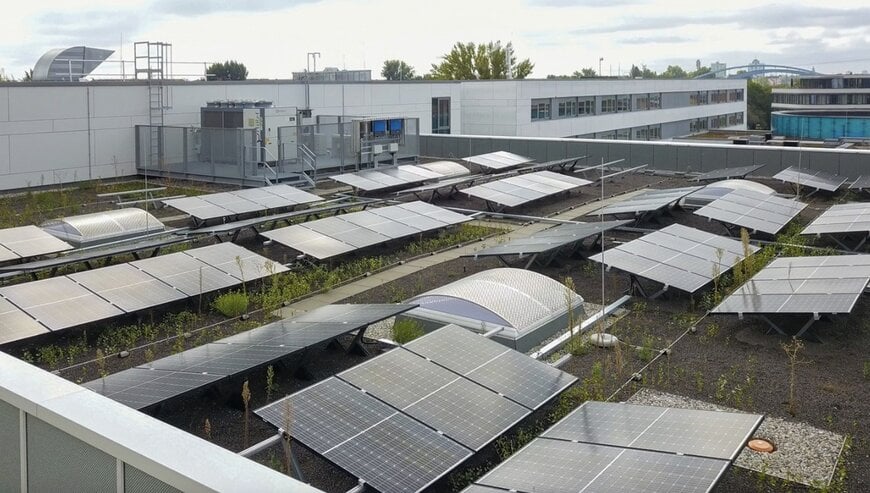
Large photovoltaic (PV) plants are typically monitored at the string or inverter level, limiting visibility into faults that originate at individual modules. Researchers at Fraunhofer Institute for Factory Operation and Automation IFF are addressing this limitation through a sensor system designed to provide continuous, high-resolution monitoring at the module level.
Limitations of conventional PV monitoring
Current monitoring approaches aggregate data at inverter or string level, which obscures the condition of individual modules. Faults such as defective bypass diodes, electrical connection issues, or localized degradation can remain undetected until they significantly impact overall system performance.
Optical inspection methods, including infrared thermography and drone-based imaging, provide only periodic assessments and are constrained by environmental conditions. These methods are effective for identifying visible defects such as hotspots but are less capable of detecting electrical or early-stage degradation issues.
High-resolution sensing at module level
The new system introduces distributed sensors installed directly on individual PV modules. These sensors measure key electrical and thermal parameters, including direct current, voltage, and module temperature. Additional environmental data, such as solar irradiance, is integrated from external weather stations.
This approach enables continuous, granular monitoring of each module rather than aggregated performance data. The result is improved visibility into localized faults and performance deviations across the PV array.
Wireless data acquisition and system architecture
Sensor nodes communicate through a mesh network using low-power wireless protocols, enabling scalable deployment across large PV installations. Data is transmitted to central gateways and forwarded to a control platform, where it is synchronized, stored, and processed.
The architecture supports large-scale systems with thousands of modules while maintaining low energy consumption and reliable communication. This is critical for utility-scale PV plants where infrastructure complexity and data volume are significant.
AI-driven anomaly detection and diagnostics
A central component of the system is the application of AI models for anomaly detection and fault classification. By analyzing patterns in electrical and thermal data, the system can identify deviations from normal operation and localize faults at the module or string level.
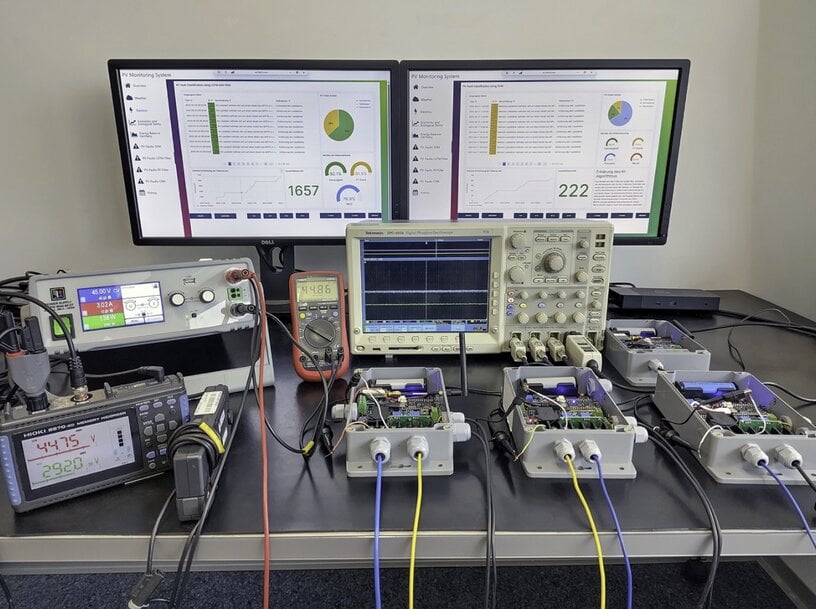
Detected issues include:
- Thermal anomalies such as hotspots
- Mechanical defects including cracks and delamination
- Electrical faults such as bypass diode failures
- Soiling, shading, and snow coverage
- Degradation and mismatch effects
The system not only detects anomalies but also provides diagnostic insights and recommended actions, supporting predictive maintenance strategies.
Validation and deployment pathway
Prototype sensors and communication systems have been tested for accuracy, stability, and reliability in laboratory environments. Field validation is underway in pilot installations, including PV sites in Türkiye and test environments using operational inverter data.
These trials aim to validate scalability, optimize hardware and communication performance, and refine AI models under real-world conditions.
Toward predictive and transparent PV operations
By enabling continuous module-level monitoring, the system addresses a key gap in current PV plant management. Improved fault detection and localization support higher energy yield, reduced downtime, and more efficient maintenance planning.
As photovoltaic systems play an increasingly significant role in energy systems, such high-resolution monitoring solutions contribute to improved reliability, forecasting accuracy, and overall system performance.
Edited by Romila DSilva, Induportals Editor, with AI assistance.
Validation and deployment pathway
Prototype sensors and communication systems have been tested for accuracy, stability, and reliability in laboratory environments. Field validation is underway in pilot installations, including PV sites in Türkiye and test environments using operational inverter data.
These trials aim to validate scalability, optimize hardware and communication performance, and refine AI models under real-world conditions.
Toward predictive and transparent PV operations
By enabling continuous module-level monitoring, the system addresses a key gap in current PV plant management. Improved fault detection and localization support higher energy yield, reduced downtime, and more efficient maintenance planning.
As photovoltaic systems play an increasingly significant role in energy systems, such high-resolution monitoring solutions contribute to improved reliability, forecasting accuracy, and overall system performance.
Edited by Romila DSilva, Induportals Editor, with AI assistance.
