
www.industryemea.com
15
'26
Written on Modified on
Reichelt: Reduced Production Downtime, but Declining Economic Outlook in Netherlands
Despite improved component availability, high energy prices and logistical costs continue to pressure the Dutch manufacturing sector.
www.reichelt.com
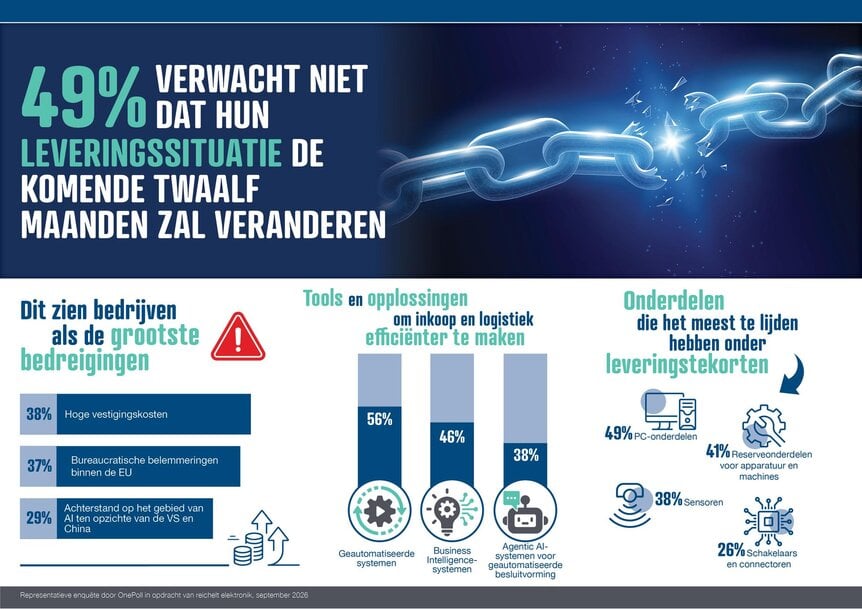
Dutch companies are experiencing significantly less production downtime due to material shortages. According to the Supply Chain Report 2026 by reichelt elektronik, which surveyed 250 technology decision-makers in the Netherlands, average downtime over the past twelve months dropped to 21.4 days, compared to 27.6 days in 2025. Although the procurement of critical components is running smoother, geopolitical tensions, high energy costs, and persistent price increases are dampening the sector's economic confidence; only 37 percent of companies currently view the outlook positively.
Component Availability and Rising Costs
Procuring industrial and electronic components is presenting fewer bottlenecks. Only 16 percent of respondents experienced severe purchasing problems over the past year, down from 21 percent a year earlier. The scarcest product groups remain PC components (49 percent), machine spare parts (41 percent), sensors (38 percent), and switches or connectors (26 percent). Despite better availability, rising prices for these critical parts pose a major challenge for 77 percent of companies. At the same time, margin pressure from high energy prices (66 percent), increasing freight costs (62 percent), and raw material shortages (62 percent) continues to escalate.
Declining Confidence Due to Geopolitical Uncertainty
Optimism regarding a swift resolution to supply chain disruptions is waning. While 48 percent of companies expected a substantial improvement over the coming twelve months last year, that figure has fallen to 36 percent. Nearly half anticipate stagnation, while 15 percent foresee further degradation in the supply chain. Respondents cite international conflicts as a primary pressure on global trade. The conflict between Iran and the US is viewed negatively by 62 percent, followed by the war in Ukraine (60 percent) and ongoing trade tensions between the EU and China (49 percent).
Additional Context: Reshoring and the Semiconductor Cycle
This section details technical specifications and competitive benchmarking not included in the original market report.
The persistent tightness in specific components, such as industrial sensors and switches, is partly driven by structural investment dynamics in global semiconductor manufacturing. While chipmakers heavily invest in advanced nanometer nodes for AI and consumer electronics, older "legacy" nodes (such as 90nm or 130nm)—which are crucial for standard industrial components and power electronics—are often underfunded. To mitigate these shortages and logistical vulnerabilities, many OEMs are moving away from traditional just-in-time (JIT) procurement. Instead, they are adopting just-in-case (JIC) strategies with strategic buffer inventories. While this reduces immediate production downtime, it results in significantly higher capital lockup and storage costs. Furthermore, geopolitical trade barriers are forcing companies toward nearshoring, which shortens physical logistics lines but structurally increases component costs compared to heavily centralized supply chains in Asia.
Edited by industrial journalist Lekshman Ramdas, with AI assistance.
www.reichelt.com
