
www.industryemea.com
21
'26
Written on Modified on
MOL Group Inaugurates Hungarian Solar and Battery Storage Facility
The 37.4 MWp solar park and 40 MWh battery system boost renewable capacity and grid stability.
molgroup.info
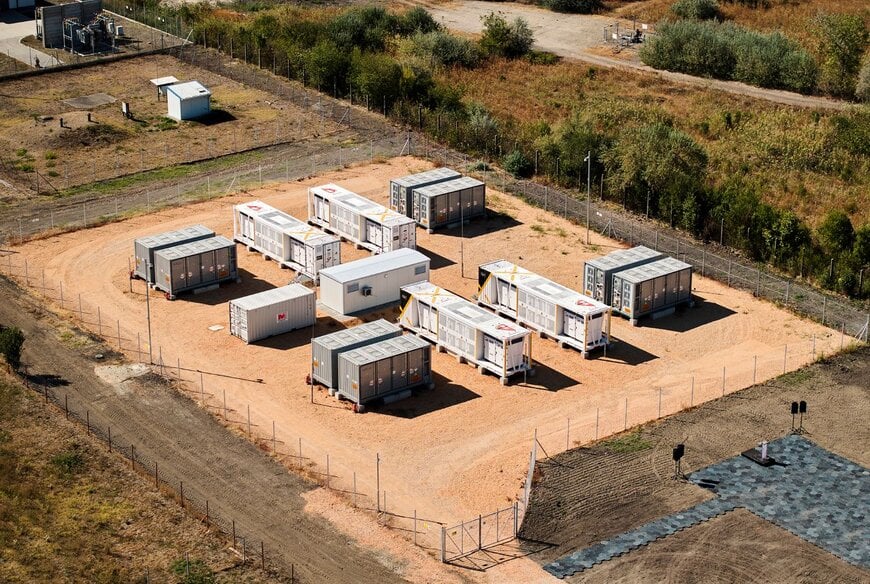
MOL Group has officially inaugurated a 37.4 MWp solar park alongside a 20 MW / 40 MWh battery energy storage system at its Algyő site in Hungary. Constructed by ALTEO Plc., the new renewable energy complex is capable of fully covering the electricity demands of the company's Algyő operations. By generating green electricity on-site and managing supply fluctuations through the battery system, the facility enhances MOL's operational energy independence, reduces overhead costs, and cuts CO2 emissions by approximately 13,000 tonnes annually.
The integration of the battery storage system is a critical component of the investment, designed to balance the inherent intermittency of weather-dependent renewable generation and contribute to the stability of the national power grid. The Algyő project aligns with MOL Group’s SHAPE TOMORROW strategy, which emphasizes the smart energy transition and the expansion of renewable capacities. With this latest addition, MOL Group's total regional photovoltaic capacity now stands at 415 MWp across 11 solar parks (nine in Hungary and two in Croatia). The company currently operates 80 MWh of total energy storage and plans to scale its Hungarian storage capacity to 500 MWh by 2030.
Additional Context
This section provides technological and market background not explicitly detailed in the original release.
The co-location of large-scale Battery Energy Storage Systems (BESS) alongside utility-scale solar photovoltaic (PV) generation is becoming a mandatory strategy for heavy industrial operators and regional grid stability. Solar power generation is inherently intermittent and peaks during midday hours when general demand is often lower, creating a supply-demand mismatch commonly referred to as the "duck curve." By integrating a 40 MWh storage system, MOL can capture excess solar energy during peak sunlight and discharge it during evening demand spikes or sudden cloud cover. Furthermore, beyond simple energy shifting, large BESS installations provide essential ancillary services to national transmission system operators. These systems can instantly inject or absorb power to perform frequency regulation and voltage control, services that are increasingly vital for maintaining the 50 Hz European grid frequency as traditional fossil-fuel baseload plants are progressively decommissioned.
Edited by Lekshman Ramdas, Induportals editor – adapted by AI.
www.molgroup.com
