
www.industryemea.com
20
'26
Written on Modified on
Acoustic Leak Detection Systems for Pressurized Water Infrastructure
HIKMICRO provides a dual-sensor acoustic diagnostic tool engineered to identify and isolate concealed water system failures across diverse indoor and outdoor environments.
www.hikmicrotech.com
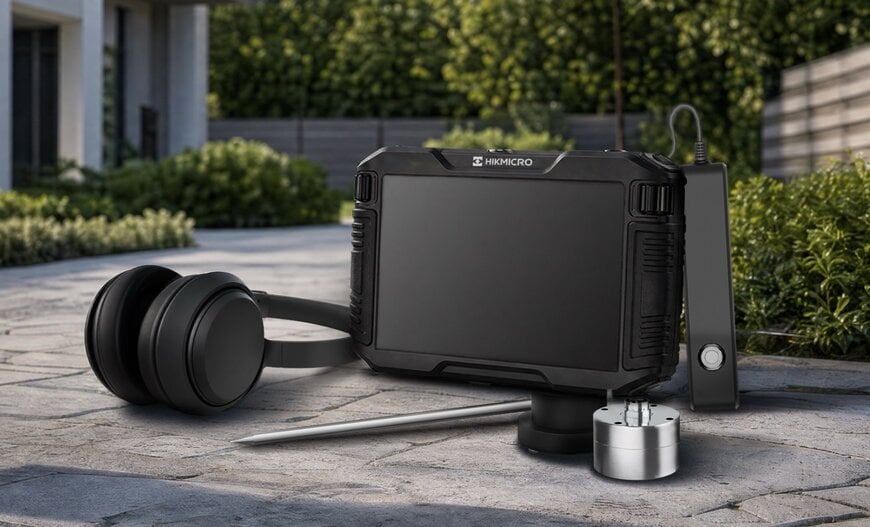
HIKMICRO is releasing the AD22P, an acoustic leak detector designed to identify concealed structural and pipeline vulnerabilities within pressurized water systems. The hardware allows facility managers and plumbing professionals to conduct industrial maintenance and water loss management across both indoor structural piping and external utility networks.
Acoustic Diagnostic Mechanisms and Capabilities
Pressurized water leaks generate distinct acoustic emissions and mechanical vibrations when fluid escapes through structural fissures or degraded joints. The AD22P captures these specific acoustic signatures using interchangeable application-specific sensors, addressing the technical challenge of diagnosing failures across varied surface impedances. For internal environments, a high-sensitivity sensor analyzes piping concealed within walls and flooring. Conversely, a robust three-point contact sensor is utilized for external inspections, maintaining consistent surface coupling across soil, concrete, asphalt, and paving. By matching the acoustic sensor to the specific surface material rather than the general pipe location, technicians achieve higher diagnostic accuracy and reduce the necessity for exploratory excavation.
Signal Processing and Workflow Optimization
Leak acoustics are frequently attenuated by ground cover or masked by ambient environmental noise. To address this interference, the hardware utilizes a proprietary intelligent leak detection algorithm that automatically isolates genuine hydraulic leak frequencies from background noise. The system operates across a wide acoustic bandwidth from 200 Hz to 16,000 Hz, with the upper 16,000 Hz threshold specifically active during indoor diagnostic operations to capture high-frequency fluid escape. Technicians can toggle between a rapid screening mode for broad area surveys and a dedicated multi-point comparison mode for precise fault localization, thereby accelerating the inspection workflow.
Hardware Durability and Interface Specifications
Diagnostic data, including acoustic intensity parameters and waveforms, is visualized on a 7-inch high-definition touchscreen interface. This display allows operators to interpret complex acoustic metrics directly in the field. To accommodate demanding industrial maintenance conditions, the unit is engineered with an operational temperature range of -10°C to +50°C and features a 1.2-meter drop resistance rating. Stefan Li, Overseas General Manager at HIKMICRO, notes that integrating optimized signal capture with a flexible inspection workflow enables operators to isolate hidden hydraulic faults efficiently while minimizing unnecessary structural repair costs.
Additional Context
This section details technical specifications and competitive benchmarking not included in the original news release.
Comparable professional acoustic leak detectors include the Sewerin Aquaphon A 200 and the Gutermann Aquascope systems. These competing devices generally rely on interchangeable ground microphones and offer frequency analysis ranges up to 10,000 Hz or 15,000 Hz. The AD22P’s extended 16,000 Hz upper frequency limit in indoor mode provides a measurable advantage for detecting highly attenuated, high-frequency acoustic signals emitted by micro-leaks in highly pressurized indoor plumbing. Furthermore, the integration of algorithmic noise-filtering natively on a 7-inch touchscreen interface streamlines the hardware footprint compared to legacy utility systems that utilize separate control modules and analog acoustic filtering.
Edited by Aishwarya Mambet, Induportals Editor, with AI assistance.
www.hikmicrotech.com
