
www.industryemea.com
22
'26
Written on Modified on
BASF Innovates Plastic Joining with Patented Hot Gas Welding Process
The new technology enables faster, energy-efficient, and material-friendly welding of thermoplastic components, maximizing process reliability and seam strength for advanced eMobility applications.
www.basf.com
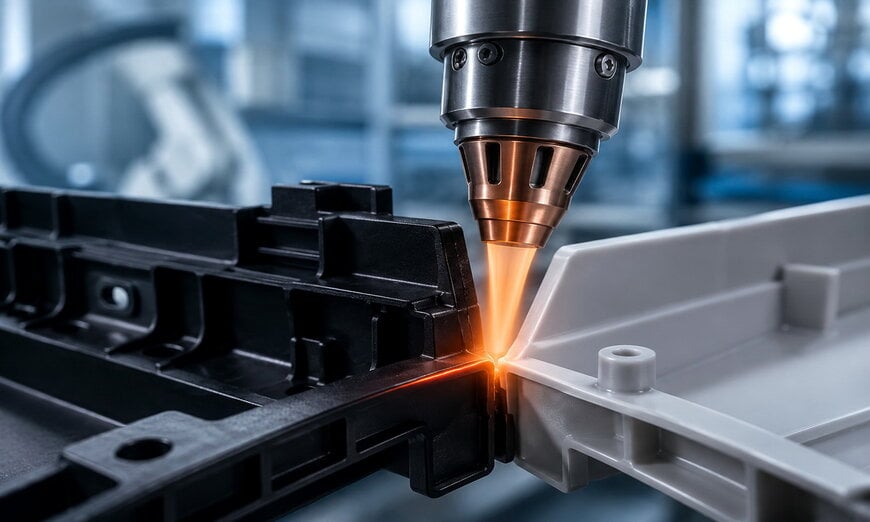
BASF has developed a patented hot gas welding technology that improves energy efficiency and joint strength for high-performance thermoplastic components. This engineering approach optimizes the assembly of heat-resistant parts used in automotive electrical systems and industrial fluid management applications.
Channel-Guided Gas Distribution Dynamics
Conventional hot gas welding relies on individual nozzles that direct heated gas at specific points along a plastic welding rib. This method frequently results in non-uniform thermal distribution and significant localized heat loss, which can cause material degradation or incomplete bonding in high-temperature polymers like polyphthalamide.
The new tooling architecture replaces isolated nozzles with structured, integrated channels that guide the thermal medium continuously along the entire path of the joint. This configuration ensures a homogeneous heat transfer to the welding ribs without requiring elevated process temperatures or narrow tool-to-part clearances.
Thermal Profile Optimization and Mechanical Performance
Empirical testing on polyphthalamide specimens demonstrates that the channel-guided system achieves uniform material plasticization and robust joint structural integrity within a heating phase of approximately ten seconds. Standard hot gas welding configurations typically fail to form a reliable cohesive bond within this brief processing window.
The optimized thermal distribution produces a thicker, more consistent melt layer. This increased depth of molten material provides the physical compliance necessary to compensate for dimensional warpage, which is a common challenge in large-format or geometrically complex molded components.
Energy Reduction and System Reliability
By maintaining a uniform thermal profile, the process operates at lower peak temperatures, lowering overall electrical energy and inert gas consumption during production cycles. Furthermore, the geometric design allows for an increased physical clearance between the gas delivery channels and the polymer substrate. This configuration minimizes the risk of molten material adhering to and clogging the gas orifices, thereby increasing production uptime and reducing scheduled tool maintenance.
The technical characteristics of polyphthalamides—specifically their retention of mechanical properties under chemical, hydrolytic, and high-temperature exposure—make them standard selections for electric vehicle powertrains and fuel cell components. This specialized welding process expands the manufacturing feasibility of these polymers, allowing for higher functional integration in demanding environments.
Additional Context: Technical Specifications and Competitive Benchmarking
In industrial plastics processing, the thermal quality of welded joints is primarily evaluated by tensile strength and the homogeneity of the melt zone. When processing high-temperature thermoplastics like polyphthalamide, conventional hot gas welding methods often produce non-uniform temperature profiles. These result in localized hot spots that cause material degradation or insufficient joint strength, as typical heating times of 15 to 25 seconds increase thermal stress. The new channel-guided process reduces this heating phase to approximately 10 seconds and minimizes degradation risks through homogeneous heat distribution.
Compared to non-contact infrared welding, which also achieves rapid cycle times of 10 to 20 seconds, channel-guided hot gas routing offers distinct geometric advantages. Infrared systems face technological limitations with complex, three-dimensional welding contours due to shadowing effects from the radiant elements. The patented tooling design directs the gas flow precisely along intricate rib structures. Additionally, increased nozzle clearance enhances process reliability over standard hot gas systems by preventing material adhesion and subsequent orifice clogging, while generating a thicker melt layer to compensate for part warpage.
Edited by Evgeny Churilov, Induportals Media - Adapted by AI.
www.basf.com
