
www.industryemea.com
21
'26
Written on Modified on
Modular Deflaking Technology for Stock Preparation in Paper Production
Voith has developed a single- and double-disc deflaking unit designed to support capacity adjustment and equipment maintenance during fiber processing.
voith.com
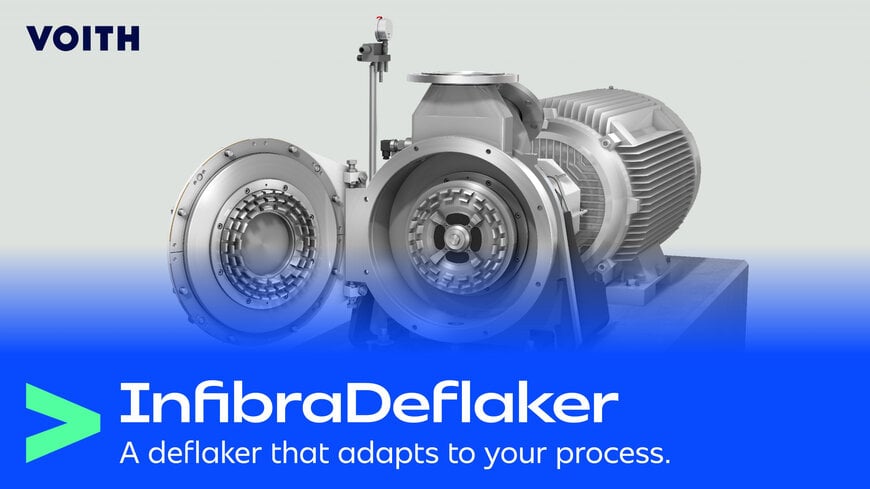
The preparation of stock in the paper manufacturing industry requires specialized equipment to separate fiber bundles without cutting or damaging the individual fibers. To address these operational requirements within wet end processes, Voith has developed the InfibraDeflaker. The system is engineered to handle variable production capacities while maintaining stable fiber breakdown, targeting applications such as Old Corrugated Containers (OCC) screening and production reject preparation.
Modular Configuration and Capacity Management
The operational architecture of the machine relies on a modular disc configuration. Operators can configure the equipment for either single-disc or double-disc operation based on specific process demands and filling selections. This structural flexibility allows the system to process throughput levels of up to 1,000 liters per minute in the single-disc setup, or up to 2,000 liters per minute in the double-disc arrangement. By enabling these capacity adjustments within a single machine framework, paper mills can modify production volumes without the installation of supplementary deflaking units.
Maintenance Architecture and Mechanical Sealing
Equipment runability in stock preparation is highly dependent on maintenance accessibility. A central engineering feature of this unit is its water-cooled cartridge bearing. This design permits maintenance personnel to replace the complete bearing unit directly on-site, minimizing the duration of planned maintenance intervals and reducing the probability of unplanned operational downtime. Furthermore, the system incorporates an integrated mechanical seal, which functions to isolate the process fluid from the mechanical components, thereby extending the operational lifespan of the internal assemblies.
Fiber Processing Efficiency and Integration
The fluid dynamics within the deflaker are designed to optimize the acceleration and deceleration of fibers. This mechanical action generates hydraulic shear forces that separate fiber bundles while preserving the structural integrity of the fibers themselves. Steffen Bassmann, Head of Product Management Fiber Systems at Voith Paper, noted that the combination of flexible configuration and simplified maintenance allows industrial facilities to stabilize processes while limiting operational complexity. The equipment is constructed with a robust housing and accessible filling replacement points to facilitate integration into both existing and newly commissioned stock preparation lines. For facilities upgrading older infrastructure, Voith provides a rebuild adapter that enables the direct replacement of the preceding Deflaker E2000 model without requiring modifications to the existing concrete foundation.
Additional Context: This Section Details Technical Specifications and Competitive Benchmarking Not Included in the Original Product Announcement
In the industrial deflaking market, equipment is generally evaluated based on throughput capacity, energy consumption per ton of processed stock, and the ease of gap adjustment between the stator and rotor discs. Competing systems from manufacturers such as Valmet and Andritz utilize similar hydraulic shear principles to treat secondary fibers and broke. Valmet systems focus on variable gap control to manage specific energy consumption, while Andritz offers specific stator-rotor topographies tailored for high-consistency applications. The Voith system differentiates itself primarily through its interchangeable single- to double-disc modularity, allowing a throughput transition from 1,000 to 2,000 liters per minute within the same footprint, a parameter specifically relevant for mills facing variable incoming furnish qualities and fluctuating production loads.
Edited by an industrial journalist, Lekshman Ramdas, with AI assistance.
www.voith.com
