
www.industryemea.com
18
'26
Written on Modified on
Hybrid Cryptography Advances Quantum-Safe TLS Communications
NEC and IBM Japan demonstrate how QKD and post-quantum encryption can work together without modifying existing applications.
www.nec.com

NEC Corporation and IBM Japan have demonstrated a hybrid quantum-safe communication method combining quantum key distribution (QKD) and post-quantum cryptography (PQC), the first demonstration of this approach in Japan. NEC supplied the QKD equipment, while IBM Japan provided a custom-built version of IBM Quantum Safe Proxy (formerly IBM Quantum Safe Remediator) for the proxy-based validation environment.
Quantum Computing Risk to Deployed Encryption
Advances in quantum computing raise concern that currently deployed cryptographic technologies may eventually be broken, increasing the risk of information leakage in sectors such as finance, critical infrastructure and defence. In 2024, the U.S. National Institute of Standards and Technology (NIST) established PQC standards, with IBM contributing to two of the three standardised algorithms, and a U.S. Executive Order issued in June 2026 requires federal agencies to migrate to PQC by 2030. PQC can be introduced without extensive modifications to existing systems, while QKD distributes cryptographic keys securely over optical-fibre links. Integrating both within a key management infrastructure widens the range of key establishment methods, for example by enabling a PQC-based method when QKD is unavailable.
Complementary Expertise of the Two Companies
NEC has been developing quantum cryptographic communication technologies for more than 20 years and has carried out long-distance QKD demonstrations. IBM brings experience in quantum computing development, contributions to NIST PQC standardisation and the advancement of quantum-safe technologies.
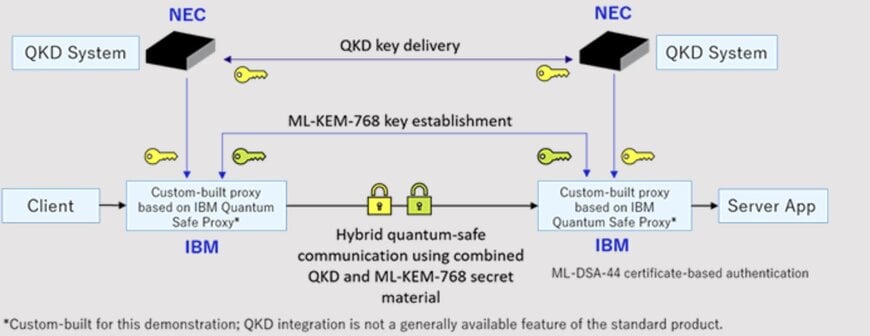
Combining QKD and ML-KEM-768 in TLS Key Establishment
The validation was carried out from July to September 2026. NEC’s QKD equipment was connected to the proxy environment through a REST-based key delivery API based on ETSI GS QKD 014, with the proxy layer deployed in front of existing applications without modifying them. For TLS key establishment, secret material obtained through QKD and secret material established through ML-KEM-768 were cryptographically combined using HKDF-SHA256 to derive the traffic-protection secret, so QKD was used together with PQC rather than as an alternative to it. Peer authentication remained certificate-based and used ML-DSA-44 signatures.
Standard API Interoperability With Minimal System Changes
The demonstration confirmed that QKD-based key distribution and PQC-based key establishment can be integrated within a single TLS communication architecture. It did not evaluate QKD as a replacement for certificate-based authentication or as an independent fallback channel. The companies also confirmed that products and technologies from different vendors can interoperate on the basis of standardised specifications, and verified an architecture that enables migration to a QKD and PQC communications environment without major changes to existing TLS environments.
Applications Requiring Long-Term Confidentiality
NEC and IBM Japan will explore practical deployment in areas requiring long-term confidentiality, including core banking and transaction systems as well as communications between financial institutions and data centres.
Edited by Aishwarya Mambet, Induportals Editor, with AI assistance.
www.nec.com
