
www.industryemea.com
26
'26
Written on Modified on
Vision-Language AI Automates Disaster Precursor Detection
NEC Corporation develops an evaluation system that utilizes existing live camera networks to quantitatively analyze environmental anomalies like flooding and snow accumulation.
www.nec.com
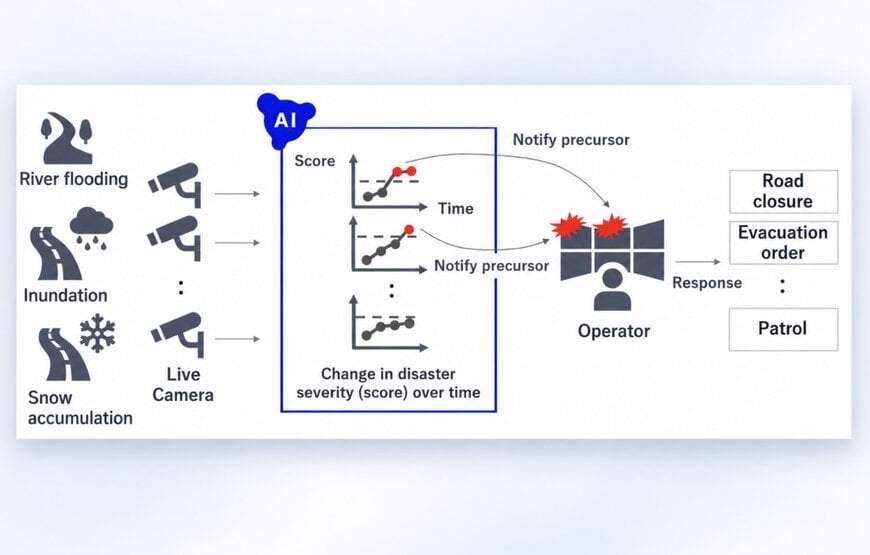
NEC Corporation has introduced a new artificial intelligence technology that applies vision-language models (VLMs) to existing live camera networks to detect early signs of environmental disasters. The software system processes video feeds from roads and rivers to assign numerical severity scores for local governments and infrastructure operators, targeting practical deployment by fiscal year 2027.
Overcoming Vision-Language Constraints in Quantitative Monitoring
Standard image recognition artificial intelligence requires extensive, labor-intensive data annotation to accurately identify specific disaster types across different geographical locations. While pre-trained VLMs can natively interpret video content without additional training, their standard text-based responses often lack consistency and fail to quantify subtle environmental changes as they progress. To resolve this limitation within the digital infrastructure, the new architecture bypasses standard text generation outputs. Instead, it analyzes the internal likelihood values computed by the VLM during its generation process. By extracting this raw internal data, the system converts qualitative visual information into a continuous numerical score, measuring the precise extent of changing conditions such as river inundation, waterlogging, or snow accumulation. This continuous scoring mechanism allows facility operators to set localized, data-driven danger thresholds for proactive disaster management.
Automated Prompt Calibration for Rapid Deployment
A significant bottleneck in deploying general-purpose VLMs across diverse physical sites is the high sensitivity of the model to text-based prompts, which traditionally requires specialized engineers to manually tune queries for each specific camera angle and environment. The system eliminates this manual trial-and-error phase through an automated prompt generation process. When deployed at a new site, the artificial intelligence iteratively adjusts its internal prompts by analyzing successive video frames, specifically identifying which spatial areas of the image the model should focus on and which background elements can be ignored to maintain score continuity. This automatic calibration stabilizes the scoring output against minor visual fluctuations and enables rapid, scalable deployment across various disaster types and geographic locations without requiring localized expert intervention. By streamlining these monitoring operations, government agencies can accelerate their response decisions.
Additional Context
This section details technical specifications and competitive benchmarking not included in the original news release.
The commercial artificial intelligence video analytics market currently relies heavily on specialized, fixed-rule neural networks for disaster detection, which require manual dataset annotation to classify specific environmental states. Emerging platforms from enterprise surveillance providers have begun incorporating VLMs to evaluate operations via natural language prompts; however, these conventional VLM systems typically output descriptive text, which can result in factual inconsistencies or plausible misinterpretations during complex environmental monitoring. The utilized architecture diverges from standard competitive models by leveraging raw internal likelihood values rather than natural language outputs to establish a continuous numerical score. This approach addresses the spatial reasoning constraints typical of standard edge-based VLMs, negating the need for constant manual prompt engineering while ensuring quantifiable accuracy for early warning mechanisms.
Edited by Aishwarya Mambet, Induportals Editor, with AI assistance.
www.nec.com
