
www.industryemea.com
16
'26
Written on Modified on
KIPP launches REMOTE line for remote locking and operation
Locking pins, triggers and snap locks operated via Bowden cables, with an online configurator for component selection.
www.kippwerk.de
KIPP has expanded its product range with the new REMOTE line, designed for applications where operating elements are not directly accessible, either due to restricted installation space or because functions must be kept out of direct reach. The range primarily includes locking pins, triggers and snap locks connected via Bowden cables, so that mechanical functions can be actuated safely from a distance. In mechanical and plant engineering, this applies mainly to opening and closing flaps and covers; in tilting or rotating fixtures, to establishing defined locking positions; and in special vehicle construction, to securely positioning stops.
Mechanical transmission and centralized operation
REMOTE brings together matched components connected by Bowden cables. Force transmission is mechanical, while the operating element can be positioned freely. Multiple locks can be connected to a single operating element to centralize access to functions, or alternatively, a single function can be actuated from two independent operating elements. According to KIPP, this significantly improves ease of use and ergonomics in hard-to-reach areas and on large moving parts. During installation, the Bowden cable can be adjusted to the required length, allowing it to adapt to different mounting situations without additional special solutions.
New locking pin platform with online configurator
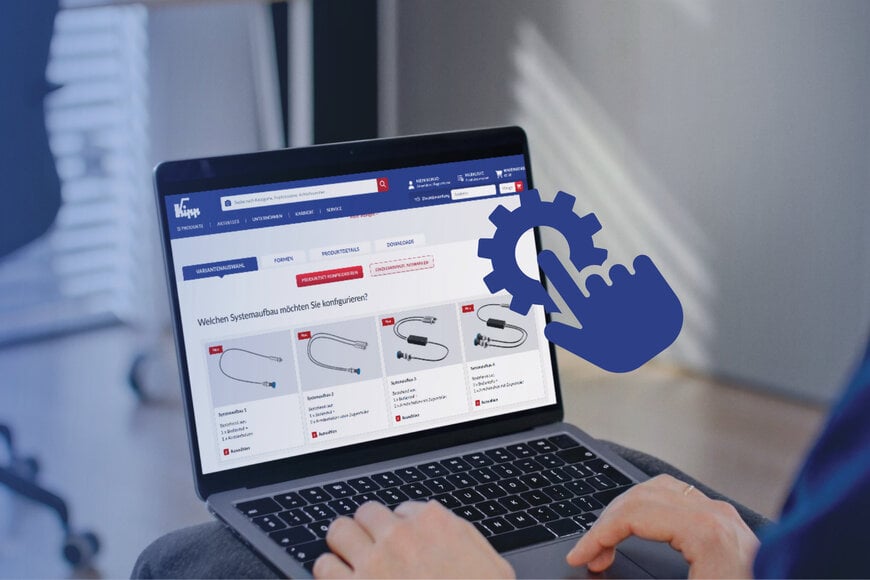
At the core of the REMOTE series is a new locking pin platform for remote actuation, complemented by operating elements designed to work together. The restructuring of the product range was driven by numerous specific customer requests, which have now been incorporated into an expanded standard range. New additions include variants with extended locking pins, as well as versions with hexagon and thread, with a threaded through-sleeve, or with a smooth sleeve. For operating elements, KIPP offers T-grips, star grips and clamping levers, alongside solutions with connections for one or two Bowden cables. An online configurator, available directly on each product page, guides users through the relevant parameters and links compatible operating elements, locking pins and cable splitters, so that designers do not have to check each combination individually. The configured solution can be transferred directly into the ordering process.
Pneumatic locking pins for automated processes
Complementing the mechanical solutions, the KIPP range includes pneumatic locking pins with end-position detection. These are used when manual actuation is not possible, for example in automated processes, or when cycle times are very tight. The pin is actuated entirely by compressed air, and an integrated sensor indicates whether it is retracted or extended, providing the plant's control system with clear information on its status.
Additional Context:
This section explains general principles of Bowden cable transmission and end-position detection not included in the original press release.
A Bowden cable transmits a pulling force via an inner cable that slides within an outer housing. Because the housing supports the reaction force, the pull can be transmitted along curved paths without rigid linkages or joints, allowing the operating element to be located away from the locking point. In spring-loaded locking pins, the pin typically returns to its locking position by spring force when the cable is released.
In pneumatic actuators, end-position detection is usually achieved using magnetic or inductive sensors that register the position of the piston or pin. This signal allows the control system to verify that a locking action is complete before initiating the next step in the process.
Edited by an industrial journalist, Lekshman Ramdas, with AI assistance.
www.kipp.com
