
www.industryemea.com
12
'26
Written on Modified on
Micro-Epsilon introduces vacuum-compatible interferometer for nanometer-precision measurements
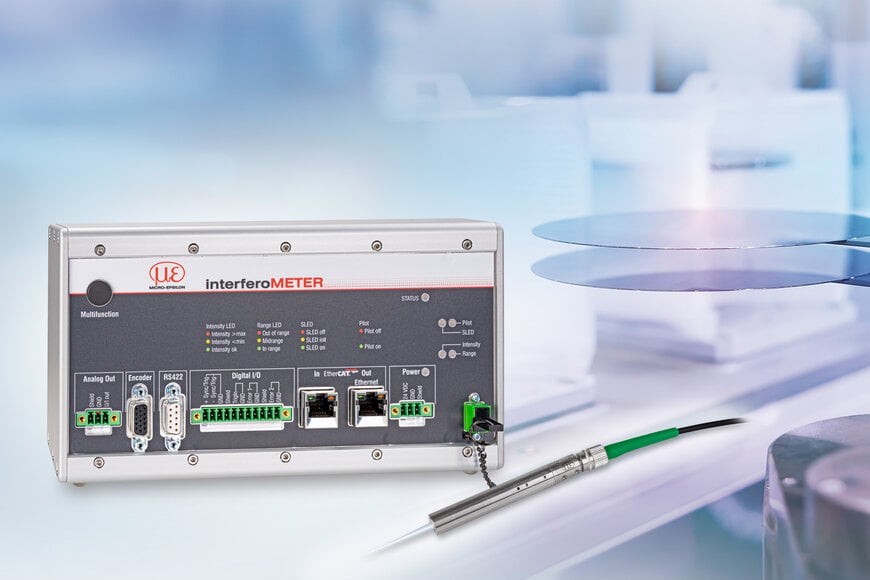
The new interferoMETER IMP DS35/VAC enables non-contact distance measurements with nanometer resolution, supporting precision applications in semiconductor and glass wafer production.
www.micro-epsilon.com
Modern semiconductor lithography, physical vapor deposition, and glass-panel display manufacturing increasingly execute precision handling and multi-layer inspection directly inside high-vacuum and ultra-high vacuum (UHV) chambers. Conventional non-contact optical displacement sensors—such as laser triangulation probes or standard chromatic confocal sensors—often struggle in vacuum environments due to polymer outgassing, thermal drift, or short working distances that place delicate optical lenses dangerously close to moving wafer chucks and hot substrates. Furthermore, standard incremental laser interferometers measure relative displacement rather than absolute distance, causing them to lose position reference whenever the optical beam is interrupted by wafer edges, etched trenches, or stepped surface topologies. Overcoming these metrology limitations requires absolute-measuring optical sensors constructed from low-outgassing vacuum-rated materials that deliver nanometer precision from a safe mechanical standoff distance.
Large Standoff Distance and Vacuum-Hardened Optical Design
To address high-precision measurement challenges inside vacuum processing tools, Micro-Epsilon introduced the interferoMETER IMP DS35/VAC, expanding its portfolio of absolute-measuring white light interferometers. Engineered specifically for vacuum environments extending down into the ultra-high vacuum range, the sensor pairs a robust stainless steel housing with vacuum-compatible optical assemblies to prevent chamber contamination.
A central advantage of the IMP DS35/VAC is its large offset distance of approximately 35 millimeters combined with a 2.1-millimeter measuring range. This extended working clearance enables non-contact position monitoring in glass wafer production and coated wafer inspection without risking physical collision with delicate substrates, while also reaching recessed or geometrically obstructed measurement points inside crowded process chambers. The optical assembly projects a focused light spot measuring just 15 micrometers in diameter, allowing reliable detection of fine micro-structures and narrow wafer features, while an allowable measuring angle of plus-or-minus one degree maintains signal stability across demanding mechanical mounting orientations.
Sub-Nanometer Resolution and Multi-Layer Controller Integration
The IMP DS35/VAC sensor interfaces directly with Micro-Epsilon’s IMS5400 and IMS5400MP industrial interferometer controllers via fiber-optic transmission, separating sensitive electronics from the vacuum chamber. Paired with these controllers, the system achieves a measurement resolution of less than one nanometer and linearity errors below plus-or-minus 50 nanometers, meeting tight process-control tolerances in modern semiconductor and flat-panel inspection lines.
When coupled with the multi-peak IMS5400MP controller variant, the system extends beyond single-surface distance tracking to perform simultaneous multi-peak distance and thickness evaluations across up to 13 distinct optical interfaces. This capability allows process engineers to measure air gaps, coating thicknesses, and individual layer dimensions across transparent, multi-layer, or coated glass substrates in a single non-contact pass.
Additional Context
This section details technical specifications and competitive benchmarking not included in the original product announcement.
In industrial white light interferometry, absolute distance measurement relies on low-coherence interferometry using a broadband near-infrared superluminescent diode (typically operating around an 840 nanometer center wavelength). Unlike monochromatic laser interferometers that count interference fringes incrementally and suffer from phase ambiguity across step heights, low-coherence white light interferometers split the broadband light between a reference arm and the measurement target, analyzing the resulting spectral interference pattern via a high-speed spectrometer inside the controller. Because constructive interference occurs only when the optical path difference approaches zero, the system determines exact physical distance immediately upon power-up or after beam interruption, making it immune to step-profile discontinuities on patterned silicon or glass wafers. Operating in ultra-high vacuum environments further imposes strict material governance: optical probes must eliminate trapped air pockets via vented blind holes, replace standard PVC or polyurethane cable jackets with PTFE or bare stainless steel corrugated armor, and utilize vacuum-compatible epoxies and UHV fiber-optic feedthroughs to prevent outgassing hydrocarbons from contaminating EUV lithography mirrors or thin-film deposition chambers.
Within the high-precision non-contact optical displacement and metrology market, Micro-Epsilon’s IMP DS35/VAC benchmarks directly against vacuum-rated optical sensors from Keyence (such as the SI-F series spectral-interference displacement sensors and CL-3000 confocal displacement sensors), Precitec (CHRocodile IT and vacuum-compatible chromatic confocal probes), Fogale Nanotech (capacitive and low-coherence interferometric wafer sensors), and Zygo (ZMI laser displacement interferometers). While chromatic confocal sensors like Precitec’s CHRocodile and Keyence’s CL-3000 offer higher angular tilt tolerance on diffuse or curved surfaces, achieving sub-nanometer resolution with confocal optics typically restricts working standoff distances to just a few millimeters. Conversely, traditional heterodyne laser interferometers like Zygo’s ZMI achieve picometer resolution over long ranges, but require cooperative corner-cube retroreflectors mounted to the target and lose absolute position if the beam breaks. By delivering sub-nanometer resolution, 13-layer multi-peak transparency evaluation, and a 35-millimeter standoff inside a stainless-steel UHV package, Micro-Epsilon provides semiconductor equipment OEMs and glass wafer manufacturers with a compact, target-independent absolute sensor tailored for tight vacuum load-locks and wafer alignment stages.
Edited by Romila DSilva, Induportals Editor, with AI assistance.
www.micro-epsilon.com
