
www.industryemea.com
11
'26
Written on Modified on
AI-Powered Operations Enhance Plant Performance at Indorama
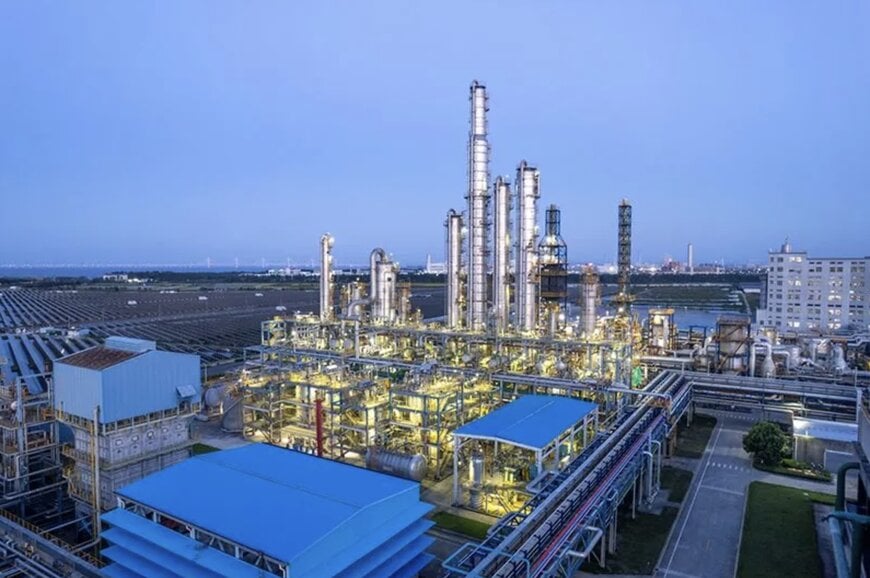
KBR has deployed its artificial intelligence (AI) solution, KBR INSITE, across Indorama Corporation’s ammonia and olefins process units in Nigeria.
www.kbr.com
Continuous chemical synthesis and petrochemical cracking processes—particularly in large-scale ammonia synthesis loops and olefin recovery trains—operate under tight thermodynamic and safety-critical constraints. In high-tonnage fertilizer and petrochemical plants, balancing reformer firing rates, steam-to-carbon ratios, cracking furnace severities, and refrigeration compression circuits requires continuous multi-variable reconciliation. Historically, chemical processing facilities relied on advanced process control architectures or traditional empirical data-driven machine learning models. However, purely statistical neural networks and black-box machine learning approaches frequently fail in safety-critical process industries; lacking fundamental chemical kinetics and thermodynamic grounding, they risk recommending unviable operational setpoints, generating false alarms, or suffering performance degradation when boundary conditions shift outside historical training distributions. Furthermore, unexplainable algorithmic outputs make plant engineers and board operators reluctant to execute closed-loop recommendations during live operations. Overcoming these adoption and safety hurdles requires physics-informed operational artificial intelligence platforms that combine first-principles chemical engineering physics with real-time operational telemetry, providing traceable, explainable decision-support directly into the control room.
Physics-Informed World Modeling and Enterprise Deployment
To address complex operational optimization across capital-intensive synthesis and cracking assets, KBR completed the commercial deployment of its KBR INSITE artificial intelligence platform across Indorama Corporation’s ammonia and olefins process units in Port Harcourt, Nigeria. Developed for safety-critical processing environments, the platform continuously tracks asset performance, detects emerging operational constraints, diagnoses transient equipment anomalies, and performs systematic root-cause analysis backed by explainable technical justifications.
The deployment integrates Applied Computing’s Orbital AI, an industrial foundation model developed in technical collaboration with KBR’s chemical design and process advisory specialists. Rather than relying solely on surface-level correlation patterns in historical time-series data, the platform implements a specialized "world model" for ammonia and petrochemical synthesis that models interconnected cause-and-effect relationships across an entire facility. This foundation reduces commissioning complexity, accelerating the duration between initial contract execution, site data onboarding, and live model delivery.
Commercial Expansion Across Downstream Assets
Building on the Nigerian deployment, KBR is scaling the commercial footprint of KBR INSITE across international fertilizer and petrochemical assets. Egypt Basic Industries Corporation has executed an agreement to deploy the platform at its ammonia manufacturing facilities, with the operational system scheduled to achieve full live operation by year-end.
Additional Context
This section details technical specifications and competitive benchmarking not included in the original product announcement.
In industrial process chemistry and digital plant governance, advanced digital twin architectures are structured around first-principles thermodynamic property packages—such as Peng-Robinson or Soave-Redlich-Kwong equations of state—coupled with mass, momentum, and heat transfer balances. In Haber-Bosch ammonia synthesis loops, optimizing conversion efficiency involves tracking shifting dynamic equilibrium states dictated by Le Chatelier’s principle, catalyst bed temperature profiles, loop circulation rates, and non-condensable inert gas accumulation (such as methane and argon) that degrades partial pressures of nitrogen and hydrogen. In olefin cracking furnaces, operational governance centers on balancing coil outlet temperatures, cracking severity, and hydrocarbon residence times against radiant tube coking and tube metal temperatures. Purely statistical artificial intelligence architectures risk predicting control actions that violate these physical realities, potentially inducing thermal shock or catalyst deactivation. Physics-informed neural networks and hybrid digital models resolve this risk by embedding conservation laws directly into the loss functions and architecture of the neural network, ensuring that all predictive outputs respect mass and energy balances and mechanical boundary constraints before generating recommendations for distributed control system operators.
Within the industrial chemical AI and advanced process optimization landscape, KBR INSITE benchmarks against established industrial software suites and digital twin solutions from AspenTech (including Aspen DMC3 and Aspen Virtual Inspection), Honeywell Process Solutions (Forge for Industrial Operations and Profit Suite APC), AVEVA (APC and Process Simulation platforms), and Yokogawa Electric (Platform for Advanced Control and Estimation). While incumbent automation vendors typically rely on classical linear or non-linear multi-variable predictive control layers that require extensive, periodic manual step-testing and parameter re-tuning whenever catalyst activity decays or feedstocks switch, KBR INSITE leverages KBR's direct domain position as a foundational ammonia process technology licensor (via KBR's Purifier and KAAP technologies). By embedding licensor proprietary kinetic models into Applied Computing’s Orbital foundation world model, KBR delivers an end-to-end operational co-pilot that provides contextual reasoning and root-cause explanations directly aligned with original equipment design specifications. This structural alignment bridges the gap between static engineering design simulations and dynamic daily DCS plant management, offering operators an explainable advisory tier that legacy black-box machine learning implementations struggle to deliver.
Edited by Romila DSilva, Induportals Editor, with AI assistance.
www.kbr.com
