
www.industryemea.com
27
'26
Written on Modified on
Bürkert Launches Standardised Control Heads for Hygienic Valve Automation
Bürkert introduces the Type 8682 and Type 8683 control heads featuring universal adapters and teach-in replacement to eliminate downtime in hygienic processing.
www.buerkert.de
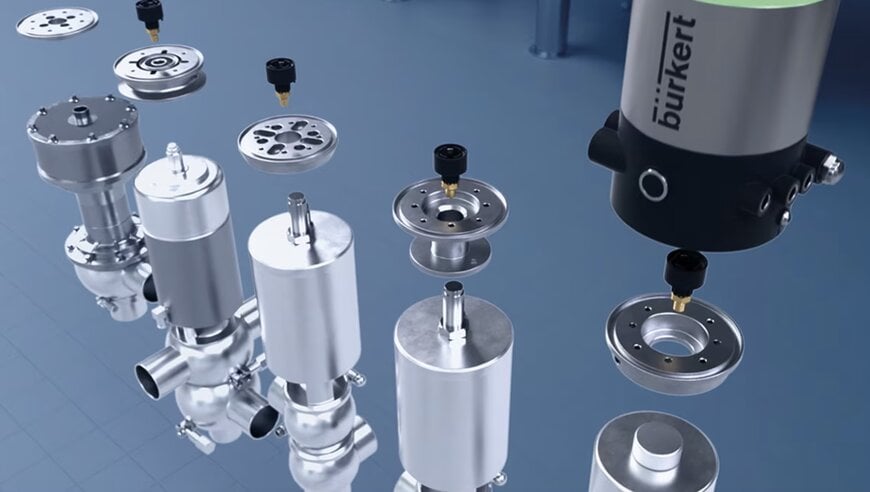
Hygienic and aseptic process plants in the food, beverage, and pharmaceutical sectors face chronic productivity losses stemming from frequent short interruptions during routine valve maintenance and line changeovers. Traditional control head replacements often require halting active process batches, manually calibrating mechanical limit switches, and managing a patchwork of manufacturer-specific adapters and communication interfaces across heterogeneous valve manifolds. These operational bottlenecks are compounded by rigid Clean-in-Place cycles that consume excessive water and chemical cleaning agents without providing real-time verification of valve seal lifting. Mitigating these production losses requires decentralized valve control heads that support online hot-swapping, universal mechanical mounting across multi-brand installations, and monitored, automated seat-cleaning routines.
Continuous Processing via Teach-In Device Replacement
To eliminate batch disruptions during routine servicing, Bürkert Fluid Control Systems launched the Type 8682 and Type 8683 control heads. The devices are engineered for decentralized automation across hygienic and aseptic processing facilities, addressing operating environments where plant availability is constrained by recurring maintenance delays rather than major equipment breakdowns.
A core operational feature is the integrated teach-in commissioning mode, which allows operators to configure and commission a replacement unit directly at the valve assembly without interrupting ongoing process cycles. By eliminating the need to take process lines offline or halt fluid distribution during component exchanges, the system reclassifies control head replacement from unplanned downtime into scheduled, ongoing maintenance. Both models entered commercial availability in June 2026.
Universal Mechanical Adaptation and Resource-Efficient Cleaning
The product portfolio provides standardisation across varied valve architectures through a modular engineering framework:
- Valve Compatibility: The Type 8682 automates single-seat and butterfly valves, while the Type 8683 extends automation functionality to double-seat mixproof valves.
- Standardized Adapters: Both models utilize identical, standardized mechanical adapter kits, enabling mounting onto valves from various third-party manufacturers without requiring piping modifications or valve body replacements.
- Configurable Cleaning Cycles: The Type 8683 features a configurable cleaning function with cyclical seat-lift movements, delivering targeted application of cleaning media to reduce chemical and water consumption while maintaining continuous process monitoring.
- Visual Diagnostics: Dual LED indicators mounted on the housing provide immediate local signaling of valve position and maintenance status directly on the plant floor.
By standardizing mechanical adapters and operating logic across diverse valve fleets, processing facilities can reduce spare parts inventory, eliminate pre-expansion combination testing, and streamline maintenance training through a unified control concept.
Additional Context
This section details technical specifications and competitive benchmarking not included in the original product announcement.
In hygienic process automation governed by EHEDG and 3-A Sanitary Standards, control heads must withstand aggressive washdown environments while maintaining precise pneumatic and electrical feedback. The Bürkert Type 8682 and Type 8683 housings are constructed to achieve ingress protection ratings up to IP65, IP67, and IP69K, alongside NEMA 4X compliance for high-pressure caustic spray cleaning. Position sensing is executed via a contactless inductive or magnetic non-contact position sensor covering up to 86 millimeters of linear travel or 359 degrees of rotary motion, eliminating mechanical wear and drift associated with traditional potentiometer linkages. Digital communications support point-to-point IO-Link (Port Class A and B) and AS-Interface fieldbuses alongside conventional discrete parallel wiring, transmitting real-time switching times, cycle counts, and predictive diagnostics aligned with NAMUR NE 107 status categories.
Within the hygienic process valve automation sector, the Bürkert Type 8682 and 8683 family benchmarks directly against decentralized control tops including the Alfa Laval ThinkTop V70 and V50 series, GEA T.vis (M-15 and A-15), and SPX FLOW CU4 series. While competing systems often deploy proprietary mechanical mounts that bind end users to a single valve OEM's mechanical envelope, Bürkert's modular Type KK01 adapter series allows direct mounting across third-party actuator diameters without replacing the underlying valve bodies. Furthermore, while conventional mixproof seat-lift pulsing relies on fixed PLC timing pulses that can cause hydraulic hammer or incomplete cleaning fluid flushes, the Type 8683 incorporates internal solenoid pulse-width control to modulate seat lift strokes with millisecond precision, lowering wastewater discharge loads and shortening CIP cycle times in high-volume food, beverage, and biopharmaceutical plants.
Edited by Romila DSilva, Induportals Editor, with AI assistance.
