
www.industryemea.com
07
'26
Written on Modified on
Microfluidic Media Separated Dosing Valve for Laboratory Automation
Bürkert Type 6732 Whisper Valve eliminates sample thermal degradation and internal dead volume in analytical fluidic circuits.
www.buerkert.de
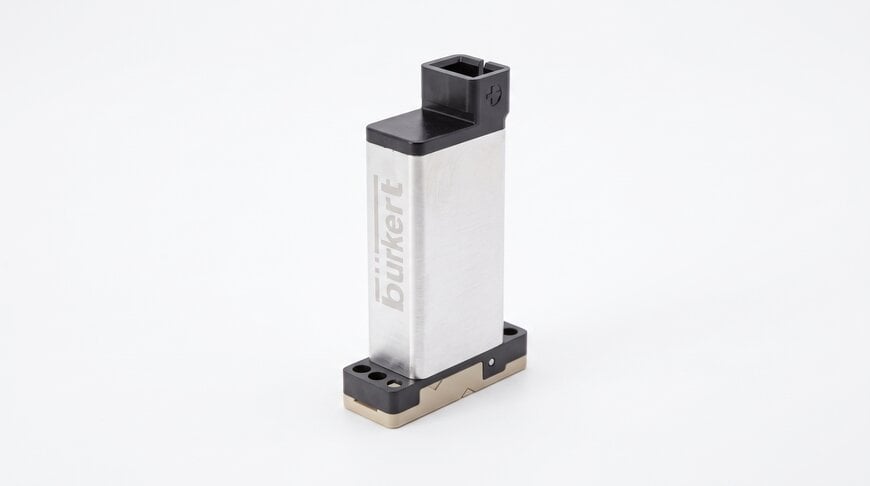
Analytical instrumentation and clinical diagnostic equipment require precise micro-dosing of chemically aggressive reagents without sample cross-contamination or thermal degradation. The Bürkert Type 6732 Whisper Valve introduces a media-separated 2/2-way microfluidic architecture engineered for point-of-care diagnostics, automated liquid handling, and bioanalytical processing.
Industrial Fluid Handling Challenges in Bioanalytics
Automated laboratory automation and in vitro diagnostic systems frequently process microscopic volumes of thermally sensitive reagents, enzymes, and synthetic oligonucleotides. Conventional solenoid valves often introduce two major engineering obstacles: thermal transfer from electromagnetic coils into the fluid path, and large internal fluid volumes that trap residual media. Unintended heat transfer alters enzymatic reaction kinetics or denatures biological compounds, while dead volume leads to reagent wastage, sample carryover, and protracted rinsing protocols.
To address these microfluidic constraints, fluid control architectures require physical separation between mechanical actuators and wetted paths, sub-millisecond response dynamics, and compact form factors suitable for multi-channel pipetting manifolds.
Operating Principle of Lorentz Actuation and Media Separation
The Bürkert Type 6732 microfluidic dosing valve utilizes an integrated Lorentz force actuator rather than an inductive iron-core solenoid. By moving a dedicated conductor within a permanent magnetic field, the Lorentz mechanism generates rapid, direct linear movement with minimal acoustic emission and reduced power draw.
Because the Lorentz actuator does not rely on saturated magnetic holding currents, electrical power dissipation is significantly lowered. This reduction in power consumption virtually eliminates thermal transfer from the drive mechanism into the fluid channel, protecting temperature-critical biological samples in point-of-care testing.
The wetted fluid chamber is fully isolated from the actuator mechanism via an impermeable membrane, providing total media separation. The fluid path geometry is optimized for laminar displacement, enabling thorough flushing at low volumes. With an overall component width of 7 mm, the unit fits into high-density robotic arrays, such as automated pipetting arms and compact analytical manifolds.
Integration and Sensorless Diagnostics
The Type 6732 incorporates Bürkert ValveInsight diagnostic functionality to support continuous process monitoring in automated analytical workflows. ValveInsight inspects the electrical current profile of the Lorentz actuator in real time. Because mechanical switching dynamics, stroke completion, and resistance changes correlate directly with the electrical response curve, the system detects physical performance deviations without external position sensors or flow meters.
This diagnostic capability facilitates predictive maintenance and immediate fault localization in automated liquid handling, preventing erroneous dispensing cycles during high-throughput PCR preparation or continuous oligo synthesis. The assembly is vacuum-compatible, allowing deployment in both positive-pressure dispensing heads and vacuum-driven waste or extraction lines.
Real-World Industrial Applications
In molecular diagnostics, the valve integrates into polymerase chain reaction (PCR) platforms to deliver microliter-scale master mixes and target DNA solutions with high repeatability. The optimized internal flow path ensures complete purging between sequential processing steps, preventing sample cross-contamination.
In oligonucleotide synthesis and peptide production, where expensive reagents must be dispensed in precise pulses, the fast switching speed enables micro-dosing cycles while minimizing residual fluid loss. Furthermore, the 7 mm installation pitch allows multiple valves to be banked directly on analytical pipetting arms, minimizing transfer tubing length and associated fluid compliance errors.
Additional Context
This section details technical specifications and competitive benchmarking not included in the original product announcement.
Miniaturized media-separated valves within life sciences typically rely on either traditional rocker/plunger solenoids or shape-memory alloy (SMA) drives. Standard rocker-style microvalves commonly feature widths of 10 mm to 16 mm with internal volumes ranging from 20 to 65 microliters. Plunger-actuated media-separated valves frequently generate holding heat that elevates fluid temperature by several degrees Celsius during prolonged energization, requiring external hit-and-hold electronic controllers to mitigate thermal creep.
The adoption of voice-coil and Lorentz actuation in analytical fluidics addresses this limitation by decoupling actuation force from thermal dissipation. Operating alongside established industry communication protocols and standardized manifold interfaces, 7 mm media-separated architectures represent a continuing industry transition toward modular microfluidic backplanes, where fluidic components match standard microplate pitch dimensions (such as 9 mm center-to-center spacing for standard 96-well formats).
Edited by Evgeny Churilov, Induportals Media - Adapted by AI.
www.burkert.co.uk
