
www.industryemea.com
20
'26
Written on Modified on
Open Industrial Automation Architecture for Machine Control
KEBA Industrial Automation presents the Kemro X control platform and scalable drive systems at SPS 2026 to reduce machine engineering complexity.
www.keba.com
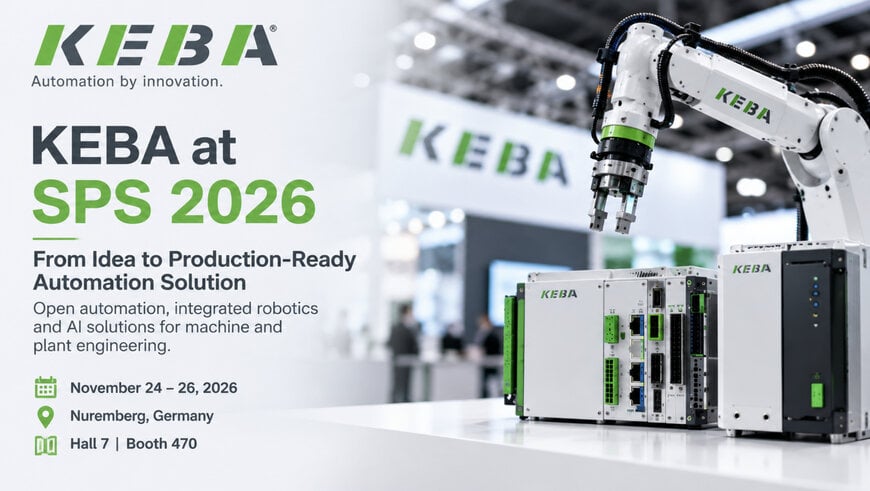
At the SPS trade show for industrial automation in Nuremberg, Germany, from November 24 to 26, 2026, KEBA Industrial Automation will present an open control architecture, multi-axis servo drives, and artificial intelligence software. These systems are engineered for machine builders and plant manufacturers operating in robotics, intralogistics, plastics, wind energy, turbo systems, and sheet metal processing.
Core Technology and System Architecture
The system architecture centers on the modular Kemro X platform, which utilizes standardized interfaces to allow original equipment manufacturers to integrate proprietary software modules and third-party applications directly into the control environment. For synchronized motion requirements, Kemro X pairs with the KeMotion robotics package to unify machine logic, robot kinematics, and process sequences on a single hardware controller.
The drive architecture accommodates varying power profiles through two distinct configurations. The AC-powered KeDrive D3-AC integrates up to three servo axes, a mains filter, and a braking resistor into a single housing. For multi-axis machinery with regenerative loads, the KeDrive D3 Smart DC Systems link drives via a shared DC bus to exchange, temporarily store, and reuse braking energy. Functional safety is managed by the KeSafe subsystem, which combines a dedicated safety CPU with certified function blocks for safe logic, axis monitoring, and robotics, configured via the KeStudio SafeEdit diagnostic and validation environment. Mobile human-machine interaction is handled by the wired KeTop T135 and the wireless KeTop T150 and T155 teach pendants, featuring PROFINET and PROFIsafe protocol compatibility.
Deployment and Implementation
At Hall 7, Booth 470, the hardware and software interaction will be demonstrated via a virtual production line alongside physical application models. This setup illustrates how simulation and diagnostic tools validate system behavior prior to physical commissioning. During industrial implementation, KEBA DIGITAL supports engineering teams from initial process analysis and software development through to final production deployment. Because the artificial intelligence software modules are hardware-independent, system integrators can deploy them directly into existing information technology networks and brownfield automation environments without replacing legacy programmable logic controllers.
Industry Applications
The modular platform targets general machine and tool construction where synchronized robotics and custom process control are required on a shared network. In intralogistics, sheet metal processing, and plastics manufacturing, unifying robot kinematics and machine sequences eliminates separate robot controllers and reduces cabinet wiring. In high-inertia applications such as wind energy and turbo systems, the shared DC bus architecture stabilizes power consumption during rapid deceleration and acceleration cycles. Wireless PROFIsafe operator panels allow maintenance personnel to monitor and control robotic cells safely across large plant floors without physical cable tethering.
Operational Impact and Performance Metrics
Consolidating up to three axes, filtering, and braking resistance into the KeDrive D3-AC module directly reduces control cabinet footprint and assembly wiring time. In the KeDrive D3 Smart DC configuration, intermediate capacitive energy storage absorbs regenerative braking energy, mitigating electrical grid peak loads and lowering overall thermal dissipation. Furthermore, executing machine control, robotics, and safety validation within a single engineering framework shortens software development workflows, while AI-assisted forecasting optimizes capacity utilization, production scheduling, and predictive maintenance routines.
Edited by Sucithra Mani, Induportals editor – adapted by AI
www.keba.com
