
www.industryemea.com
14
'26
Written on Modified on
Comau and Intecells showcase plasma-based battery manufacturing
The roll-to-roll cold plasma treatment improves electrode wettability, accelerating production times and reducing energy consumption.
www.comau.com
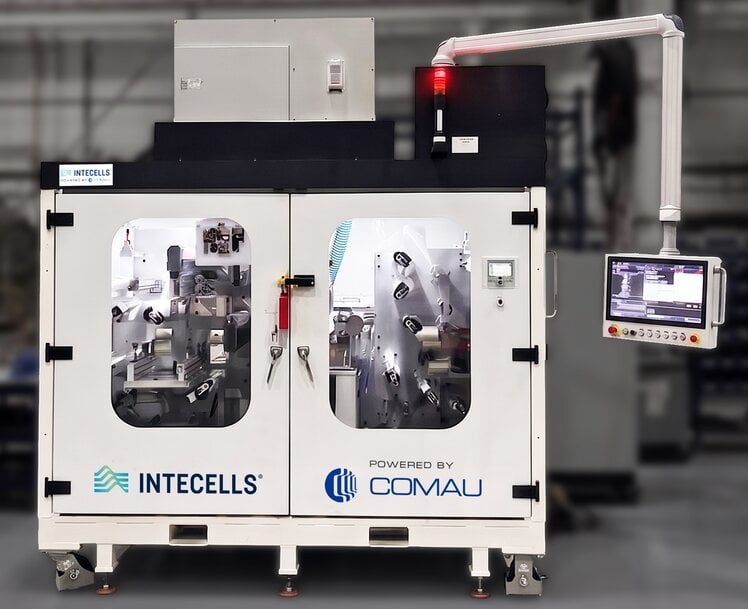
Comau and Intecells are introducing an industrial roll-to-roll surface treatment process for battery cell manufacturing at the Battery Show North America in Detroit. The system utilizes Intecells’ field-proven cold plasma technology to make central battery production steps faster and more energy-efficient. Following Comau's 2025 investment in Intecells, the companies have combined atmospheric plasma technology with gigafactory-scale automation. The partnership aims to lower capital expenditures and improve production efficiency for battery and energy storage applications, while also exploring integration into other industrial sectors.
Cold plasma surface treatment
By applying cold plasma to battery electrodes and separators, the solution enables faster and more uniform electrolyte wetting and penetration. This modification significantly shortens the time required for electrolyte filling, aging, and drying phases. Concurrently, it reduces thermal requirements, which lowers overall energy consumption, shrinks the required factory footprint, and cuts associated costs. Beyond production efficiencies, the plasma treatment lowers the internal resistance of the cells, directly enhancing battery performance. According to Dr. Xiaohong Gayden, Founder and CEO of Intecells, transforming battery manufacturing beyond incremental improvements is necessary to meet the escalating energy demands of AI data centers and global mobility.
Flexible cell formation and testing
At the event, Comau is also highlighting a recently delivered semi-automated cell formation and testing center built for the National Institute of Chemistry (NIC). Designed for scalability, the platform supports pouch, cylindrical, and prismatic formats—ranging from laboratory prototypes to high-performance automotive and industrial cells. Equipped with dedicated formation chambers and environmental testing stations, the facility serves both academic and industrial users across Europe. Comau will also exhibit its broader portfolio of battery manufacturing, recycling, and e-drive automation technologies at the upcoming Battery Show India in October 2026.
Additional Context: Overcoming the electrolyte wetting bottleneck
This section details technical specifications and competitive benchmarking not included in the original product announcement.
In lithium-ion battery manufacturing, the electrolyte filling and subsequent aging process is one of the most severe production bottlenecks. Electrodes—particularly thick, high-energy-density cathodes—and porous polymer separators are often inherently hydrophobic (liquid-repellent) or possess low surface energy. This forces manufacturers to store newly assembled cells in massive, climate-controlled aging racks for days or weeks to ensure the liquid electrolyte fully permeates the micro-pores. If wetting is incomplete, the cell suffers from high internal resistance, localized lithium plating, and degraded cycle life. Atmospheric cold plasma treatment solves this by bombarding the roll-to-roll web with ionized gas, modifying the surface chemistry at the nanometer scale to render the materials highly hydrophilic (liquid-attracting). This allows the electrolyte to wick instantly and uniformly into the electrode matrix, drastically cutting aging times and eliminating the need for vast, energy-intensive aging warehouses in modern gigafactories.
Edited by an industrial journalist, Lekshman Ramdas, with AI assistance.
www.comau.com
