
www.industryemea.com
07
'26
Written on Modified on
FANUC at PACK EXPO International 2026
From November 8 to 11, in Chicago, USA, FANUC America demonstrates collaborative robotics and vision-guided automation systems to solve packaging line constraints and labor shortages.
www.fanuc.eu
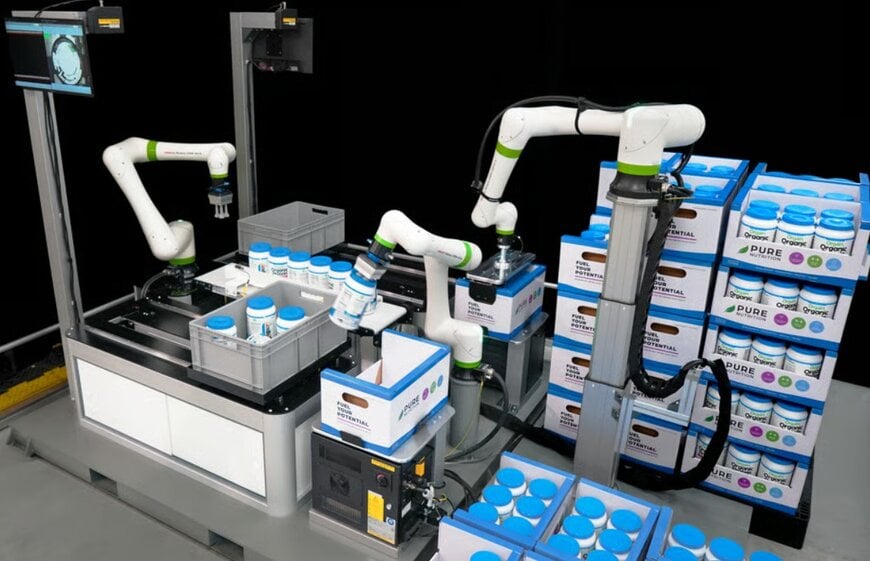
Industrial automation platforms combining collaborative robots, machine vision, and generative artificial intelligence address line throughput and manual handling limits in packaging and food processing.
Core Technology and System Architecture
The exhibited systems interface multi-axis manipulators with integrated machine vision and algorithmic motion planning. Generative artificial intelligence operates on the FANUC CRX-20iA/L collaborative robot by translating natural-language instructions into deterministic Python execution code, eliminating manual teach-pendant programming. Workspace safety and continuous cycle rates are maintained through dynamic proximity monitoring on the CRX-10iA/L, which uses visual line tracking and automated path recalculation to adjust trajectories around human operators without tripping emergency-stop circuits.
Packaging execution relies on integrated sensor architecture. The 2D and 3D machine vision systems identify part coordinates, verify label orientation, and execute barcode checks on dynamic conveyors. High-speed picking combines vacuum end effectors with conveyor tracking algorithms executed through dedicated software interfaces and digital controller platforms, including the R-50iA and R-30iB Mini Plus. For secondary packaging, digital twin simulations model motion envelopes and crate kinematics to ensure kinematic stability before physical palletizing.
Deployment or Implementation
Implementation occurs in standard manufacturing environments through plug-and-play fieldbus networks and existing conveyor infrastructure. For primary food production, deployments use hardware meeting strict hygiene standards, such as the DR-3iB/6 delta robot engineered with an IP69K stainless steel rating. This mechanical enclosure withstands high-pressure, high-temperature caustic washdown procedures without requiring secondary protective jacketing. Digital twin integration allows engineers to pre-commission kinematic paths and cycle times in virtual simulations, minimizing integration downtime during field deployment.
Industry Applications
Primary implementation targets the food processing, consumer packaged goods, and industrial packaging sectors. Applications range from primary processing, where delta and SCARA units coordinate the sanitary handling and placement of unpackaged foodstuffs, to end-of-line operations involving random-case packing of frozen goods. Palletizing applications extend collaborative robotics to higher structural demands, deploying the CRX/30-18A with a 40 kg payload capacity and the M-710/50-26D handling payloads up to 50 kg for bulk warehouse preparation.
Operational Impact and Performance Metrics
Automated line tracking and dynamic motion planning decouple process velocity from manual intervention. Mechanical tooling changes are executed within the robotic work envelope on circular tracking lines, consolidating multiple packaging stages into a single kinematic cell to maximize spatial efficiency. By combining vision guidance with automated pallet pattern generation, operations achieve consistent load integrity, eliminate manual lifting fatigue, and sustain line throughput during continuous operation.
Regarding deployment feasibility across manufacturing operations, James Cooper, Vice President of U.S. General Industry Sales at FANUC America, noted that industrial operators require automation technologies that can be applied across manufacturing environments to reduce manual tasks and improve operational efficiency.
Edited by Evgeny Churilov, Induportals Media - Adapted by AI.
www.fanucamerica.com
