
www.industryemea.com
01
'26
Written on Modified on
Struktol TR 451 Enhances High-Filler Polyolefin Compound Processing
Processing additive TR 451 optimizes untreated mineral fillers to reduce costs and maintain polyolefin physical properties.
struktol.com
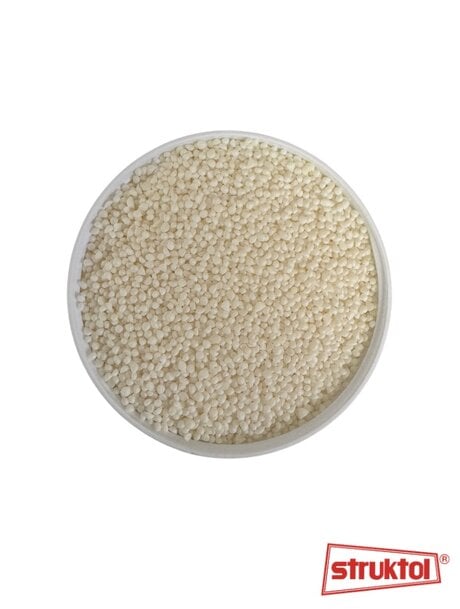
Struktol Company of America, LLC has introduced TR 451, a processing additive explicitly engineered for highly loaded mineral-filled polyolefin systems. Formulated as an optimized blend of specialized oleochemicals, the additive aims to solve one of the primary challenges in high-filler compounding: maintaining processability and mechanical integrity while pushing filler limits to reduce raw material costs.
A primary economic driver for polyolefin compounders is the substitution of costly treated minerals with less expensive untreated alternatives. TR 451 enables this transition by preserving the flow and physical properties typically associated with treated minerals. At higher filler loadings, untreated minerals normally cause excessive melt viscosity, leading to equipment strain, higher torque, and elevated energy consumption during compounding and injection molding. TR 451 maintains melt flow and handling characteristics, preventing pressure build-up and mitigating the physical property degradation that typically accompanies aggressive cost-reduction formulations.
Designed for seamless integration into existing polyolefin systems, TR 451 requires a low dosage level of just 0.2 to 2.0 percent of the total compound. Supplied as tan pastilles, the additive facilitates straightforward feeding and dosing in standard compounding equipment, while offering a shelf life of at least two years. By preserving key mechanical targets—such as rigidity, density, and durability—TR 451 grants manufacturers greater latitude to fine-tune the balance between raw material costs, line speeds, and finished part performance.
Additional Context
This section provides technological and market background not explicitly detailed in the original release.
The plastics compounding industry relies heavily on mineral fillers like calcium carbonate, talc, and mica to reduce the volume of expensive petrochemical resins in a formulation. However, untreated minerals lack chemical compatibility with non-polar polyolefins (like polyethylene and polypropylene). To prevent the minerals from clumping and causing stress fractures in the final plastic part, compounders typically purchase "treated" minerals that have been pre-coated with stearic acid or other coupling agents, adding significant cost.
Using a specialized additive like TR 451 allows compounders to purchase bulk, untreated commodity minerals directly and achieve the dispersion and wetting during the actual melt phase inside the twin-screw extruder. The oleochemicals act as an internal lubricant and dispersing agent. By reducing the friction between the filler particles and the polymer matrix, the additive prevents the dramatic spike in melt viscosity that usually forces operators to slow down production lines to avoid overloading the extruder motors. This combination of cheaper raw materials and maintained (or increased) line speed creates a compounding cost advantage.
Edited by an industrial journalist, Lekshman Ramdas, with AI assistance.
www.struktol.com
