
www.industryemea.com
10
'26
Written on Modified on
Automated Produce Bin Washer Integrated into Demonstration Facility
JBT Marel and Denham Plastics have collaborated to integrate automated bin washing technology into industrial fruit and vegetable processing workflows.
marel.com
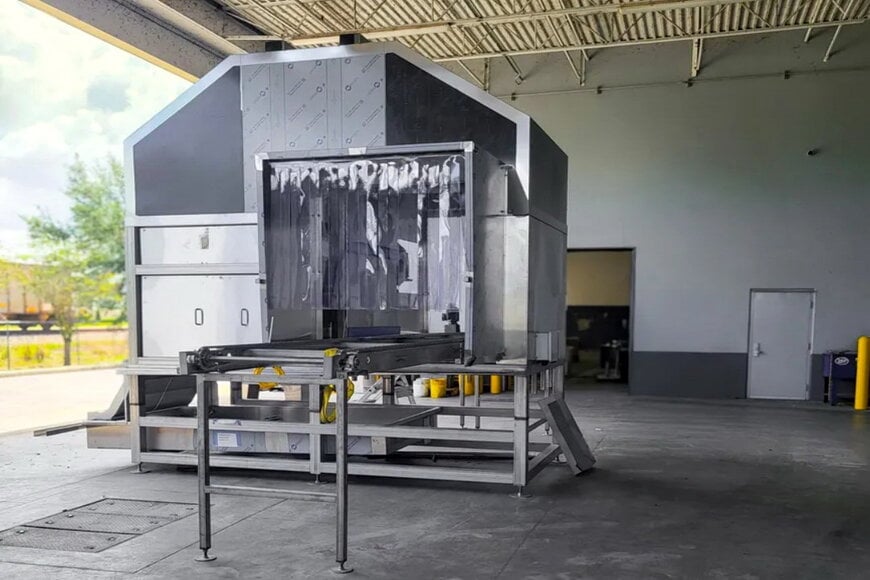
JBT Marel and agricultural container manufacturer Denham Plastics have aligned equipment development with container design to automate produce bin sanitation. The system addresses the labor-intensive nature and variable quality associated with manual pressure washing in agricultural logistics. By integrating mechanical inversion and targeted spraying, the approach standardizes hygiene protocols for industrial automation within the fresh produce supply chain.
Technical Challenge in Agricultural Logistics
Reusable agricultural containers require thorough sanitation between processing cycles to maintain hygiene standards. Manual washing using handheld pressure washers requires significant labor. Denham Plastics previously deployed approximately ten workers across its facilities to manually wash 2,000 to 3,000 containers per day. Manual methods often yield inconsistent surface coverage, extended cycle times, and high water consumption. Replacing manual cleaning with an automated system required a solution capable of handling structural container variation while maintaining continuous throughput.
Automated Mechanical Inversion and Washing System
The cooperative approach integrates Denham Plastics' container specifications, such as the Macro 34FV produce bin, directly into the kinematic design of the JBT Marel Flip and Wash system.
The system operates via a continuous chain conveyor that transfers individual bins into an enclosed wash chamber. Within the module, a mechanical inversion mechanism rotates the bin 180 degrees. This rotation allows gravity to assist in draining debris while high-flow, low-pressure water nozzles spray all interior and exterior surfaces simultaneously. Following the wash cycle, the mechanism returns the bin to an upright position before conveying it to the discharge zone.
The system achieves a processing throughput of up to 120 bins per hour. Operating parameters, including conveyor speed and spray duration, are adjustable to accommodate variable soil levels and specific sanitation requirements.
Deployment and Operational Integration
The automated bin washing system has been installed at the JBT Marel Customer Innovation Center in Lakeland, Florida, for operational testing and demonstration. The facility allows food processors to evaluate the equipment within an active processing environment. The setup demonstrates direct integration with existing conveyance infrastructure, allowing engineering teams to analyze surface coverage, mechanical handling, and cycle repeatability under controlled conditions.
Operational Performance Impact
Transitioning from manual pressure washing to an automated inversion system establishes repeatable sanitation parameters across high-volume container operations. Mechanical handling eliminates manual ergonomic strain and reduces the required labor footprint. The automated cycle ensures uniform nozzle coverage over internal corners and external ribbing, improving process control, maintainability, and operational stability in industrial food processing applications.
Edited by Evgeny Churilov, Induportals Media - Adapted by AI.
www.jbtmarel.com
