
www.industryemea.com
19
'26
Written on Modified on
Freudenberg launches low-iridium CCMs for PEM electrolyzers
The catalyst-coated membranes reduce capital and operating costs while integrating proprietary safety technology to prevent explosive gas mixtures.
www.freudenberg.com
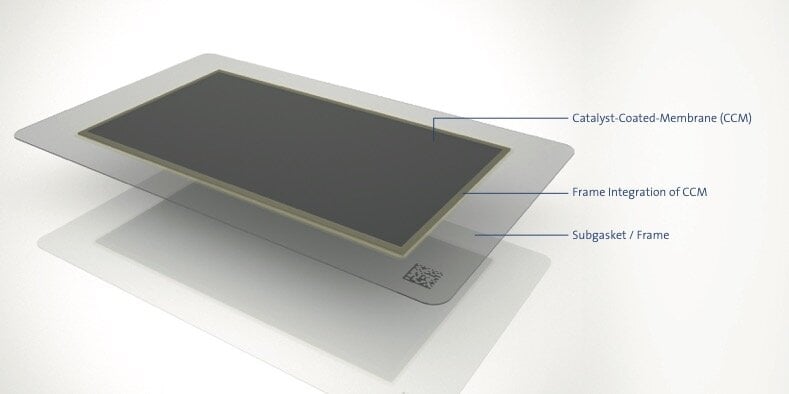
Freudenberg Sealing Technologies will debut a new generation of catalyst-coated membranes (CCMs) for Proton Exchange Membrane (PEM) electrolyzers at the Hydrogen Technology Expo 2026 in Hamburg. The new membranes significantly reduce the requirement for iridium, one of the earth's rarest precious metals, to just 0.5 milligrams per square centimeter. By optimizing the catalyst layers, the CCMs achieve a highly efficient cell voltage of 1.74 volts at a current density of 3 amperes per square centimeter, thereby lowering both the capital expenditure (CAPEX) of the stack and the operational electricity costs (OPEX) of large-scale hydrogen production.
Mitigating gas crossover for enhanced safety
In PEM electrolysis, operational pressure on the hydrogen side can exceed the oxygen side by up to 30 bar. This pressure differential creates a risk of hydrogen migrating through the membrane and forming a highly explosive oxyhydrogen gas mixture upon reaching a concentration of four percent by volume. To counteract this, the new CCMs incorporate Freudenberg's proprietary HTO-Protection technology. Operating at 0.5 A/cm², this integrated safety mechanism restricts hydrogen crossover into the oxygen stream to less than 0.25 percent by volume—approximately one-sixteenth of the lower explosive limit—providing a critical safety margin for continuous electrolyzer operations.
Customizable membrane assemblies for stack integration
The new generation of CCMs is available in two ultra-thin configurations: 50 micrometers for maximized electrical efficiency and 80 micrometers for extended mechanical service life, allowing manufacturers to align the component with specific stack design philosophies. To streamline manufacturing, Freudenberg supplies the membranes in standard rolls and sheets, or as complete, ready-to-install assemblies. These assemblies can be laminated or bonded to protective frames using a hot-melt process and fitted with integrated elastomer seals. When paired with a gas diffusion layer from Freudenberg Performance Materials, the units form complete Membrane Electrode Assemblies (MEAs) that simplify final stack assembly while shielding the active catalytic surfaces from contamination.
Additional Context: The iridium bottleneck in green hydrogen
This section details technical specifications and competitive benchmarking not included in the original product announcement.
In PEM electrolysis, iridium acts as the critical catalyst for the Oxygen Evolution Reaction (OER) at the anode. Because the anode environment is highly acidic and operates at high positive potentials, iridium is one of the only elemental metals stable enough to drive the reaction without rapidly corroding. However, global iridium production is strictly constrained to roughly 7 to 9 metric tons per year as a minor byproduct of platinum mining, creating a severe supply chain bottleneck for gigawatt-scale green hydrogen projects. Reducing iridium loading from historical industry-standard levels (1.5 to 2.5 mg/cm²) down to 0.5 mg/cm² without triggering a massive spike in cell overpotential (voltage loss) requires advanced nano-structuring of the catalyst layer to maximize the electrochemically active surface area. Sustaining a cell voltage of 1.74 V at a high current density of 3 A/cm² with such ultra-low precious metal loading ensures the electrolyzer maintains high electrical efficiency (kWh/kg of H2) while drastically reducing the initial material procurement costs.
Edited by an industrial journalist, Lekshman Ramdas, with AI assistance.
www.freudenberg.com
