
www.industryemea.com
16
'26
Written on Modified on
Unified Robotics Platform for Scalable Automation
KUKA expands its industrial LBR iisy cobot with the iiQKA.OS2 operating system to enable flexible automation across diverse production environments.
www.kuka.com
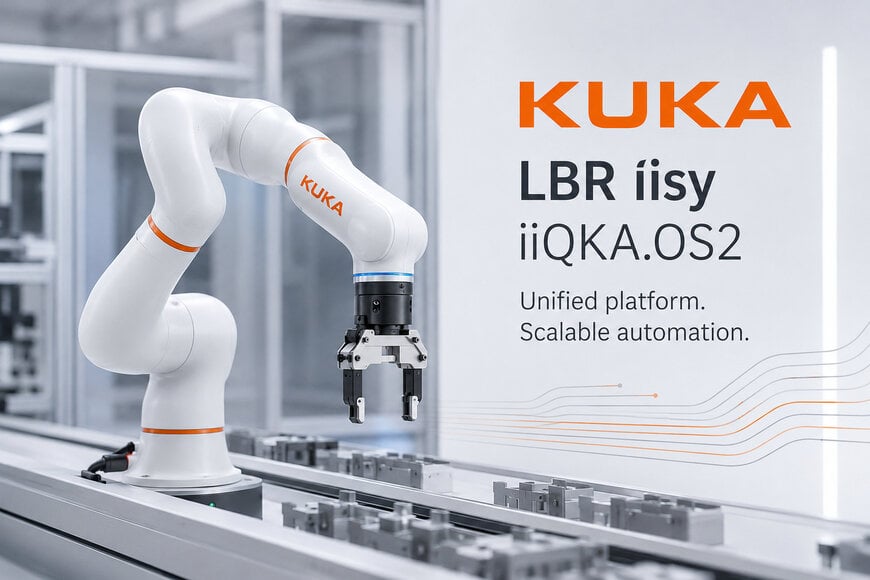
The industrial LBR iisy cobot is now available with the iiQKA.OS2 operating system, providing a unified software platform for collaborative robotics and industrial automation. The solution is designed for companies seeking to expand their robotic applications gradually within a common automation ecosystem.
Industrial Robotics on a Unified Software Platform
With the integration of iiQKA.OS2, KUKA aims to simplify the adoption of industrial automation while providing a scalable platform for future expansion. The operating system supports both collaborative applications and conventional industrial environments, enabling consistent operation across different robotic systems within the KUKA portfolio.
Companies can expand their automation solutions incrementally without changing software platforms or programming systems. This approach reduces integration effort and simplifies the long-term planning of robotic systems, particularly in manufacturing environments with growing automation requirements.
Industrial Performance for Material Handling and Palletizing
The LBR iisy has been developed for continuous operation in industrial production environments. According to KUKA, the cobot combines robust industrial-grade components with the safety features of a collaborative robot, making it suitable for material handling, palletizing, and production-oriented assembly tasks.
The platform supports applications in the automotive, electronics manufacturing, metal processing, and other manufacturing industries. By combining collaborative operation with industrial performance, the robot can be deployed both in shared workspaces with human operators and in automated production cells.
Digital Commissioning and Flexible Production
With iiQKA.OS2, users gain access to digital engineering tools such as iiQWorks.Sim for simulation and virtual commissioning. Production processes can be tested and optimized before installation, reducing integration time and minimizing adjustments during commissioning.
Integrated sensors, hand-guiding capabilities, and modern user interfaces simplify the programming and deployment of new applications. As a result, production automation can be adapted more easily to changing manufacturing requirements.
Unified Automation Ecosystem
The LBR iisy with iiQKA.OS2 is part of the KUKA automation ecosystem. Users gain access to additional robots, software solutions, engineering tools, and global services built on the same technology platform.
This common architecture enables companies to expand existing automation solutions progressively and operate different robotic systems within a unified software environment. As a result, robotics investments remain valuable over the long term, and future expansions can be implemented without changing platforms.
Additional Context: This section outlines technical specifications and competitive benchmarking that were not included in the original product announcement.
In the collaborative robotics market, unified software platforms, digital engineering tools, and virtual commissioning are becoming increasingly important evaluation criteria. Comparable systems, including ABB GoFa and the Universal Robots e-Series, also provide intuitive programming environments, offline programming, and human-robot collaboration capabilities. With iiQKA.OS2, KUKA follows a similar platform strategy by integrating different robotic systems into a common software environment.
Depending on the configuration, the LBR iisy is available with payload capacities ranging from 3 to 15 kg and reaches from 760 to 1,300 mm. Integrated joint torque sensors support collaborative operation, while iiQKA.OS2 enables the use of iiQWorks.Sim for simulation and virtual commissioning. These capabilities facilitate the planning, validation, and optimization of robotic applications before installation. Typical applications include material handling, palletizing, assembly, machine tending, and flexible manufacturing processes in the automotive, electronics manufacturing, and metal processing industries.
Edited by Sucithra Mani, Induportals Editor – adapted by AI.
www.kuka.com
