
www.industryemea.com
01
'26
Written on Modified on
ABB expands EV charging infrastructure across Latvia retail
Terra 54 fast chargers installed at Lidl stores enable everyday EV charging with integrated payment and user access systems.
global.abb
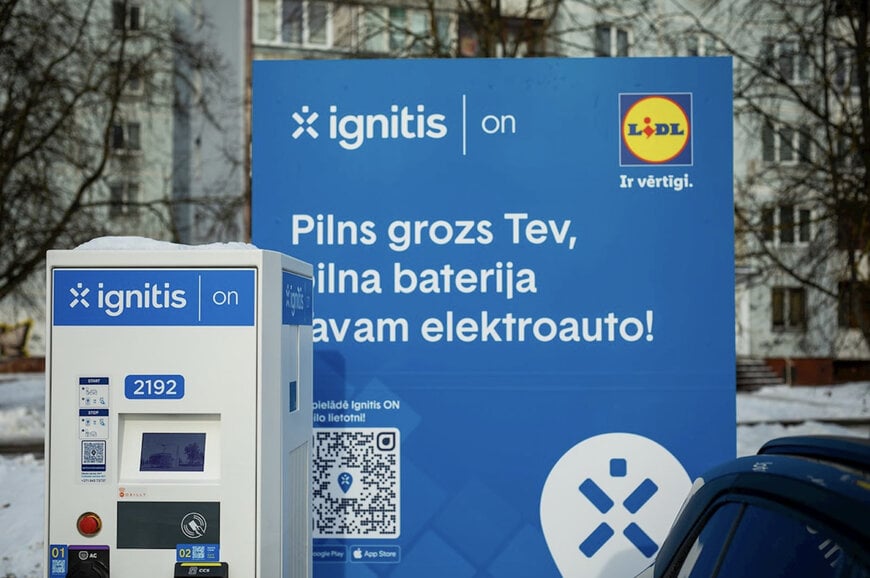
Electric vehicle charging infrastructure, retail mobility solutions, and urban transport electrification require accessible, fast, and reliable charging systems integrated into daily routines. In this context, ABB has deployed Terra 54 DC fast charging stations across 36 Lidl locations in Latvia, enabling practical EV charging during routine shopping activities.
The charging network spans key urban and regional areas, from Daugavpils to Liepāja, supporting nationwide accessibility. Charging services, payment systems, and customer support are operated by Ignitis ON, ensuring a consistent user experience.
Fast charging integrated into daily retail activity
The Terra 54 stations are designed to align charging duration with typical shopping times. Each unit delivers DC fast charging, enabling most electric vehicles to recharge within approximately 20–30 minutes, depending on battery capacity and charging conditions.
Each station supports simultaneous charging of two vehicles and is compatible with both battery electric vehicles (BEVs) and plug-in hybrid electric vehicles (PHEVs). This dual-outlet configuration increases utilisation rates and reduces waiting times in high-traffic retail locations.
Charging sessions can be initiated via mobile applications or RFID cards. In addition, the Auto Charge functionality allows automatic vehicle recognition and charging initiation without requiring user authentication through apps or cards, reducing interaction steps and simplifying operation.
Proven deployment model in European EV charging infrastructure
The installation of EV chargers at retail locations is a widely adopted model across Europe, where charging availability is integrated into everyday destinations such as supermarkets and shopping centres. Within this framework, Lidl has deployed more than 500 Terra 54 charging stations across multiple countries.
The Latvian rollout demonstrates how this model can be replicated at a national scale, increasing charging accessibility and supporting broader EV adoption. By placing infrastructure in frequently visited locations, the system reduces range anxiety and improves usability for regular users.
Contribution to transport decarbonisation targets
Latvia has set climate targets including achieving carbon neutrality by 2050 and reducing CO₂ emissions by 65% by 2030. The transport sector plays a central role in these objectives, with EV adoption supported by accessible charging infrastructure.
Electric vehicles can reduce lifecycle CO₂ emissions by approximately 50–70% compared to internal combustion engine vehicles, depending on energy sources and usage conditions. Expanding public charging networks is therefore a key enabler for meeting national and municipal climate targets.
At the city level, Riga has set a target of reducing emissions by 80% by 2030, further highlighting the role of electrified mobility systems.
Reliability and system monitoring of charging infrastructure
The Terra 54 charging stations are widely deployed across Europe and are designed for operation under varying environmental conditions. Their compatibility with multiple vehicle standards ensures interoperability across different EV brands and models.
The systems are supported by remote monitoring and software updates, enabling continuous operation and maintenance without requiring frequent on-site intervention. This capability is critical for maintaining uptime and service reliability in distributed charging networks.
Positioning among DC fast charging solutions
DC fast chargers such as the Terra 54 are commonly used in public and semi-public infrastructure, particularly in retail and urban environments. Comparable systems include Siemens Sicharge D and Schneider Electric EVlink DC, which offer similar charging capacities and integration capabilities.
Selection criteria for such systems typically include charging power, interoperability, user authentication options, and backend integration for billing and monitoring. In this deployment, the combination of dual charging capability, Auto Charge functionality, and integration with a service provider platform supports efficient operation in high-frequency usage scenarios.
By integrating EV charging into everyday retail environments, ABB’s deployment in Latvia illustrates how infrastructure design can support the transition toward practical and scalable electromobility.
Edited by Natania Lyngdoh, Induportals Editor — Adapted by AI.
www.abb.com
