
www.industryemea.com
25
'26
Written on Modified on
Large-Format 3D Printing Enables Sustainable Clay Construction
WASP develops modular construction 3D printing systems for off-grid housing projects and integrates maintenance-free bearing technology from igus to improve reliability and reduce service requirements.
www.igus.eu
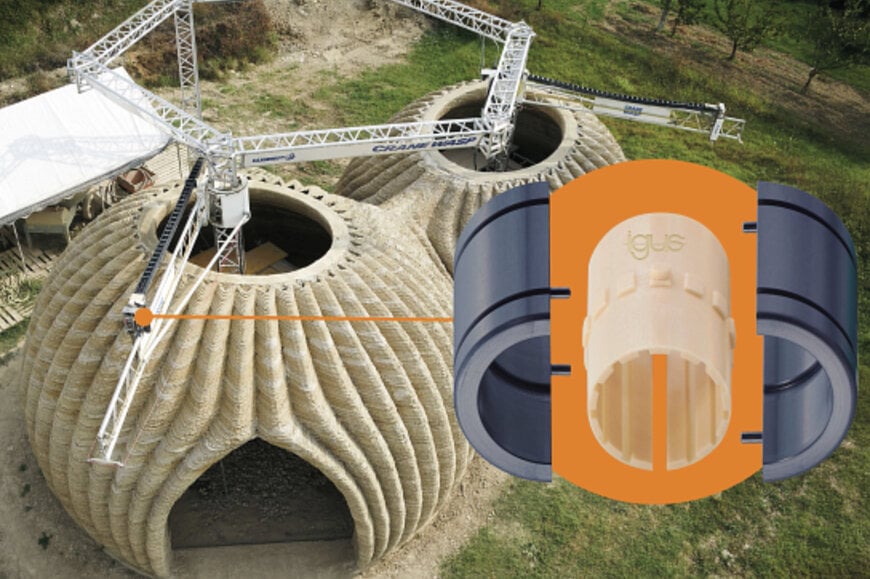
The Italian company WASP is deploying its large-format 3D printer, Crane WASP, to automate clay-based construction and enable cost-efficient, sustainable housing in off-grid regions. The technology combines additive manufacturing for construction with locally available materials such as soil, water, and agricultural by-products, addressing the need for resource-efficient building methods with reduced infrastructure dependency.
Additive Construction Using Local Materials
The modular 3D printing system is inspired by natural building processes and constructs house walls layer by layer using clay extrusion. A reference project is the TECLA house in Massa Lombarda, a dome-shaped structure produced entirely from a mixture of earth and water. The system is designed to automate construction workflows while using materials sourced directly from the surrounding environment, reducing transport costs, emissions, and build times.
A single printing unit covers a build area with a diameter of 8.2 meters and a height of 3.2 meters. The mechanical structure consists of a vertical lifting mast and a height-adjustable boom capable of 360-degree rotation. A clay extruder moves horizontally along the boom, forming the building geometry layer by layer. The construction of the TECLA house required approximately 200 operating hours.
Mechanical Demands in Dust-Intensive Construction Environments
Large-scale additive construction systems impose significant loads on mechanical components, particularly on bearing points that guide the print head during extended operating cycles. Construction sites typically expose moving parts to high levels of dust and debris, which can compromise lubrication films in conventional metal bearings, increasing friction, wear, and the risk of failure.
To enhance system reliability and reduce maintenance, WASP sought an alternative to traditional metal bearings that could operate without lubrication and withstand harsh environmental conditions.
Maintenance-Free Sliding Bearings for Continuous Operation
The solution involves drylin R JUM-01-50 sliding elements made from iglidur J high-performance polymer by igus. The print head carriage glides along these sliding liners mounted on the aluminum profiles of the boom. Solid lubricants integrated into the polymer material enable dry operation over extended periods without the need for grease.
This lubrication-free design reduces maintenance intervals and lowers the risk of bearing failure in dusty environments. In addition, the sliding elements are up to 80 percent lighter than comparable metal bearings, contributing to improved dynamic response and positioning precision of the print head. The components are designed to withstand both axial and radial loads and exhibit resistance to moisture and temperature fluctuations.
Additive Manufacturing as a Platform for Sustainable Building
By combining large-format 3D printing technology with low-maintenance mechanical components, the system supports reliable operation under challenging field conditions. The integration of lubrication-free sliding bearings enhances operational stability and contributes to the economic scalability of additive construction processes.
The project illustrates the growing role of additive manufacturing in construction, particularly in scenarios where flexible infrastructure, local materials, and automated processes converge to enable sustainable housing concepts.
www.igus.com
