
www.industryemea.com
16
'26
Written on Modified on
Stereo 3D line-scan camera targets 4.4 m surface inspection
Chromasens extends wide-format inspection with integrated 2D/3D capture, reducing multi-camera stitching requirements in high-speed production lines.
www.chromasens.com
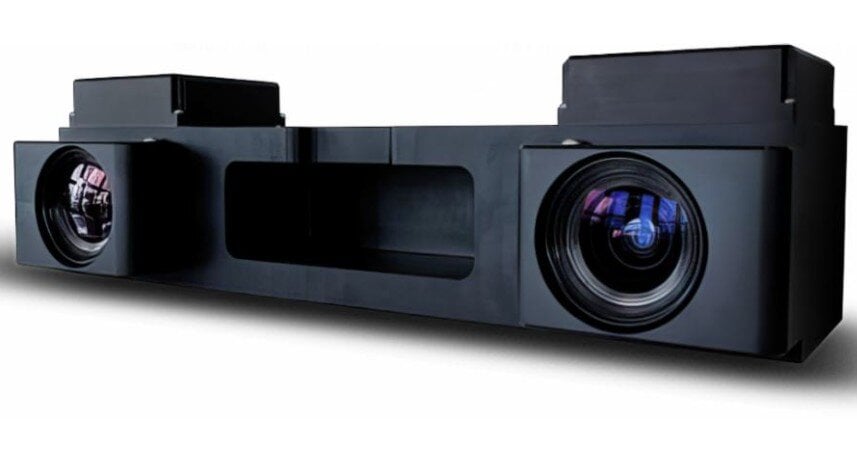
Wide-format manufacturing and infrastructure inspection increasingly require full-width defect detection and 3D profiling without slowing down web speeds or scan vehicles. Against this background, Chromasens has introduced the 3DPIXA pro dual 615µm stereo line-scan camera, combining 2D color imaging and 3D data capture over a 4.4-meter field of view.
One-pass, 4.4 m coverage changes wide-format system design
The 3DPIXA pro dual 615µm is designed to inspect very large surfaces in a single pass, delivering a 4400 mm field of view. In wide-format inspection, systems often rely on multi-camera arrays and stitching to cover full widths, increasing calibration effort and mechanical complexity. By extending coverage to 4.4 m with one unit, the camera is positioned to reduce the number of cameras required and avoid stitching algorithms in applications where alignment and synchronization overheads are significant.
The camera uses a line-scan architecture, which is commonly selected in continuous-web environments because coverage scales with width while maintaining high line rates and deterministic acquisition timing.
Integrated 2D + 3D capture from a tri-linear RGB sensor
Chromasens integrates a tri-linear CCD RGB sensor with 10 µm × 10 µm active pixels, enabling simultaneous high-resolution 2D color images and 3D datasets. Color capture is aimed at use cases where true-color differentiation helps identify subtle surface changes—such as print consistency issues, discoloration, or material non-uniformity—that may not be visible with monochrome inspection.
The stereo configuration uses factory-calibrated dual lenses, intended to provide out-of-box readiness for height mapping, warp detection, and surface profiling, alongside conventional intensity-based defect classification.
Target sectors: road surfaces, battery foils, metals, textiles and films
The camera is positioned for wide, flat, or rolled products where inspection must be continuous, full-width, and high-speed. Typical use cases include: road, railway and infrastructure scanning for cracks and damage; wide battery electrode foils in gigafactory-scale lithium-ion production; metal coils and sheets during rolling, slitting or coating; broad textiles and non-wovens such as carpets and technical fabrics; paper, board and tissue webs; and plastic films, foils and sheets for contaminants, holes, wrinkles or thickness-related anomalies.
In automated road inspection, the camera is described as capable of generating 3D surface models alongside 2D color imagery to detect potholes, cracks, depth variations, and repair quality, with vehicle-mounted line-by-line acquisition reducing dependence on manual surveys.
Resolution tuned for millimeter-scale defect confirmation
The system operates at 615 µm/pixel optical resolution across approximately 7,154 pixels per line. Chromasens positions this resolution as suitable for detecting features above 1–2 mm, allowing multi-pixel confirmation for more reliable identification of macro-level defects such as tears, scratches, contamination, and dimensional variation while maintaining throughput.
This balance targets inspection environments where defect detectability must be maintained without overwhelming the data pipeline at high line speeds.
CameraLink bandwidth for deterministic high-speed acquisition
For production integration, the camera uses a CameraLink interface aimed at deterministic, low-latency transfer in machine vision pipelines. Chromasens specifies line frequencies up to 29.7 kHz, with a maximum speed of 18.265 m/s, aligned with high web speeds in printing, metal processing, and converting lines.
By combining factory-calibrated stereo 3D measurement with true-color line-scan capture, the 3DPIXA pro dual 615µm is positioned for embedded inspection systems where width, speed, and repeatable 3D metrology are required without multi-camera arrays.
www.chromasens.com
