
www.industryemea.com
25
'26
Written on Modified on
Luffing Jib Tower Crane With 90 t Capacity
Manitowoc's Potain MCR 1306 combines 90 t capacity, 80 m jib and compact slewing radius for congested high-rise and infrastructure jobsites.
www.manitowoc.com
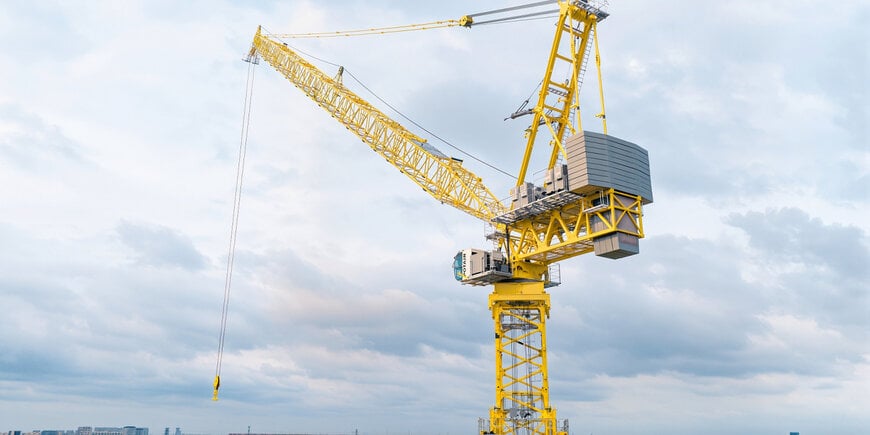
Urban construction sites are becoming denser, buildings taller and more slender, and many projects now run several cranes side by side under strict oversailing limits. Manitowoc has addressed these conditions with the Potain MCR 1306, a luffing jib tower crane with a maximum lifting capacity of 90 t, presented at bauma CHINA 2026, which takes place from 23 to 27 November 2026 at the Shanghai New International Expo Centre and the Shanghai World Expo Exhibition and Convention Center in Shanghai, China.
Why luffing jib cranes suit dense jobsites
A luffing jib crane changes its working radius by raising and lowering the jib instead of moving a trolley along a horizontal jib. Because the jib can be raised close to vertical, the crane needs a much smaller slewing circle, which allows several cranes to work on one site and limits oversailing of neighbouring properties. The MCR 1306 is manufactured at Manitowoc's Zhangjiagang factory in China and is intended for high-rise, infrastructure, industrial and energy projects across Asia, the Middle East, Australia, New Zealand, Africa and Latin America. It is the sixth luffing jib model introduced for these markets in recent years and tops a range that also includes the MCR 305, MCR 505, MCR 515, MCR 625 and MCR 815.
"We're seeing more complex, multi-crane projects and stricter controls on oversailing as projects continue to scale. Customers need greater lifting capacity while maintaining the efficiency and jobsite flexibility they expect," said Brian Wang, SVP of emerging markets at Manitowoc.
Lifting capacity and reeving configurations
The crane reaches its 90 t maximum capacity in three-fall reeving, while one-fall and two-fall reeving provide 30 t and 60 t respectively. Additional rope falls share the load between more rope lines, raising capacity at the cost of hook speed, so contractors can match the configuration to heavy lifts or faster cycles. In single-fall reeving, the crane hoists 30 t at 0.58 m/s. The maximum jib length is 80 m with a jib-end capacity of 11 t, and up to 996 m of wire rope can be stored on the drum, a value that matters on tall buildings where hook height grows with each climbing stage. Freestanding heights of 57.8 m, 63.5 m or 69.2 m are available depending on configuration.
Compact footprint and simplified erection
The minimum in-service slewing radius ranges from 5.2 m to 8.7 m depending on jib length, and the out-of-service slewing radius from 19.5 m to 22.4 m depending on jib configuration. A new 3.45 m K1000 mast carries the crane's loads while keeping the footprint compact. Transport and installation are simplified by a panel-type mast design, the TC1000 telescoping system, an auxiliary winch for the mast and the AK1000 anchor frame. A new lightweight SB hook, around 1 t lighter than the 1B hook block, is available for one-fall operations.
Crane control system and safety functions
The new Vision Cab layout relocates the electrical control panel outside the cab to give the operator more space. Potain's Ergo Control System (ECS) uses CAN bus communication, which replaces point-to-point wiring with a shared data network and simplifies the wiring layout. Its 13.3-inch high-definition display provides data logging, troubleshooting assistance and dedicated modes for installation and telescoping. Hoisting, luffing and slewing mechanisms use full variable-frequency control for smooth acceleration and precise load positioning. Standard motor brakes are complemented by hydraulic safety brakes on both the hoisting and luffing winches, adding an independent braking stage. A motorised slewing-ring greaser automates lubrication, and a low-grease-level alarm signals when service is required.
Additional Context
This section details technical specifications and competitive benchmarking not included in the original product announcement.
Tower cranes placed on the European market are designed against EN 14439, the harmonised safety standard for tower cranes, while structural design commonly follows the EN 13001 series and duty classification is defined in ISO 4301. Luffing jib cranes are frequently specified in city centres because the reduced out-of-service radius allows the crane to weathervane freely in high wind without the jib sweeping over adjacent buildings, a common condition of oversailing agreements. Within Potain's own luffing jib range for emerging markets, the MCR 1306 extends maximum capacity beyond the earlier MCR 815 and introduces the K1000 mast system to support it.
Edited by Sucithra Mani, Induportals editor – adapted by AI.
www.manitowoc.com
