
www.industryemea.com
24
'26
Written on Modified on
Danisense launches high-precision AC/DC leakage current transducer
Equipped with a 41mm aperture and removable isolation, the DN1-5UD-10V measures galvanically isolated AC and DC currents up to 1.5A across three-phase cable arrangements.
www.danisense.com
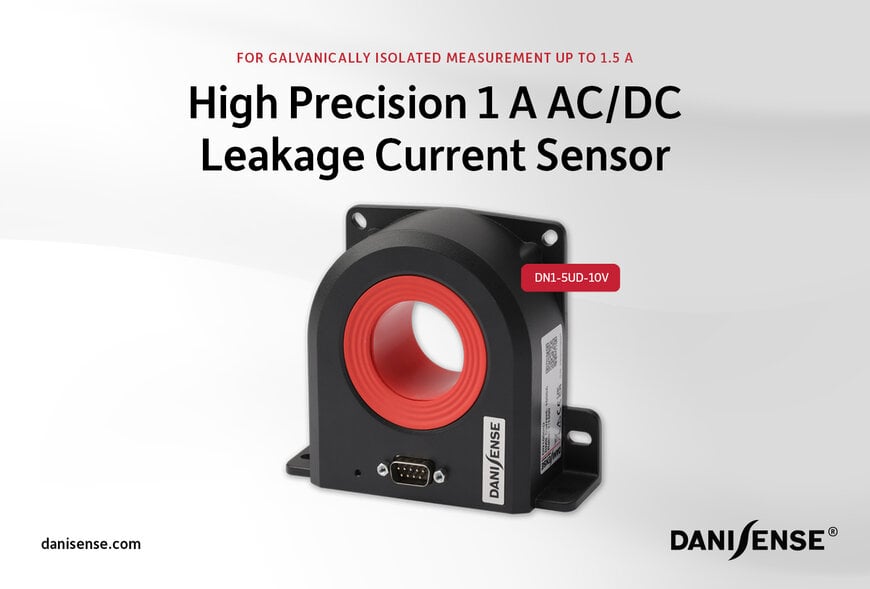
Danisense has announced the launch of the DN1-5UD-10V, a high-precision DC current transducer (DCCT) engineered for galvanically isolated measurement of small AC and DC currents up to 1.5A. Combining a large 41mm aperture with Danisense's closed-loop fluxgate technology, the sensor accurately captures very small currents, including leakage and floating currents, even within large cable arrangements.
Simplified installation and closed-loop fluxgate stability
The large 41mm aperture and removable isolation insert allow installers to pass all three phase cables through the transducer simultaneously, simplifying integration into existing systems and confined enclosures. Housed in a compact, rugged aluminium casing, the transducer is built for durability in demanding industrial environments.
Operating on the closed-loop fluxgate principle, the DN1-5UD-10V achieves very low offset and ultra-low drift, enabling high-resolution, reliable, and consistent measurement of minute currents over extended periods.
Electrical specifications and target applications
The DN1-5UD-10V is rated for a nominal current of 1A rms AC and delivers a 10V output at 1.5A via a D-sub-9 connector. This direct voltage output is suited for connection to oscilloscopes, which are commonly used in target applications where dedicated power measurement instruments are not typically deployed. The unit achieves a total accuracy of 1% and incorporates a status signal and LED indicator for straightforward operational monitoring.
Early deployment areas include measuring real leakage currents to optimise the design of new-generation inverters, such as those used in vehicle-to-grid (V2G) applications. The transducer also measures floating currents in battery state-of-health (SOH) analysis, as well as small currents in large voltage-isolation cables within medium-voltage (MV) systems. Additional applications span electrical distribution panels, data centres, electricity substations, industrial facilities, heavy machinery, electrical installation monitoring, EV test benches, and battery testing and evaluation systems.
Additional Context:
This section explains general principles of differential leakage current measurement and closed-loop fluxgate sensing not included in the original press release.
When all three phase conductors (and neutral, where applicable) of an AC or DC power circuit are routed together through a single transducer aperture, their normal operational load currents generate equal and opposite magnetic fields that cancel each other out. Any non-zero net magnetic flux detected by the transducer core directly corresponds to the residual or leakage current escaping to earth, enabling engineers to isolate micro-ampere or milli-ampere fault currents without disconnecting heavy high-voltage busbars or cables.
Closed-loop fluxgate transducers detect weak DC and low-frequency magnetic fields by driving a high-permeability magnetic core into saturation with an excitation coil and measuring the resulting second-harmonic asymmetry. A feedback amplifier then drives a compensation current through a secondary winding to null the core flux back to zero, minimising the effects of magnetic hysteresis and temperature drift while providing galvanically isolated voltage or current outputs.
Edited by an industrial journalist, Lekshman Ramdas, with AI assistance.
www.danisense.com
