
www.industryemea.com
20
'26
Written on Modified on
Honeywell selected to accelerate South African eSAF production
Phelan Green chooses Honeywell Technologies' end-to-end modular carbon capture and fuel synthesis solutions to produce up to 140,000 metric tons of eSAF annually at Saldanha Bay.
www.honeywell.com
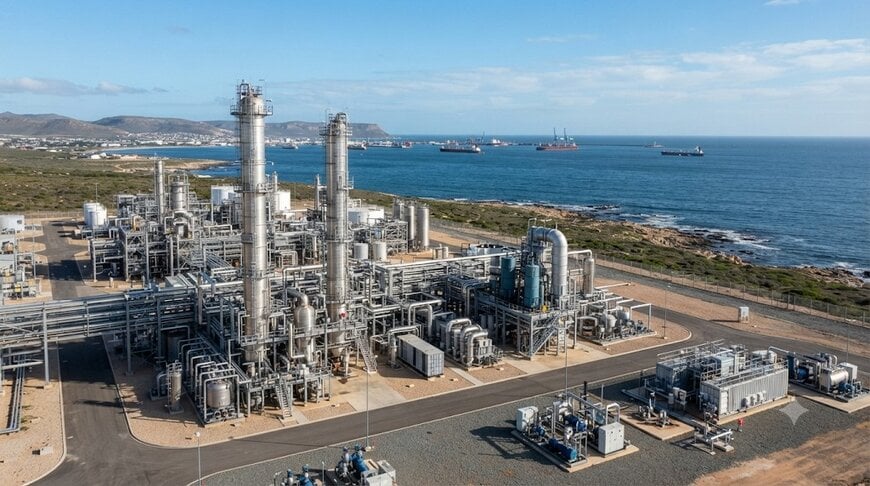
Phelan Green, operating through its clean fuels subsidiary Phelan eFuels, has selected Honeywell Technologies to supply Advanced Solvent Carbon Capture (ASCC) technology and modular engineering services for the first phase of its electro-sustainable aviation fuel (eSAF) facility in Saldanha Bay, South Africa. Following Phelan Green’s decision earlier in 2026 to deploy Honeywell Technologies UOP Fischer-Tropsch (FT) Unicracking process technology, this latest agreement consolidates critical process technologies under a single provider as the project reaches its final investment decision. Once fully operational, the facility will produce up to 140,000 metric tons of eSAF per year.
Streamlining execution through an integrated modular pathway
To reduce integration risk and accelerate commercial deployment, Honeywell Technologies is providing an end-to-end technology suite that includes HyCOgen and FT-CANS—solutions jointly developed with bp. The Saldanha Bay plant is part of the broader Phelan Green Hydrogen Project, a planned $2.5 billion private investment recognised by the South African government as a trailblazer within its nationally strategic Green Hydrogen programme.
Blair Phelan, Group Managing Director at Phelan Green, stated that the company is bringing together proven technologies across the eSAF value chain to establish South Africa as a competitive producer and exporter of lower-carbon aviation fuel. He added that Honeywell Technologies’ integrated offering provides a coordinated pathway from carbon capture through fuel synthesis and final upgrading, while the modular delivery model is designed to simplify project execution.
Scaling sustainable aviation fuel to meet global demand
Addressing the commercial hurdles of alternative jet fuels, Rajesh Gattupalli, president of Honeywell Technologies UOP, noted that cost remains a primary challenge to scaling SAF production and adoption, requiring efficient technologies to build investor confidence. Drawing on process technologies that already support 30% of global SAF production, Honeywell Technologies combines deep process expertise with digital and connected capabilities to lower execution risks and help producers bring lower-carbon aviation fuels to market more rapidly.
Additional Context:
This section explains general principles of electro-sustainable aviation fuel production not included in the original press release.
Electro-sustainable aviation fuel, or eSAF, is produced from captured carbon dioxide and hydrogen made by water electrolysis using renewable electricity. Because the carbon in the fuel comes from captured CO2 rather than fossil sources, eSAF can significantly reduce lifecycle greenhouse gas emissions compared with conventional jet fuel when low-carbon electricity is used.
In a typical power-to-liquid route, the captured CO2 and the hydrogen are first converted into synthesis gas, a mixture of carbon monoxide and hydrogen. Fischer-Tropsch synthesis then turns this gas into long-chain hydrocarbons, which are upgraded by hydrocracking and separation into a fuel fraction that meets jet fuel specifications.
Edited by an industrial journalist, Lekshman Ramdas, with AI assistance.
www.honeywell.com
