
www.industryemea.com
18
'26
Written on Modified on
MultiJet and Metal Powder Systems in Additive Manufacturing
3D Systems presents the MJP 300 plastic printer, TSR metal powder management module, and DRM software tools at Formnext to standardize industrial additive production.
www.3dsystems.com
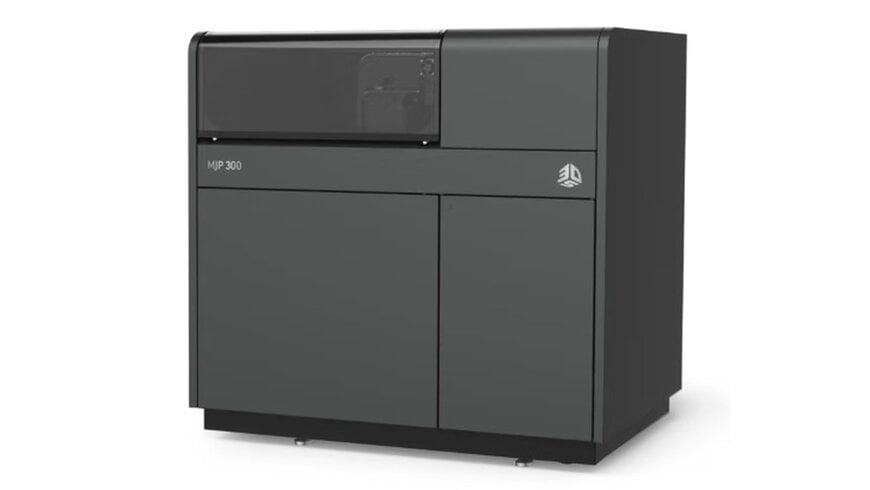
Formnext 2026 takes place from November 17 to 20, 2026, at Messe Frankfurt in Frankfurt, Germany, focusing on additive manufacturing technologies, materials, and post-processing workflows. At Booth D11 in Hall 11.0, 3D Systems showcases MultiJet Printing hardware, closed-loop metal powder handling systems, industrial wax kits, and digital rights management software engineered for aerospace, defense, healthcare, and dental manufacturing.
Core Technology and System Architecture
The hardware portfolio centers on the MJP 300 plastic 3D printer, which operates across a 294 x 211 x 144 mm build volume divisible into three independent print lanes to optimize printhead travel for small or tall part batches. The platform executes high-definition, ultra-high-definition, and extreme-high-definition build modes at 16-micron layer thicknesses and 1600 x 900 dpi resolution using VisiJet acrylate materials, while integrating cybersecurity controls compliant with ESA and IEC standards. For direct metal printing, the mobile Transport-Sieve-Reload (TSR) module connects to DMP Flex 350 systems to recover, sieve, and recirculate metal powders under continuous low-oxygen inert conditions using Russell Finex separation hardware. Software security is managed via 3D Sprint Pro with the finite toolset, encrypting print files, verifying data integrity, and restricting print counts per workstation.
Deployment or Implementation
The additive platforms and workflow modules integrate into regulated production facilities and fleet environments. Hardware monitoring and asset scheduling execute through the AddiTrak fleet management software, while finite digital rights management initially deploys across MJP 300W wax and MJP 300 acrylate platforms before expanding to additional systems in early 2027. On the metal production floor, a single mobile TSR unit interfaces across multiple DMP Flex 350 printers to share inert powder processing infrastructure, while the Industrial Wax Kit adapts existing MJP 300W Plus printers to process VisiJet Wax Jewel Red material for larger investment casting patterns.
Industry Applications
The technologies address intellectual property exposure, manual powder contamination, and tooling lead times across aerospace, defense, medical device, and dental laboratories. Distributed additive supply chains face risks of unauthorized file duplication and print overruns when transmitting digital part geometries to external contract manufacturers. Simultaneously, open-air metal powder handling exposes operators to fine particulates and degrades alloy purity through oxidation, while large aerospace investment castings require ductile, high-accuracy wax patterns without hard tooling overhead.
Operational Impact and Performance Metrics
Dividing the MJP 300 build envelope into three print lanes increases batch throughput and reduces support material consumption alongside hands-free post-processing routines. Closed-loop inert powder recirculation maintains low oxygen levels throughout recovery and sieving cycles, preserving metal powder reusability and minimizing operator exposure. Embedding workstation-level print limits and cryptographic integrity checks secures proprietary design data across distributed manufacturing networks.
"Updated electronics and software provide a new level of accuracy, surface finish, ease-of-use and security for our customers with a platform that can scale," said Martin Johnson, Vice President, Product & Technical Fellow, 3D Systems.
Edited by Romila DSilva, Induportals Editor, with AI assistance.
www.3dsystems.com
