
www.industryemea.com
10
'26
Written on Modified on
The Next Wave of AI: Why Tomorrow's OEM Products Will Be Designed Like Today's AI Data Centers
How AI's spillover is opening new markets, seen from Delta's position across data center, industrial, medical, e-mobility and appliance power.
www.delta-emea.com
Artificial intelligence is usually discussed in terms of GPUs, hyperscale data centers and record investment. Yet for many industrial, medical and mobility OEMs, the bigger story lies elsewhere. The technologies developed for AI infrastructure are rapidly becoming the design benchmark for the next generation of products across multiple industries.
Higher power density. Liquid cooling. High-voltage DC architectures. Silicon carbide power electronics. These are no longer technologies reserved for hyperscale computing – they are increasingly shaping machines, medical devices, electric vehicles and even home appliances.
For OEMs, the question is no longer whether AI will influence product development, but how quickly these technologies should be integrated into future platforms.
AI infrastructure is being built at unprecedented speed. The five largest US cloud providers plan to invest more than USD 600 billion in capital expenditure in 2026, most of it in AI compute, data centers and networking. All of them say the market is constrained by supply, not demand.
The impact of this investment will not stay inside the server rack. Technologies originally developed for AI infrastructure are increasingly influencing industrial equipment, medical devices, mobility and consumer products, creating new opportunities for OEMs across multiple industries. The question is where those opportunities lie, and how companies can take advantage of them.
The timing is right
This shift is already visible across multiple industries. ZVEI, the German Electro and Digital Industry Association, expects the global electrical and electronics market to grow by 7% this year and a further 6% in 2027, driven primarily by AI infrastructure investment alongside the continued advance of electrification, digitalisation and automation. At the same time, European manufacturing is showing renewed momentum. According to VDMA, price-adjusted orders for the German mechanical engineering industry rose by 5% in the first seven months of 2026, with orders from outside the eurozone increasing by 14%. VDMA expects production to return to growth in 2027.
Several key OEM markets are evolving at the same time. Europe remains one of the world's largest medical technology markets, valued at around EUR 173 billion, while many manufacturers continue to face growing demands for higher performance, stricter safety standards and shorter development cycles. Meanwhile, e-mobility continues to expand, with battery-electric vehicles accounting for 20.7% of new EU passenger car registrations in the first half of 2026. Consumer products are evolving as well, with sustainability, energy efficiency and AI-enabled functionality increasingly influencing purchasing decisions and product development.
The market does not simply need more products – it needs a new generation of products. For OEMs, this is the moment to rethink product platforms and prepare for technologies that were once confined to AI data centers but are now becoming relevant across almost every industry.
Opportunity 1: Supply equipment and technology to AI data centers
The first opportunity is not to build AI itself – it is to supply the infrastructure that enables AI. An AI data center needs far more than servers. It relies on equipment that industrial OEMs already know well: pumps, valves, coolant distribution, fans, power distribution and control systems. As liquid cooling becomes mainstream, this non-IT domain is expanding rapidly, and the capabilities it requires, such as fluid control, motor drives and high-reliability field equipment, are exactly where European industrial OEMs excel.
Experience from e-mobility is just as valuable. Data centers are moving toward high-voltage DC architectures such as 800 VDC, and the design, protection and thermal management of high-voltage DC systems are capabilities the EV industry has built over years of 800 V platform development. Equipment makers that can help data centers solve their power and cooling challenges will be at the front of this wave of demand. For many OEMs, this does not require entirely new technology. It means bringing existing strengths into a fast-growing new industry.
Opportunity 2: Make your own products smarter
The second opportunity is even broader: bringing AI-enabled capabilities into OEMs' own products. As computing power moves beyond the data center, AI is becoming an integral part of industrial equipment, medical devices, vehicles and consumer products. The challenge is no longer simply adding intelligence, it is designing the power and thermal architecture needed to support it.
Medical devices are among the fastest-moving fields for AI adoption. Taking the US FDA, the regulator of the world's largest medtech market, as a benchmark, the number of AI-enabled medical devices it had authorised reached 1,451 by the end of 2025, including a record 295 approvals in 2025 alone. Radiology accounts for 76% of these devices. Many combine AI software with dedicated hardware, such as mobile X-ray systems that detect fractures at the point of image capture. As AI moves into imaging systems, patient monitoring and surgical robotics, power supplies must deliver higher performance while meeting stringent medical requirements for safety isolation, low leakage current and electromagnetic compatibility. For medical OEMs, these factors directly influence certification timelines and time to market.
The same trend is visible across industrial automation, mobility and consumer products. Machine vision, predictive maintenance and edge AI are moving into production equipment, while vehicles and charging infrastructure are becoming increasingly software-defined. Across these applications, AI capabilities require higher peak power, greater efficiency and more sophisticated thermal management within the same installation footprint. OEMs that incorporate these requirements at the platform design stage will bring new products to market faster, improve long-term product competitiveness and be better prepared for future performance demands.
Opportunity 3: Use regulation as a catalyst for next-generation platforms
Most companies view regulation primarily as a compliance requirement. Increasingly, it is becoming an opportunity to redesign entire product platforms. Across Europe, new legislation is encouraging manufacturers to improve efficiency, cybersecurity, repairability and lifecycle performance. Rather than making incremental changes to existing products, many OEMs now have an opportunity to combine regulatory compliance with broader technology upgrades.
For industry, the Machinery Regulation (EU) 2023/1230, which applies in full from January 2027, introduces new requirements relating to cybersecurity, AI and lifecycle management. In consumer products, the Standby Regulation (EU) 2023/826 and the Right to Repair Directive (EU) 2024/1799 are accelerating demand for more energy-efficient, modular and serviceable product designs.
For companies already redesigning products to accommodate AI, higher computing performance and more sophisticated power architectures, these regulatory changes provide an opportunity to modernise entire platforms rather than treating compliance as a separate engineering exercise.
Companies that integrate efficiency, repairability and future regulatory requirements into their next generation of products today will be better positioned as demand continues to grow.
The next engineering baseline: AI is writing the next generation of specifications
The discussion around AI often focuses on servers and semiconductors. Yet one of the most significant transformations is taking place across power electronics. Technologies originally developed for hyperscale AI infrastructure are rapidly becoming the engineering baseline for industrial equipment, medical devices, mobility solutions and consumer products.
Higher power density, high-efficiency power conversion, liquid cooling, silicon carbide power devices and high-voltage DC architectures are no longer confined to the data center. They are steadily becoming standard design requirements across a much broader range of applications.
The real question is therefore not whether to seize the AI opportunity, but where to start and at what pace. Every OEM has different products, customers, certification requirements and development cycles, meaning there is no one-size-fits-all approach.
From Delta's perspective, one common misconceptions is that AI infrastructure and industrial products are evolving independently. In reality, the two are converging rapidly. The technologies being developed for AI data centers today – including higher power density, advanced thermal management, high-voltage DC architectures and next-generation power conversion – are becoming tomorrow's engineering standards across industrial equipment, medical devices, mobility solutions and consumer products.
Companies that recognise this shift early will be better positioned to accelerate innovation, shorten development cycles and remain competitive as performance expectations continue to rise.
Looking ahead
The AI era will not only create new markets—it will redefine how products are designed. Companies that adopt these technologies early will be better prepared for higher performance requirements, increasing energy efficiency demands and the next generation of intelligent applications.
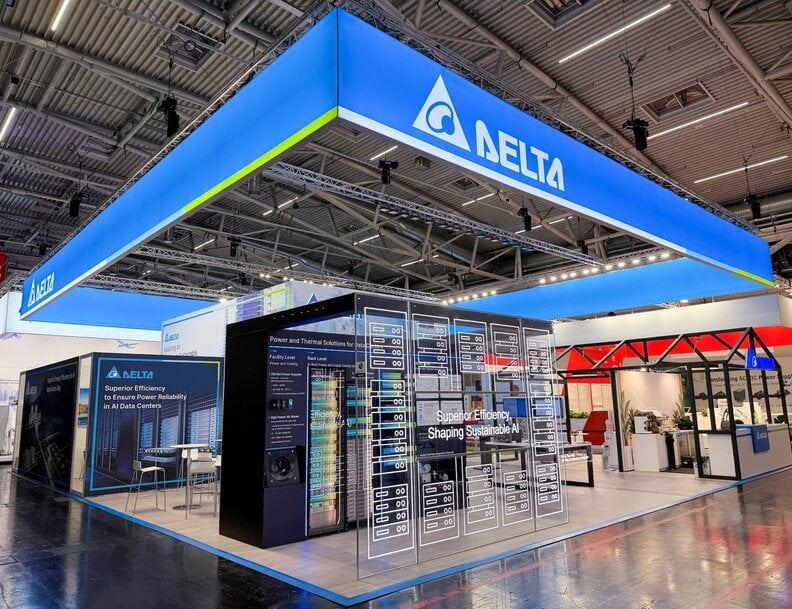
These developments will be among the key themes discussed at electronica 2026, where engineers, OEMs and technology providers will discuss how AI-driven power and thermal innovations are reshaping products across multiple industries. At Booth A5.202, Delta will demonstrate how technologies originally developed for AI infrastructure are already finding practical applications in industrial, medical, mobility and consumer markets.
www.deltaww.com
Higher power density. Liquid cooling. High-voltage DC architectures. Silicon carbide power electronics. These are no longer technologies reserved for hyperscale computing – they are increasingly shaping machines, medical devices, electric vehicles and even home appliances.
For OEMs, the question is no longer whether AI will influence product development, but how quickly these technologies should be integrated into future platforms.
AI infrastructure is being built at unprecedented speed. The five largest US cloud providers plan to invest more than USD 600 billion in capital expenditure in 2026, most of it in AI compute, data centers and networking. All of them say the market is constrained by supply, not demand.
The impact of this investment will not stay inside the server rack. Technologies originally developed for AI infrastructure are increasingly influencing industrial equipment, medical devices, mobility and consumer products, creating new opportunities for OEMs across multiple industries. The question is where those opportunities lie, and how companies can take advantage of them.
The timing is right
This shift is already visible across multiple industries. ZVEI, the German Electro and Digital Industry Association, expects the global electrical and electronics market to grow by 7% this year and a further 6% in 2027, driven primarily by AI infrastructure investment alongside the continued advance of electrification, digitalisation and automation. At the same time, European manufacturing is showing renewed momentum. According to VDMA, price-adjusted orders for the German mechanical engineering industry rose by 5% in the first seven months of 2026, with orders from outside the eurozone increasing by 14%. VDMA expects production to return to growth in 2027.
Several key OEM markets are evolving at the same time. Europe remains one of the world's largest medical technology markets, valued at around EUR 173 billion, while many manufacturers continue to face growing demands for higher performance, stricter safety standards and shorter development cycles. Meanwhile, e-mobility continues to expand, with battery-electric vehicles accounting for 20.7% of new EU passenger car registrations in the first half of 2026. Consumer products are evolving as well, with sustainability, energy efficiency and AI-enabled functionality increasingly influencing purchasing decisions and product development.
The market does not simply need more products – it needs a new generation of products. For OEMs, this is the moment to rethink product platforms and prepare for technologies that were once confined to AI data centers but are now becoming relevant across almost every industry.
Opportunity 1: Supply equipment and technology to AI data centers
The first opportunity is not to build AI itself – it is to supply the infrastructure that enables AI. An AI data center needs far more than servers. It relies on equipment that industrial OEMs already know well: pumps, valves, coolant distribution, fans, power distribution and control systems. As liquid cooling becomes mainstream, this non-IT domain is expanding rapidly, and the capabilities it requires, such as fluid control, motor drives and high-reliability field equipment, are exactly where European industrial OEMs excel.
Experience from e-mobility is just as valuable. Data centers are moving toward high-voltage DC architectures such as 800 VDC, and the design, protection and thermal management of high-voltage DC systems are capabilities the EV industry has built over years of 800 V platform development. Equipment makers that can help data centers solve their power and cooling challenges will be at the front of this wave of demand. For many OEMs, this does not require entirely new technology. It means bringing existing strengths into a fast-growing new industry.
Opportunity 2: Make your own products smarter
The second opportunity is even broader: bringing AI-enabled capabilities into OEMs' own products. As computing power moves beyond the data center, AI is becoming an integral part of industrial equipment, medical devices, vehicles and consumer products. The challenge is no longer simply adding intelligence, it is designing the power and thermal architecture needed to support it.
Medical devices are among the fastest-moving fields for AI adoption. Taking the US FDA, the regulator of the world's largest medtech market, as a benchmark, the number of AI-enabled medical devices it had authorised reached 1,451 by the end of 2025, including a record 295 approvals in 2025 alone. Radiology accounts for 76% of these devices. Many combine AI software with dedicated hardware, such as mobile X-ray systems that detect fractures at the point of image capture. As AI moves into imaging systems, patient monitoring and surgical robotics, power supplies must deliver higher performance while meeting stringent medical requirements for safety isolation, low leakage current and electromagnetic compatibility. For medical OEMs, these factors directly influence certification timelines and time to market.
The same trend is visible across industrial automation, mobility and consumer products. Machine vision, predictive maintenance and edge AI are moving into production equipment, while vehicles and charging infrastructure are becoming increasingly software-defined. Across these applications, AI capabilities require higher peak power, greater efficiency and more sophisticated thermal management within the same installation footprint. OEMs that incorporate these requirements at the platform design stage will bring new products to market faster, improve long-term product competitiveness and be better prepared for future performance demands.
Opportunity 3: Use regulation as a catalyst for next-generation platforms
Most companies view regulation primarily as a compliance requirement. Increasingly, it is becoming an opportunity to redesign entire product platforms. Across Europe, new legislation is encouraging manufacturers to improve efficiency, cybersecurity, repairability and lifecycle performance. Rather than making incremental changes to existing products, many OEMs now have an opportunity to combine regulatory compliance with broader technology upgrades.
For industry, the Machinery Regulation (EU) 2023/1230, which applies in full from January 2027, introduces new requirements relating to cybersecurity, AI and lifecycle management. In consumer products, the Standby Regulation (EU) 2023/826 and the Right to Repair Directive (EU) 2024/1799 are accelerating demand for more energy-efficient, modular and serviceable product designs.
For companies already redesigning products to accommodate AI, higher computing performance and more sophisticated power architectures, these regulatory changes provide an opportunity to modernise entire platforms rather than treating compliance as a separate engineering exercise.
Companies that integrate efficiency, repairability and future regulatory requirements into their next generation of products today will be better positioned as demand continues to grow.
The next engineering baseline: AI is writing the next generation of specifications
The discussion around AI often focuses on servers and semiconductors. Yet one of the most significant transformations is taking place across power electronics. Technologies originally developed for hyperscale AI infrastructure are rapidly becoming the engineering baseline for industrial equipment, medical devices, mobility solutions and consumer products.
Higher power density, high-efficiency power conversion, liquid cooling, silicon carbide power devices and high-voltage DC architectures are no longer confined to the data center. They are steadily becoming standard design requirements across a much broader range of applications.
The real question is therefore not whether to seize the AI opportunity, but where to start and at what pace. Every OEM has different products, customers, certification requirements and development cycles, meaning there is no one-size-fits-all approach.
From Delta's perspective, one common misconceptions is that AI infrastructure and industrial products are evolving independently. In reality, the two are converging rapidly. The technologies being developed for AI data centers today – including higher power density, advanced thermal management, high-voltage DC architectures and next-generation power conversion – are becoming tomorrow's engineering standards across industrial equipment, medical devices, mobility solutions and consumer products.
Companies that recognise this shift early will be better positioned to accelerate innovation, shorten development cycles and remain competitive as performance expectations continue to rise.
Looking ahead
The AI era will not only create new markets—it will redefine how products are designed. Companies that adopt these technologies early will be better prepared for higher performance requirements, increasing energy efficiency demands and the next generation of intelligent applications.
These developments will be among the key themes discussed at electronica 2026, where engineers, OEMs and technology providers will discuss how AI-driven power and thermal innovations are reshaping products across multiple industries. At Booth A5.202, Delta will demonstrate how technologies originally developed for AI infrastructure are already finding practical applications in industrial, medical, mobility and consumer markets.
www.deltaww.com
