
www.industryemea.com
09
'26
Written on Modified on
Antaira introduces cost-effective G-Series unmanaged industrial Ethernet switches
The plug-and-play series offers PoE+, Gigabit speeds, and extended-temperature ruggedness for budget-conscious automation networks.
www.antaira.com
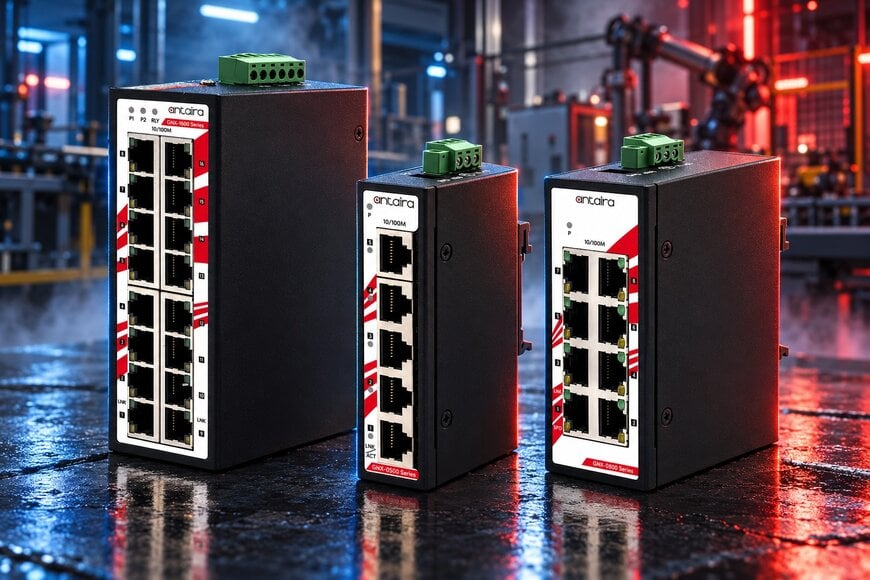
Built for budget-minded industrial networks, Antaira’s G-Series unmanaged switches combine industrial construction with true plug-and-play setup. Choose GNX for Fast Ethernet or Gigabit connectivity, or GNP for IEEE 802.3at PoE+ delivering up to 30 W per port, in 5-, 8- and 16-port models with standard and extended-temperature “T” options.
Antaira Technologies has launched the G-Series, a new family of unmanaged, general-purpose industrial Ethernet switches designed specifically for cost-conscious deployments without sacrificing physical ruggedness. Encased in durable metal housings rather than the consumer-grade plastic typical of this price point, the plug-and-play switches target OEMs and system integrators building networks for factory automation, video surveillance, and transportation systems. The comprehensive lineup consists of 24 SKUs, offering 5-, 8-, and 16-port configurations in both Fast Ethernet and Gigabit speeds, with base models starting at $69.
PoE+ integration and thermal ruggedness
The G-Series is divided into two distinct product lines: the GNX series for standard data connectivity and the GNP series, which integrates IEEE 802.3at Power over Ethernet Plus (PoE+). The GNP models deliver up to 30 watts of power per port over standard Ethernet cables, providing up to a 300-watt total power budget on 16-port models to directly drive heavy-draw devices like PTZ IP cameras and wireless access points. Furthermore, to ensure reliable operation in unconditioned control cabinets and harsh field environments, every base model is offered in a "-T" variant engineered for extended operating temperatures, capable of withstanding extreme thermal conditions ranging from -40°C to 75°C.
Additional Context: IEEE 802.3at PoE+ thermals and Layer 2 unmanaged architectures
This section details power dissipation physics and network switching principles not included in the original press release.
In industrial networking, deploying Power over Ethernet Plus (IEEE 802.3at) inside tightly sealed, unconditioned control cabinets presents severe thermal dissipation challenges. While standard PoE (802.3af) delivers up to 15.4W per port, PoE+ pushes up to 30W by increasing the electrical current over the twisted copper pairs. This elevated power transmission naturally generates significantly more ohmic heating (I²R losses) across both the Ethernet cables and the switch's internal power supply and magnetics. To operate safely at 75°C without internal cooling fans—which are prone to mechanical failure in dusty industrial environments—ruggedized switches rely on specialized thermodynamic designs. They utilize highly thermally conductive metal enclosures equipped with deep fins that act as passive heat sinks, efficiently wicking thermal energy away from sensitive internal silicon.
Furthermore, the choice of an "unmanaged" switch architecture is highly deliberate for specific OEM applications. While managed switches offer advanced diagnostics, VLAN segregation, and rapid ring redundancy protocols (like ERPS), they require complex software configuration and exhibit longer boot-up times. Unmanaged switches operate strictly at Layer 2 of the OSI model using basic MAC address learning and forwarding. This hardcoded simplicity guarantees instantaneous boot times and deterministic, zero-configuration communication. This makes them ideal for isolated machine cells or closed-loop vision systems where the network topology is static, and immediate, fail-proof operation upon machine power-up is critical.
Edited by an industrial journalist, Lekshman Ramdas, with AI assistance.
www.antaira.com
