
www.industryemea.com
28
'26
Written on Modified on
Atlas Copco expands energy-efficient compressor ranges
New Variable Speed Drive (VSD) ranges give manufacturers a broader choice of energy-efficient compressed air systems from 5 kW through to 45 kW.
www.atlascopco.com
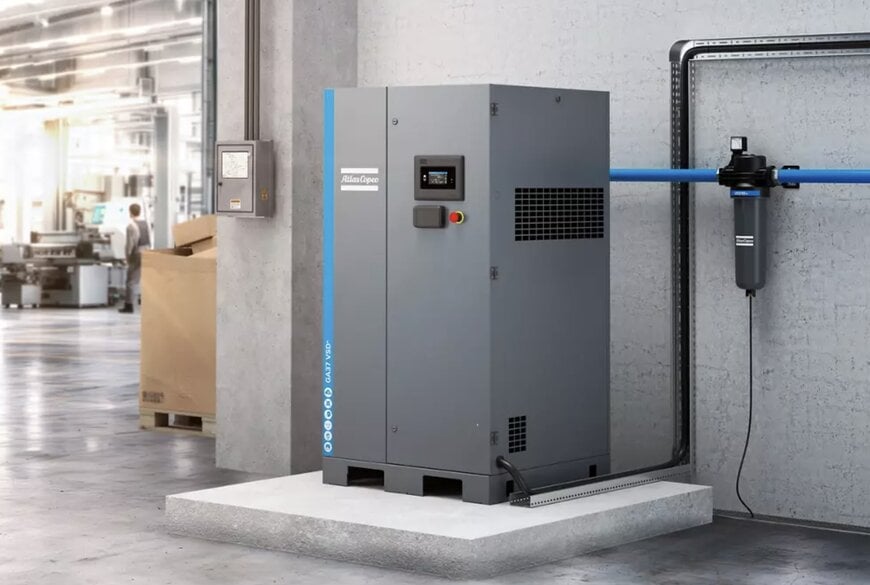
Industrial compressed air networks represent one of the most electricity-intensive utility operations in modern manufacturing facilities, frequently accounting for a major portion of a plant's total electrical baseline. Fixed-speed rotary screw compressors operate on traditional load and unload cycles, consuming substantial energy even during idling phases when production air demand drops. While variable speed drive technology adjusts motor speeds to dynamically match fluctuating pneumatic loads, industrial operators often face a difficult trade-off between the high capital expenditure required for premium, fully equipped platforms and the efficiency limitations of entry-level equipment. Addressing these operational demands requires tiered compressor architectures that balance capital investment with energy efficiency, robust thermal and moisture management, and reliable remote monitoring capabilities.
Tiered VSD Architecture for Varied Capital Budgets
To address diverse operational demands and budget constraints, Atlas Copco introduced three Variable Speed Drive (VSD) compressor ranges: the cost-effective G 22-45 VSD, alongside the premium GA 5-18 VSD+ and GA 22-37 VSD+ platforms. The rollout broadens equipment choices across power ratings spanning 5 kW through 45 kW, creating a clear operational distinction between entry-level capital control and premium lifecycle efficiency.
The G 22-45 VSD range addresses motor requirements from 22 kW to 45 kW, targeting facilities that seek variable speed efficiency gains without paying for non-essential advanced features. By automatically modulating air output to match real-time system demand, the series delivers average energy savings of up to 35 percent compared with traditional fixed-speed units. The machines combine an IE5-equivalent permanent magnet motor with an oil-cooled, service-free drivetrain engineered to withstand harsh operating conditions, such as high ambient temperatures and dusty environments. Mechanical packaging utilizes a vertical configuration to minimize the installation footprint, while the integrated Elektronikon Touch controller and IP65-rated SmartBox Pro hardware provide factory connectivity and remote monitoring through the SMARTLINK platform.
Drivetrain Engineering, Inverter Controls, and Moisture Prevention
For industrial facilities focused on maximizing lifecycle performance and reducing operating expenditures, the GA 5-18 VSD+ and GA 22-37 VSD+ series extend Atlas Copco's premium architecture across low and mid-range operating duties. The advanced drive system cuts energy consumption by up to 60 percent relative to fixed-speed units, while delivering an average increase of approximately 20 percent in Free Air Delivery.
The performance of the GA VSD+ platform centers on Atlas Copco’s proprietary NEOS NEXT inverter technology, designed to govern motor-compressor dynamics under variable duty cycles. Enhanced machine control and monitoring software continuously adjusts operation to maintain peak thermodynamic efficiency as manufacturing requirements fluctuate. To safeguard internal lubrication and process integrity, the platform integrates a Smart Temperature Control system that actively regulates oil temperatures during standard run states, while CPC+ technology extracts moisture under low-flow operating profiles to prevent internal condensation. For further thermal efficiency, an optional energy recovery module captures up to 80 percent of electrical input energy as reusable hot water for facility heating or industrial processes.
Acoustic Suppression and Low-GWP Refrigerant Integration
The mechanical structure of the GA VSD+ units incorporates acoustic damping baffles and enclosures that lower operational noise emissions to sound levels as low as 62 dB(A). This low noise profile gives plant managers the flexibility to position compressor units adjacent to active workstations without exceeding industrial noise thresholds or requiring dedicated outbuildings. Maintenance access is streamlined through a reduced internal component count and accessible service panels.
Connectivity is standardized via the SmartBox Pro and SMARTLINK ecosystems, which route equipment performance diagnostics across cellular networks, Ethernet, Wi-Fi, and plant-level industrial interfaces. In Full Feature configurations, the compressors integrate built-in refrigerant dryers utilizing R513A refrigerant, reducing the Global Warming Potential of the cooling circuit by approximately 70 percent compared to R410A refrigerants used in some competing systems.
Additional Context
This section details technical specifications and competitive benchmarking not included in the original product announcement.
Compressed air systems are benchmarked against ISO 1217 Annex C and Annex E standards for displacement compressors, which define measurement protocols for Free Air Delivery and specific energy requirements across variable-speed units. In standard oil-injected rotary screw designs, condensation represents a persistent failure mode when compressors run under low turndown conditions, as compressed air temperatures can fall below the pressure dewpoint, leading to water accumulation in the oil reservoir and resulting in bearing wear. Systems like the Smart Temperature Control architecture overcome this by pairing thermostatic bypass valves with variable-speed cooling fans to dynamically adjust lubricant operating temperatures above the condensation threshold without running the drive motor at excessive heat levels. Air treatment is evaluated against ISO 8573-1 air purity standards, where integrated refrigerant dryers and coalescing filtration trains deliver Class 1.4.2 quality air, maintaining pressure dewpoints down to 3 degrees Celsius.
Within the industrial compressed air market, the expanded Atlas Copco G and GA VSD platforms compete directly with variable-frequency rotary screw lines from Ingersoll Rand (Next Generation R-Series), Kaeser Compressors (Sigma Frequency Control series), and Sullair (S-energy VSD series). While competitors frequently utilize conventional induction motors paired with third-party off-the-shelf industrial inverters, Atlas Copco's reliance on integrated interior permanent magnet (iPM) motor technology places the motor directly on the compressor element shaft without intermediate couplings, gears, or belts, eliminating mechanical transmission losses. Furthermore, whereas legacy units rely on air-cooled motors that require separate cooling fans and oversized electrical enclosures, an oil-cooled motor configuration utilizes circulating compressor fluid to cool the stator windings, allowing the entire drivetrain to achieve ingress protection ratings up to IP66 or IP68 in a vertical footprint that reduces factory floor-space requirements.
Edited by Romila DSilva, Induportals Editor, with AI assistance.
www.atlascopco.com
