
www.industryemea.com
23
'26
Written on Modified on
Low Noise Tactile Switches for Industrial Interfaces
Panasonic Industry introduces the EVP-BX series tactile switch to resolve acoustic disruption and accidental actuation in compact electronic control assemblies.
www.panasonic.com
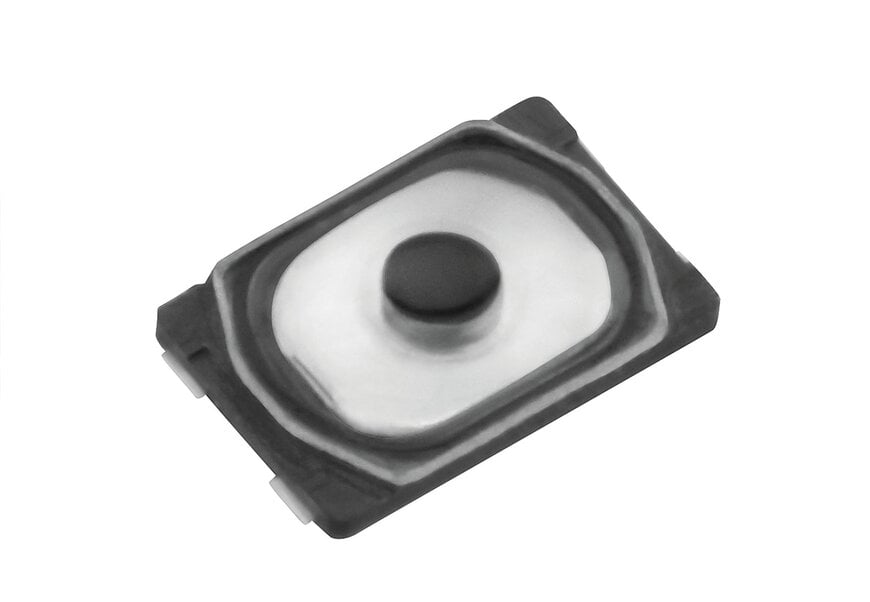
In modern human-machine interface design, mechanical tactile switches frequently generate sharp acoustic clicks that degrade user experience in noise-sensitive audio, consumer, and automotive cabin environments. At the same time, compact control assemblies often face risks of false triggering or premature mechanical fatigue when subjected to continuous operator interaction. Integrating switches that deliver clear physical feedback without high audible noise or accidental activation represents an ongoing electromechanical design challenge.
Tactile Feedback Architecture and Acoustic Damping Mechanism
The EVP-BX series expands the established portfolio of 6.0 mm x 6.0 mm surface-mount device top-push, 2-terminal components, alongside the existing EVP-BD, EVP-0B, and EVP-CD series. The switch utilizes an internal rubber dome construction engineered to dampen the acoustic output during switch depression, providing silent operation while maintaining a defined tactile response.
Operating dynamics are defined by a high click ratio of operating force relative to actuation travel distance. This force-displacement curve provides distinct tactile feedback to the operator while mitigating high-frequency acoustic emission. To prevent unintended actuation in handheld or vehicle-mounted environments, the series provides actuation resistance options of 4 N and 6 N paired with a longer travel distance. Mechanical endurance is rated at 200,000 switching cycles, ensuring consistent contact stability and long operational life under repeated mechanical loading.
Application Across Automotive and Consumer Control Assemblies
According to Maria Dieplinger, Product Manager HMI Industry at Panasonic Industry, adding the EVP-BX series provides design engineers with a low-noise tactile switch option without compromising operational reliability or tactile feedback characteristics.
The balance of silent operation, high actuation force, and long operational life makes the series suited for human-machine interface assemblies across multiple sectors:
Automotive cockpit controls, steering wheel switches, and in-cabin interfaces where low interior noise levels must be maintained.
Audio equipment, high-fidelity consoles, and connected speakers requiring click-free manual adjustments during recording or listening.
Portable consumer hardware including smartphones, true wireless earbuds, augmented reality glasses, and hand scanners subjected to continuous manual use.
Industrial human interface panels, gaming controllers, and power switches on portable medical devices that require positive actuation to prevent accidental operation.
Additional Context
This section details technical specifications and competitive benchmarking not included in the original product announcement.
Tactile switches in the 6.0 mm x 6.0 mm footprint historically utilize metal contact domes to establish electrical connection, generating acoustic sound pressure levels between 50 dBA and 65 dBA upon snap-through. While metal domes deliver sharp force drops, the resulting acoustic transient is often unsuitable for near-ear audio devices or high-end vehicle cabins.
Standard commercial metal-dome tact switches commonly operate in lower force profiles, typically ranging from 1.6 N to 2.5 N, with operational lifespans between 50,000 and 100,000 cycles. By comparison, combining internal elastomeric damping with 4 N and 6 N actuation thresholds places the EVP-BX in an operating envelope geared toward industrial reliability and prevention of inadvertent triggering. This performance aligns with rigorous mechanical endurance standards such as IEC 60068-2 mechanical durability testing, providing a defined migration path for designers requiring quiet electromechanical switching without transitioning to complex capacitive touch sensors.
Edited by Evgeny Churilov, Induportals Media - Adapted by AI.
www.industry.panasonic.eu
