
www.industryemea.com
21
'26
Written on Modified on
Humanoid Robots Collaborate with CNC Machine Tools via Physical AI
Mitsubishi Electric Corporation develops an industry-first machining architecture using physical AI to enable humanoid robots to collaborate directly with CNC machine tools.
www.mitsubishielectric.com
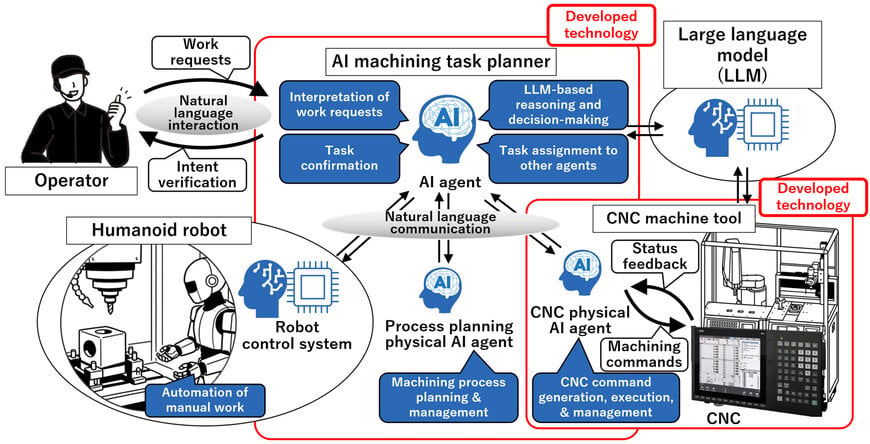
A severe labor shortage across the manufacturing sector has driven strong demand for automated machine-tending and setup workflows on factory floors. Replacing manual operator intervention—such as clamping irregular raw workpieces, sweeping chips from internal machine enclosures, handling post-process inspection, and executing localized troubleshooting—using conventional articulated or Cartesian industrial robots traditionally demands substantial capital investment. Facilities often require complete production line redesigns, customized part-feeding fixtures, dedicated safety gating, and bespoke communication protocols for every robot-to-machine interface. Addressing these implementation barriers requires general-purpose humanoid robots that operate within existing human-centric cell footprints, driven by natural language task planning and physical artificial intelligence that eliminates custom programming sequences.
Autonomous Task Planning and Machine-Robot Coordination
Mitsubishi Electric developed an integrated machining platform where general-purpose humanoid robots and computer numerical control (CNC) machine tools collaborate seamlessly through physical AI. The system enables bipedal or mobile humanoid manipulators to assume tasks traditionally executed by shop-floor machinists, including initial workpiece setup, internal tool-space cleaning, finished product removal and transport, visual inspection, and error troubleshooting.
The system architecture integrates three functional components:
1. An AI machining task planner that interprets plain operator instructions input in natural language, automatically constructs step-by-step machining routines, and schedules tasks between the CNC machine and the humanoid robot.
2. A CNC machine tool embedded with physical AI, which exchanges operational data in natural language and coordinates kinematic execution with the robot in real time.
3. A general-purpose humanoid robot capable of navigating human workspaces and manipulating standard tooling.
The task planner and the CNC machine's onboard intelligence are powered by physical AI models developed using Mitsubishi Electric's proprietary Maisart artificial intelligence technology suite.
Unmanned Operations Without Bespoke Retrofits
By interpreting high-level work directives in natural language, the physical AI pipeline automatically generates coordinated execution scripts for both the robot and the machine controller. This design removes the traditional requirement to write custom PLC handshakes, dedicate digital I/O lines, or program hard-coded robot motion paths for each work cell.
Humanoid robots can operate in front of standard machine enclosures without requiring expensive shop-floor layout modifications or purpose-built peripheral feeding systems. By replacing manual intervention with autonomous, multi-task robotic tending, the platform establishes a foundation for unmanned factory operations and lights-out machining shifts.
Additional Context
This section details technical specifications and competitive benchmarking not included in the original product announcement.
In industrial machining environments, machine tending automation is traditionally benchmarked against the ISO 10218 safety standard for industrial robots and the open MTConnect / OPC UA (specifically OPC 40501-1 for Machine Tools) data communication frameworks. Standard automated tending cells rely on stationary six-axis articulated arms or overhead Cartesian gantries equipped with pneumatic pneumatic-clamping grippers, which require rigid mechanical locating pins, hydraulic door-actuation kits, and deterministic fieldbus connections (such as CC-Link IE TSN or Profinet) to sync door-open and cycle-start commands. Transitioning to humanoid platforms using vision-language-action (VLA) foundation models allows robots to identify unmodeled fixture handles, locate chuck jaws via spatial red-green-blue-depth (RGB-D) point clouds, and manipulate dual-handed tasks (such as using an air blow gun while turning an indexer) using human-like compliance.
Within the emerging humanoid manufacturing automation space, Mitsubishi Electric's Maisart-driven physical AI platform competes conceptually with systems developed by Boston Dynamics (Atlas tending automotive lines), Figure AI (Figure 02 deployed with BMW), and Tesla (Optimus handling part delivery). While general-purpose humanoid developers focus predominantly on logistics bin-picking and sheet-metal transfer, integrating the physical AI stack directly into the CNC's internal numerical kernel (such as Mitsubishi's M800/M80 series controllers) establishes bi-directional telemetry. This direct link allows the machine to inform the robot of internal spindle loads, remaining tool wear life, or specific alarm codes, enabling the humanoid to swap worn cutting inserts or clear tangled chip nests autonomously without external supervisory host intervention.
Edited by Romila DSilva, Induportals Editor, with AI assistance.
www.mitsubishielectric.com
