
www.industryemea.com
19
'26
Written on Modified on
Omniflex highlights wireless telemetry for remote industrial assets
The Teleterm D3R connects hard-to-reach pumps and tanks to central control networks without costly conventional cabling.
www.omniflex.com
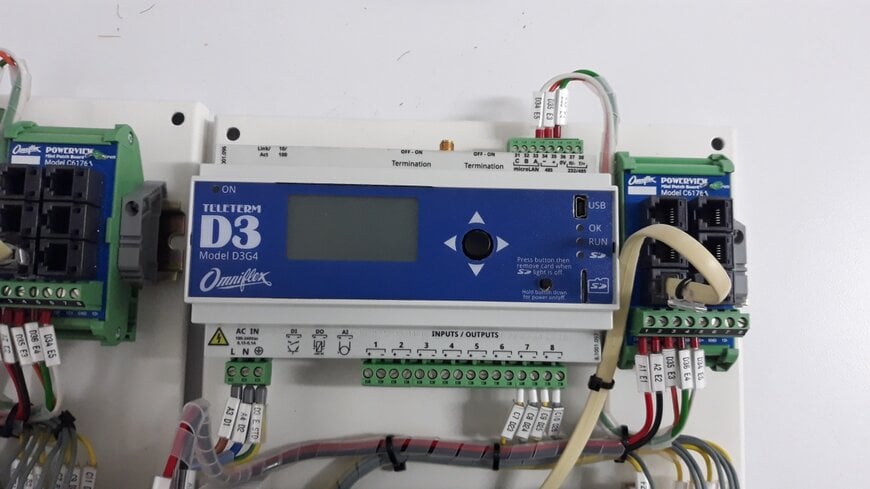
Industrial facilities in the mining, water, and utility sectors often rely on critical assets dispersed over hundreds of kilometers. Connecting these remote pumps, tanks, and reservoirs using conventional cabling is frequently impractical due to the high costs and logistical complexity of traversing difficult terrain. Ian Loudon, international sales and marketing manager at Omniflex, notes that without remote visibility, simple faults require time-consuming site visits before an assessment can even be made. To address this, wireless telemetry offers a practical method to bring isolated equipment directly into the wider operational control network, enabling immediate, automated responses to changing process conditions.
Event-based transmission and SCADA integration
Demonstrating this capability, a mining application in Zimbabwe utilized wireless telemetry to automatically control supply pumps based on high and low set points from a water storage tank located seven kilometers away. To facilitate such architectures, Omniflex offers the Teleterm D3R, a versatile outstation that interfaces with power meters via a serial connection and sensors through its microLAN port. Rather than continuously polling every device, the wireless network optimizes bandwidth by transmitting data only upon a change of state or at predefined intervals. Furthermore, Ethernet connectivity allows the D3R to link remote assets seamlessly into existing central SCADA infrastructure, while a built-in screen provides local operators with immediate parameter readouts, such as reservoir fill percentages.
Additional Context: Power constraints and Report by Exception
This section details technical specifications and competitive benchmarking not included in the original product announcement.
In remote industrial environments, establishing reliable data links typically relies on UHF/VHF radio telemetry, licensed microwave bands, or low-power cellular networks (such as LTE-M or NB-IoT) rather than standard Wi-Fi. Because these remote terminal units (RTUs) are frequently deployed in isolated areas lacking reliable grid power, they must operate with extreme energy efficiency, often relying entirely on small solar panels and localized battery banks. By transmitting data on an event-driven basis—a protocol method known as Report by Exception (RbE)—modern telemetry outstations drastically reduce radio transmission time and conserve power. This low-power, high-range architecture is essential for distributed SCADA systems managing critical municipal water pipelines, offshore platforms, or remote mining tailing dams, ensuring data integrity without draining remote power reserves.
Edited by an industrial journalist, Lekshman Ramdas, with AI assistance.
www.omniflex.com
