
www.industryemea.com
15
'26
Written on Modified on
Semiconductor Architectures for Physical Artificial Intelligence and Edge Automation
Infineon showcases embedded hardware solutions for computing, sensing, and power management in robotics, software-defined vehicles, and intelligent edge infrastructure.
www.infineon.com
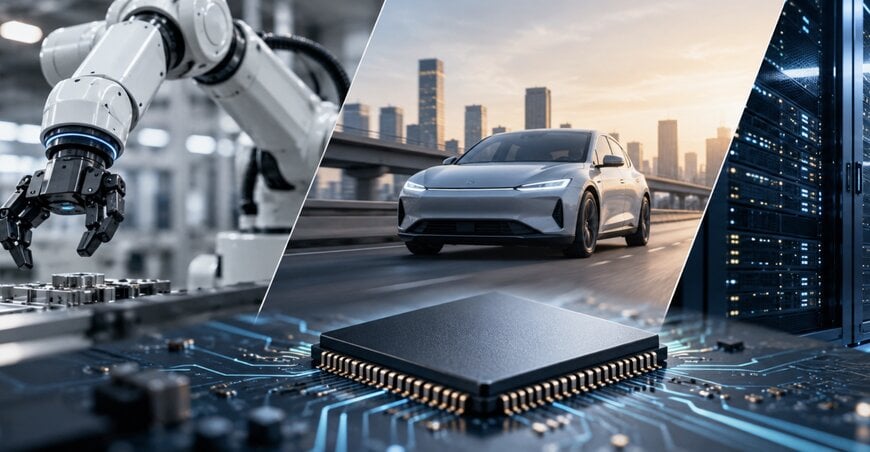
Infineon is presenting its latest system-level semiconductor solutions for physical artificial intelligence applications across the industrial robotics, automotive mobility, and data center infrastructure sectors. The demonstrated technologies focus on enabling hardware-level functional safety, secure edge computing, and high-efficiency power distribution for autonomous systems.
Hardware Architectures for Industrial Robotics and Edge Computing
The implementation of physical artificial intelligence requires integrated hardware to process data locally and translate sensor inputs into precise mechanical actions. At the electronica trade fair in Munich, Germany (10–13 November 2026), the company is exhibiting semiconductor blocks that manage sensing, computing, connectivity, and motor control for industrial applications. A primary focus is embedding functional safety and cybersecurity directly at the hardware level to protect connected devices against emerging threats in the quantum computing era. System-level demonstrations include out-of-the-box actuator control systems engineered to replicate the dexterity of a human hand. According to Andreas Urschitz, Chief Marketing Officer, transitioning artificial intelligence from cloud environments to physical devices requires dedicated semiconductor infrastructure to efficiently deploy localized intelligence and execute reliable mechanical operations.
RISC-V Microcontrollers and the Automotive Data Ecosystem
As the automotive industry transitions to software-defined electric vehicles, artificial intelligence is increasingly utilized to interpret driver assistance sensor data and dynamically adapt motion control based on road conditions. To support this centralized computing architecture, a new automotive microcontroller platform is being introduced based on the open-standard RISC-V instruction set architecture. This architecture is designed to scale processing capabilities across different vehicle domains while supporting the continuous integration of over-the-air software updates. The hardware ecosystem also integrates AI-enhanced battery management systems, consolidated x-in-1 powertrain solutions, and next-generation automotive Ethernet to facilitate secure, high-speed communication across the automotive data ecosystem.
Power Distribution Networks for Digital Infrastructure
The deployment of artificial intelligence models requires a massive expansion of data center computing capacity, leading to proportional increases in electrical grid demands. The showcased semiconductor solutions focus on optimizing energy delivery through the entire power chain, from initial grid generation to the processor cores inside server racks. By utilizing next-generation solid-state power distribution technologies and grid-forming battery storage systems, the hardware reduces energy conversion losses and maintains electrical network stability when integrating renewable energy sources. This approach allows high-performance computing centers to maximize processing output while minimizing absolute power consumption and thermal dissipation.
Additional Context
This section details technical specifications and competitive benchmarking not included in the original news release.
Within the automotive microcontroller market, the integration of the RISC-V instruction set architecture represents a strategic alternative to proprietary architectures, such as the ARM Cortex cores utilized in competing platforms like the NXP S32 or the STMicroelectronics Stellar families. While ARM-based processors currently maintain a dominant market share in automotive compute applications, the open-source nature of RISC-V allows semiconductor developers to customize processor cores specifically for machine learning workloads without architectural licensing restrictions.
In the high-power distribution and EV powertrain sectors, the transition to integrated x-in-1 modules frequently utilizes wide-bandgap semiconductor materials like silicon carbide (SiC) or gallium nitride (GaN) to compete against solutions from manufacturers such as Onsemi, Texas Instruments, and STMicroelectronics. Compared to traditional silicon insulated-gate bipolar transistors (IGBTs), these wide-bandgap components enable higher switching frequencies and superior thermal conductivity. This allows engineers to combine inverters, onboard chargers, and DC-DC converters into single, compact housings, objectively reducing total system weight and minimizing energy losses between the grid and the processor or vehicle motor.
Edited by Aishwarya Mambet, Induportals Editor, with AI assistance.
www.infineon.com
