
Teledyne FLIR's Industry-First UL 2684 Listing Strengthens the Case for Thermal Image Fire Detection in Europe
The milestone gives European fire engineers and risk professionals independent evidence when specifying thermal image fire detection, complementing established European and national approval requirements.
www.flir.com
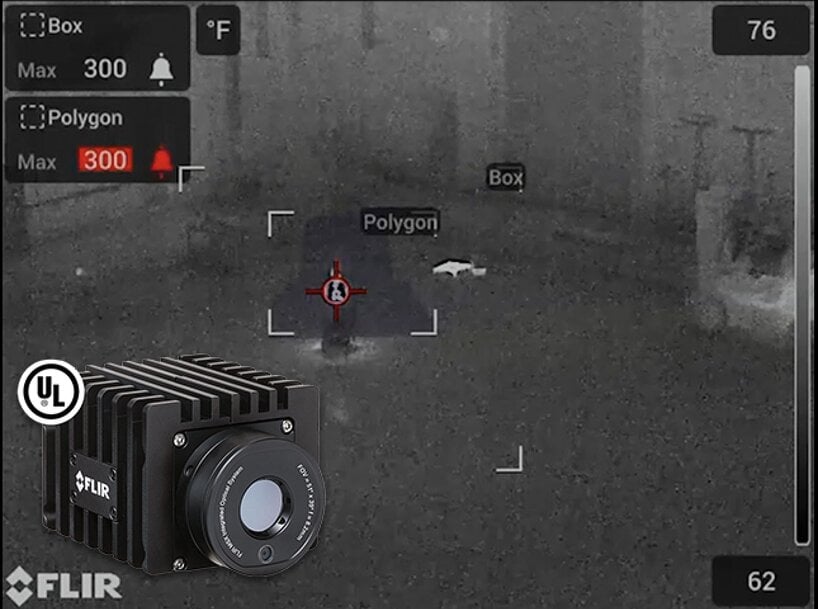
Teledyne FLIR's A40 and A70 (Axx-Series) thermal imaging cameras are the first models to achieve UL 2684 listing. They are listed as thermal image fire detectors under ANSI/CAN/UL 2684, the Standard for Video and Thermal Image Detectors for Fire Alarm Systems. Although UL 2684 is a North American standard, the Teledyne FLIR milestone has important implications for Europe.
European fire detection is supported by a mature standards and certification environment covering established technologies such as smoke, point heat, aspirating, and flame detection. Radiometric thermal image detection has no harmonised European product standard of its own, and is addressed through project-specific approval pathways and national certification schemes, including VdS in Germany and CNPP in France. These pathways support the assessment of systems that continuously measure temperature across a scene and identify abnormal heat before smoke or flame develops.
EN 54-10 covers flame detection, including the flame-response capability of certified thermal cameras. UL 2684 is written specifically for video and thermal image detectors, evaluating and testing them as fire detection devices.
In the United States, the 2025 edition of NFPA 72, the National Fire Alarm and Signaling Code, created a dedicated category for thermal image fire detection (Sec. 17.12), which requires thermal image fire detection systems to be listed for the purpose of fire detection.
UL 2684 is a North American product standard that provides an independent benchmark for the performance of video and thermal image fire detectors. In Europe, it can support the technical evidence presented through the applicable European approval pathway. European regulatory requirements, CE marking obligations, relevant EN 54 standards, national certification schemes such as VdS and CNPP continue to apply, and the approving authority determines project acceptance.
“Fire engineers work from evidence, and the strongest evidence is a published benchmark with an accredited laboratory behind it,” said Matthew Hasty, Global Vertical Director for Science, Automation, and Early Fire Detection at Teledyne FLIR. “That is what the listing adds for Europe. It gives the people building the technical case something independent to build on.”
What the listing changes is the strength of the evidence behind the specification. A consultant, a risk engineer, or a fire protection professional can now put forward a detector whose fire performance has been tested against a published benchmark by an accredited laboratory and show the reviewer where that benchmark came from. That benchmark is concrete: flaming wood, flammable liquid, and polyurethane fires with defined response criteria, plus the environmental, electrical, and durability programme around them. In a submission that has to be argued rather than ticked off against a standard, that is a considerably stronger position than manufacturer test data.
The listing tests fire performance. The everyday value sits in the instrumentation. A radiometric thermal camera is a calibrated measuring instrument, not a camera that renders heat in colour. Every pixel in the scene reports a temperature, many times a second. Teledyne FLIR Early Fire Detection solutions monitor defined regions of interest and report minimum, average, and maximum values for each, with alarms set on absolute thresholds, on the difference between regions, and on rate of rise. The system responds to how heat is behaving rather than only to how hot something is, and it leaves a record: a measured value, a location in the scene, a history behind it. That record is what an approving authority or an underwriter can actually review.
Demand is coming from operators. Waste and recycling sites deal with deep-seated fires in stored material. Manufacturers run bearings, motors, and hydraulic lines that heat up well before they ignite. Battery energy storage installations face thermal runaway. Data centres concentrate electrical load, and a failing connection runs hot long before it smokes. Rooftop solar arrays develop hotspots at connectors and modules, often on roofs with no conventional detector at all. In each case, thermal imaging provides continuous temperature-based monitoring that can identify developing heat conditions before smoke, flame, or conventional heat thresholds are reached.
Thermal imaging is line-of-sight, so a camera protects what is in its field of view. In practice that means specific high-value assets: a switchboard, a battery enclosure, a conveyor run. It works alongside conventional detection rather than in place of it. The cameras are also multispectral: detection is thermal, while an integrated visible camera supplies the picture, so an alarm arrives with video of what caused it. An operator can see what they are dealing with before stopping a line, and a stoppage that turns out to have been unnecessary is money the site never gets back.
For projects being designed in Europe today, the UL 2684 listing provides independent evidence that can strengthen the specification and approval case. It works alongside the applicable European, national, and project-specific approval pathway.
For more information about Axx-Series thermal imaging cameras and Teledyne FLIR's early fire detection solutions, visit flir.com/fire-life-safety.
