
www.industryemea.com
18
'26
Written on Modified on
Low-GWP Transport Refrigeration System Integrates Two-Stage Safety Architecture
Carrier Transicold deploys engineered leak containment and mitigation protocols to facilitate the safe adoption of mildly flammable low-warming refrigerants across commercial transport fleets.
www.carrier.com
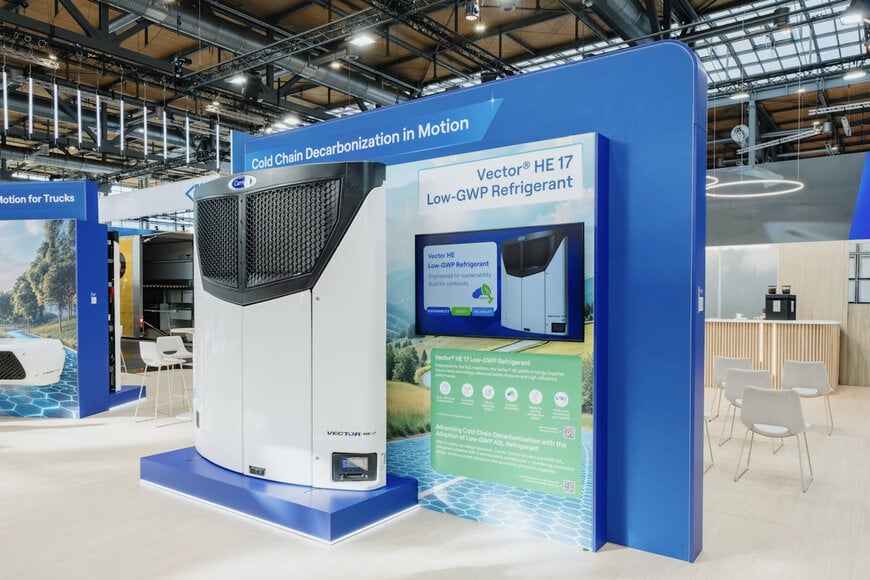
Carrier Transicold, a unit of Carrier Global Corporation, has expanded its patented two-stage safety-by-design architecture to the Vector HE 17 transport refrigeration unit to support lower-global-warming-potential A2L refrigerants. The initiative delivers engineered leak isolation, active airflow dilution, and physical containment protocols for temperature-controlled road transport and commercial cold chain logistics.
Mitigating Flammability in Low-Emission Transport Refrigeration
The European cold chain logistics sector operates under strict environmental mandates aimed at phasing down high-GWP fluorinated greenhouse gases. While hydrofluoroolefin (HFO) blends classified under the ISO 817 and ASHRAE Standard 34 as A2L refrigerants significantly mitigate global warming potential, their mild flammability requires specialized mechanical and electrical safety systems.
To address these parameters, the Vector HE 17 operates on R454A, an A2L refrigerant blend composed of R32 and R1234yf. R454A provides a GWP of 239, which represents an 89 percent reduction compared to the transport refrigeration standard R452A, which carries a GWP of 2,140. Transitioning to this chemistry allows transport operators to maintain strict temperature compliance while reducing direct carbon emissions during equipment operation and servicing.
Mechanisms of the Two-Stage Safety Architecture
The safety-by-design approach combines hermetic component sealing, automated sensor arrays, and multi-step active intervention to contain refrigerant within the sealed loop. At the initial stage of detection, sensor circuits identify vapor release within the system enclosure, triggering an automated visual and audible alert alongside forced-air circulation to disperse localized vapor and prevent accumulation beneath the lower flammability limit (LFL).
If the sensor threshold continues to indicate an active breach, the secondary mitigation sequence initiates. The system automatically isolates the charge using solenoid shut-off valves and redirects the remaining refrigerant volume into a sealed external receiver, venting or drawing the compound away from the enclosed cargo hold. This mechanical process prevents volatile gas migration into temperature-sensitive food and pharmaceutical compartments, protecting cargo integrity and operational personnel.
Fleet Implementation and Exhibition Presentation
The implementation of R454A in the Vector HE 17 follows its deployment on the larger multi-temperature Vector HE 19 platform. In conjunction with this rollout, Carrier Transicold published a technical white paper outlining safety benchmarks, component certifications, and operational workflows for servicing flammable transport units.
The technology and hardware were presented at the IAA Transportation trade fair, held at Hannover Messe in Hannover, Germany, from September 15 to 20, where the unit was exhibited in Hall 27, Stand E35, and outdoor display area J43. According to Victor Calvo, Vice President and General Manager of Carrier Transicold International Truck Trailer, the integration of lower-GWP refrigerants directly addresses fleet environmental impact requirements through engineered safeguards that sustain thermodynamic capacity and operational compliance.
Additional Context:
This section details technical specifications and competitive benchmarking not included in the original product announcement
The single-temperature Vector HE 17 utilizes Carrier Transicold's proprietary all-electric E-Drive system, which eliminates mechanical belt-driven transmissions by employing a dedicated engine-generator set to power a hermetic variable-speed scroll compressor. The unit delivers a net refrigeration capacity of 16,120 watts at 0 degrees Celsius road conditions and 8,100 watts at minus 20 degrees Celsius, with an electric standby capacity of 15,140 watts at 0 degrees Celsius. Operating airflow reaches 5,550 cubic meters per hour, and total unit mass is constrained to 720 kilograms.
Within the commercial trailer refrigeration market, the primary benchmark competitor is the Thermo King Advancer series (including models A-400 and A-500). Thermo King units utilize a 48-volt architecture combined with variable airflow and electronic engine speed regulation, historically relying on baseline R452A (A1 safety class, GWP 2,140) with lower-GWP alternatives such as R454C (GWP 148) available in select configurations. While competing units emphasize electronic engine throttling and fast pulldown, Carrier Transicold's design centers on full hermetic circuit isolation and an automated mechanical evacuation sequence, specifically designed to address European F-Gas regulatory caps without compromising thermodynamic cooling performance.
Edited by Natania Lyngdoh, Induportals editor, assisted by AI.
www.carrier.com
