
www.industryemea.com
17
'26
Written on Modified on
Siemens and P&G Scale AI Quality Inspection Globally
The edge computing solution inspects high-variation consumer goods in real time, reducing manufacturing scrap by up to 20 percent.
www.sw.siemens.com
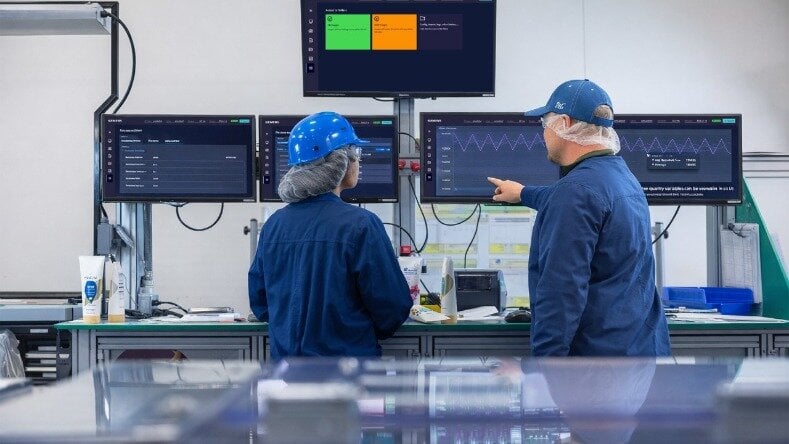
At a P&G production facility, operators use the AI-based Visual Inspection Cockpit on Siemens Industrial Edge to monitor quality in real time across high-variation consumer goods lines.
Siemens and Procter & Gamble (P&G) are globally expanding their AI-based quality inspection solution across P&G’s manufacturing facilities. The Visual Inspection Cockpit (VIC) system inspects consumer goods in real time at full line speeds, improving quality consistency and reducing scrap rates by 10 to 20 percent depending on the product. Developed jointly, the solution integrates P&G’s deep learning models with Siemens’ Industrial Edge computing platform, utilizing industrial PCs powered by Nvidia GPUs to support scalable, long-term operations across production sites.
Traditional vision systems often struggle with the delicate, textured materials of consumer goods, which naturally stretch or wrinkle at high speeds, requiring extensive reconfiguration when packaging or environments change. By utilizing Industrial AI, VIC easily adapts to these variations without frequent reprogramming. The solution features a Visual Inspection Engineering Tool that allows plant engineers to configure, train, and update inspection models directly without requiring dedicated data science resources. Processing data locally on the factory floor, the system integrates directly with manufacturing operations to instantly trigger alerts or real-time PLC actions to reject single defective products. Because VIC functions as a standardized, reusable Industrial Edge application, new deployments can be commissioned five to ten times faster than conventional bespoke vision systems.
Additional Context
This section provides technological and market background not explicitly detailed in the original release.
In high-speed Fast-Moving Consumer Goods (FMCG) manufacturing, traditional rule-based machine vision systems rely on strict geometric parameters, contrast thresholds, and pixel-matching algorithms. These legacy systems are highly brittle; minor, perfectly acceptable physical variations—such as a slight wrinkle in flexible packaging, a shifting label, or a shadow on a non-rigid product—frequently trigger false rejects, halting the production line and requiring constant recalibration by specialized vision programmers. Deep learning-based computer vision overcomes this by recognizing patterns and anomalies contextually, mimicking human visual judgment but executing at speeds of thousands of items per minute. Furthermore, deploying these computationally intensive AI models directly at the machine level via Edge computing is critical for closed-loop control. Cloud-based AI processing introduces unacceptable latency for real-time sorting; by processing high-resolution camera feeds locally through Siemens' Industrial Edge, the system maintains the microsecond deterministic response times necessary to command a PLC to physically kick a single flawed item off a high-speed conveyor without disrupting overall throughput.
Edited by Lekshman Ramdas, Induportals editor – adapted by AI.
www.siemens.com
Siemens and Procter & Gamble (P&G) are globally expanding their AI-based quality inspection solution across P&G’s manufacturing facilities. The Visual Inspection Cockpit (VIC) system inspects consumer goods in real time at full line speeds, improving quality consistency and reducing scrap rates by 10 to 20 percent depending on the product. Developed jointly, the solution integrates P&G’s deep learning models with Siemens’ Industrial Edge computing platform, utilizing industrial PCs powered by Nvidia GPUs to support scalable, long-term operations across production sites.
Traditional vision systems often struggle with the delicate, textured materials of consumer goods, which naturally stretch or wrinkle at high speeds, requiring extensive reconfiguration when packaging or environments change. By utilizing Industrial AI, VIC easily adapts to these variations without frequent reprogramming. The solution features a Visual Inspection Engineering Tool that allows plant engineers to configure, train, and update inspection models directly without requiring dedicated data science resources. Processing data locally on the factory floor, the system integrates directly with manufacturing operations to instantly trigger alerts or real-time PLC actions to reject single defective products. Because VIC functions as a standardized, reusable Industrial Edge application, new deployments can be commissioned five to ten times faster than conventional bespoke vision systems.
Additional Context
This section provides technological and market background not explicitly detailed in the original release.
In high-speed Fast-Moving Consumer Goods (FMCG) manufacturing, traditional rule-based machine vision systems rely on strict geometric parameters, contrast thresholds, and pixel-matching algorithms. These legacy systems are highly brittle; minor, perfectly acceptable physical variations—such as a slight wrinkle in flexible packaging, a shifting label, or a shadow on a non-rigid product—frequently trigger false rejects, halting the production line and requiring constant recalibration by specialized vision programmers. Deep learning-based computer vision overcomes this by recognizing patterns and anomalies contextually, mimicking human visual judgment but executing at speeds of thousands of items per minute. Furthermore, deploying these computationally intensive AI models directly at the machine level via Edge computing is critical for closed-loop control. Cloud-based AI processing introduces unacceptable latency for real-time sorting; by processing high-resolution camera feeds locally through Siemens' Industrial Edge, the system maintains the microsecond deterministic response times necessary to command a PLC to physically kick a single flawed item off a high-speed conveyor without disrupting overall throughput.
Edited by Lekshman Ramdas, Induportals editor – adapted by AI.
www.siemens.com
