
www.industryemea.com
21
'26
Written on Modified on
Frameless Torque Motors Expand Compact Motion Options
Allient Inc. has expanded its frameless torque motor range with 25 mm and 38 mm sizes for compact robotics, precision instruments, optical systems, and other space-constrained motion applications.
allient.com
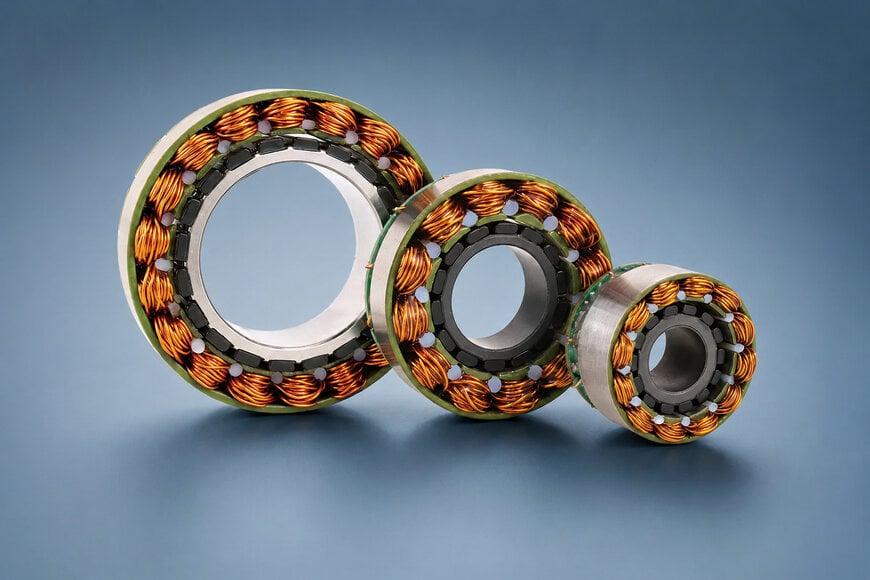
The new sizes extend the ElectroFlux Series into smaller form factors, targeting applications where motor diameter, integration space, and torque density are key design constraints. Frameless motors consist of separate stator and permanent-magnet rotor assemblies rather than a conventional housed motor, allowing the machine designer to integrate the motor directly into the mechanical structure.
For robotics, this architecture can allow the motor, bearings, shaft, and other mechanical elements to be designed as part of the same actuator assembly. The approach is relevant to robotic joints, precision instruments, optical instruments, and compact rotary motion systems where reducing the motor envelope can simplify mechanical packaging.
PCB stator termination and direct integration
According to Allient, the new 25 mm and 38 mm motors use PCB termination on the stator. This arrangement reduces the space required for conventional lead connections and can simplify electrical integration into a customer's product.
The frameless configuration also separates the motor's electromagnetic components from the mechanical housing. This gives designers greater flexibility to determine the surrounding bearings, shaft arrangement, housing, feedback system, and other components according to the requirements of the application.
Allient also states that the ElectroFlux Series uses expanded smart automation processes to achieve its torque-density objectives and supports customized configurations for application-specific requirements. The company has not disclosed torque, speed, winding, thermal, or electrical ratings for the newly introduced 25 mm and 38 mm sizes in the announcement.
Applications in robotics and precision instruments
The smaller frame sizes are intended for compact robotics and precision motion systems in which available installation space can limit motor selection. Potential system architectures include robotic joints, optical positioning mechanisms, precision instruments, and other rotary assemblies requiring direct motor integration.
The importance of diameter depends on the complete actuator design rather than motor size alone. Torque output, continuous thermal capability, peak operating conditions, winding configuration, rotor inertia, speed, feedback requirements, and available cooling all affect the suitability of a frameless motor for a particular application.
Robert Mastromattei, Chief Commercial Officer and Group President at Allient, said the 25 mm and 38 mm additions provide further options for integrating motors into space-constrained designs while addressing requirements related to size, performance, and flexibility.
Frameless motor technology in compact robotics
Frameless torque motors are used across robotics because the absence of a conventional motor housing, shaft, and bearings allows these components to be integrated into the robot's own mechanical structure. This can reduce the number of separate transmission components and provide greater freedom in actuator packaging.
Comparable products demonstrate the range of available approaches. Kollmorgen's TBM2G frameless motor family, for example, includes frame sizes from 50 mm to 115 mm and is designed for applications including collaborative robots, with configurations optimized for 48 VDC operation and below.
Other manufacturers also offer smaller frameless motors. DINGS Motion lists 25 mm and 38 mm frameless brushless motor sizes, with published peak torque ratings of 0.105 Nm and 0.76 Nm respectively. These specifications illustrate why motor diameter alone cannot establish performance equivalence: torque must be evaluated together with stack length, winding, thermal conditions, speed, current, and duty cycle.
Additional Context:
This section details technical specifications and competitive benchmarking not included in the original product announcement.
The introduction of 25 mm and 38 mm frameless motor sizes places Allient's new offerings within an established compact-motor segment. DINGS Motion, for example, publishes 25 mm and 38 mm frameless motor variants with peak torque ratings of 0.105 Nm and 0.76 Nm. Kinco Robotics also publishes frameless torque motor configurations with 25 mm and 38 mm stator diameters, including models with peak torque ratings of 0.222 Nm and 1.05 Nm respectively.
These figures should not be treated as direct performance comparisons with the new ElectroFlux sizes because Allient has not published equivalent torque, speed, stack-length, current, thermal, or duty-cycle specifications in the announcement. A meaningful comparison requires consistent test conditions and equivalent definitions of continuous and peak torque.
For compact robotics, accepted selection criteria therefore include outer diameter, axial length, continuous and peak torque, operating speed, winding temperature, voltage, current, rotor inertia, thermal resistance, feedback compatibility, and mechanical integration requirements. Published examples from other manufacturers show that frameless motors can vary substantially in these parameters even when their nominal diameters are similar.
The 25 mm and 38 mm ElectroFlux additions therefore expand Allient's stated size range for compact motion applications, while detailed performance benchmarking will require the company's technical specifications for each configuration.
Edited by Sucithra Mani, Induportals editor – adapted by AI.
www.allient.com
