
www.industryemea.com
14
'26
Written on Modified on
Continuous Inkjet System for High-Contrast Industrial Coding
Videojet Technologies has engineered an automated fluid-handling continuous inkjet printer to simplify pigmented ink delivery across packaging and industrial manufacturing lines.
www.videojet.com
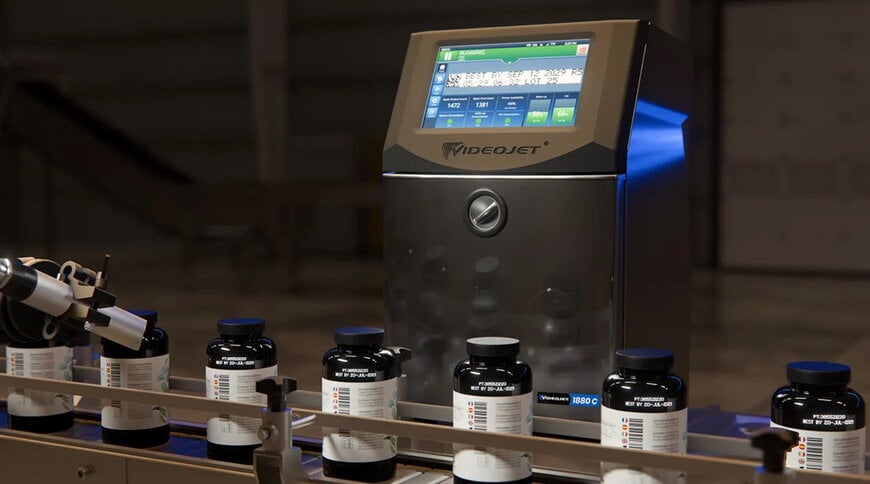
The continuous inkjet coding platform addresses the operational complexities of applying high-contrast markings on dark and non-porous substrates across beverage packaging, personal care goods, and industrial component manufacturing. By re-engineering fluid circulation, the system reduces maintenance routines to levels comparable to standard dye-based printers while supporting both soft-pigmented and hard-pigmented chemical formulations.
Fluid Circulation and Sedimentation Control
Pigmented inks utilize solid particles suspended in a carrier fluid to achieve visual contrast on dark, colored, or chemically treated materials. In traditional continuous inkjet equipment, these suspended solids tend to settle during low-flow periods, causing blockages across the nozzle, hydraulic lines, and fluid manifold.
The engineered fluid delivery system maintains steady particle dispersion and reliable flow rates throughout the hydraulic path. By counteracting particle sedimentation, the printhead assembly prevents solid accumulation, allowing facilities handling flexible packaging, beverage containers, and extruded parts to operate without frequent manual printhead flushes.
Maintenance Intervals and Extended Shutdown Management
Fluid circuit longevity depends on component wear life and filter efficiency. The system integrates a core assembly designed without annual replacement requirements alongside a main fluid filter rated for operational intervals of up to 8,000 hours. These extended duty cycles reduce scheduled maintenance interventions on high-speed production lines.
To support facilities with intermittent production schedules, seasonal manufacturing cycles, or planned changeovers, the system includes an automated fluid management routine. The printer sustains line recovery after shutdowns lasting up to four weeks without requiring manual hydraulic flushing or manual solvent intervention prior to startup.
User Interface and Digital Connectivity
Standardized user interfaces across production lines decrease operator setup errors and limit training requirements. The system incorporates a touchscreen terminal matching established interface layouts, alongside integrated Wi-Fi connectivity to support operational monitoring, telemetry acquisition, and remote diagnostic access.
Additional Context
This section details technical specifications and competitive benchmarking not included in the original product announcement.
Continuous inkjet systems utilizing pigmented inks represent a distinct engineering category compared to dye-based equivalents. In dye systems, colorants dissolve fully at the molecular level, whereas pigmented systems suspend solid mineral or synthetic particulates (such as titanium dioxide or carbon black) measuring between 0.1 and 2 microns. This suspension requires continuous mechanical agitation or specialized fluid recirculation to avoid hydraulic clogging.
Within the industrial coding sector, comparable pigmented continuous inkjet systems include the Domino Ax-Series (Ax350i/Ax550i) utilizing active ink management systems, and the Markem-Imaje 9450 S/E series featuring active hydraulic recirculation. Standard dye-based continuous inkjet printers often achieve main service intervals of 8,000 to 14,000 hours, whereas traditional pigmented printers historically required filter and fluid replacements at 3,000 to 5,000 operating hours due to particle abrasion and filter saturation. Maintaining an 8,000-hour filter interval and a four-week automated recovery window aligns operational parameters with high-uptime standards in automated bottling, wire and cable extrusion, and consumer packaged goods lines.
Edited by Evgeny Churilov, Induportals Media - Adapted by AI.
www.videojet.co.uk
