
www.industryemea.com
09
'26
Written on Modified on
Hydrogen Truck for Waste Collection
Hyundai Hydrogen Mobility expands its range of hydrogen-powered commercial vehicles with a new hooklift version designed for intensive waste collection and heavy transport applications.
www.hyundaimotorgroup.com
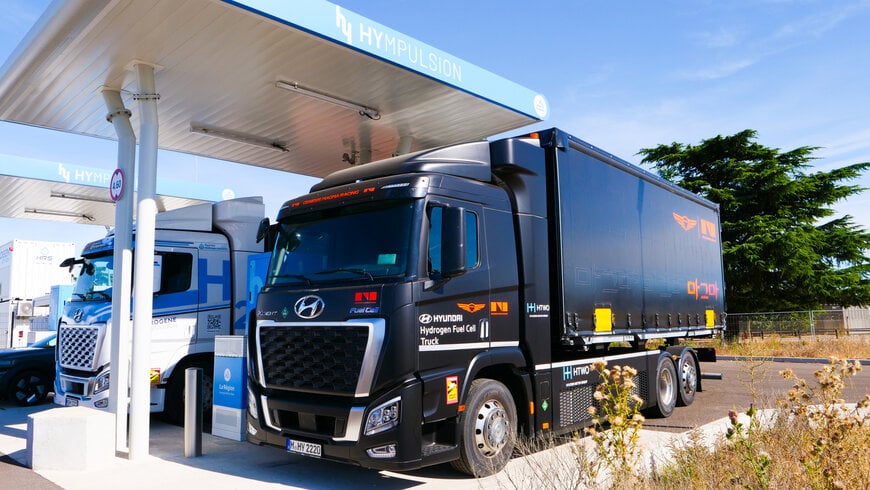
Hyundai Hydrogen Mobility unveiled a new configuration of the XCIENT FCEV truck at the Hympulsion hydrogen refueling station in Lyon Saint-Exupéry. The vehicle has been developed for waste collection and heavy-duty transport operations, targeting operators seeking a hydrogen-powered solution for demanding applications.
New Configuration for Municipal Applications
The Hyundai XCIENT FCEV is a series-produced fuel cell truck with a gross vehicle weight exceeding 16 tonnes. More than 160 vehicles are already operating across Europe, having collectively covered over 21 million kilometres while avoiding approximately 15,000 tonnes of CO2 emissions, according to the company.
The new hooklift version is now available on the French market and is equipped with a Meiller Tectrum hooklift system that enables the loading and unloading of containers up to seven metres long, as well as tipping skip containers. This configuration has been developed specifically for municipal and commercial waste collection operations in urban, suburban, and rural environments.
Technical Specifications
The vehicle has a gross vehicle weight of 27 tonnes and measures 9,605 mm in length, 2,540 mm in width, and 3,900 mm in height. Its electric powertrain combines a 370 kW electric motor with a 180 kW fuel cell system.
This configuration delivers a maximum speed of 85 km/h and a driving range of up to 400 km. The Meiller Tectrum hooklift system provides a lifting capacity of up to 21 tonnes for containers compliant with DIN 30 722. Hydrogen refueling takes less than 20 minutes, helping maximise vehicle availability during daily operations.
Validation Under Real Operating Conditions
Since May 2026, the XCIENT FCEV has been evaluated by several French companies, including PUM and Serfim Environnement. Initial results indicate a driving range suitable for daily operations, payload capacity comparable to an equivalent diesel truck, reduced operating noise, and driving characteristics well suited to repetitive collection and handling tasks.
According to Hyundai Hydrogen Mobility, these field trials demonstrate the potential of fuel cell trucks for applications requiring high operational availability while reducing local emissions and noise pollution.
Expansion of Hydrogen Infrastructure
The event in Lyon also showcased the hydrogen refueling infrastructure developed by Hympulsion. Hyundai believes that broader adoption of hydrogen-powered heavy-duty vehicles will depend on continued expansion of hydrogen distribution networks and plans to extend its portfolio with a 4x2 tractor unit for the European market.
Additional Context:This section details technical specifications and competitive benchmarking not included in the original product announcement.
The Hyundai XCIENT FCEV is one of the few series-produced hydrogen-powered heavy-duty trucks currently available in the European market. Key benchmarking criteria in this segment include fuel cell output, driving range, hydrogen storage capacity, refueling time, and payload capability. Manufacturers including Daimler Truck and Volvo Group, through their Cellcentric joint venture, are also developing hydrogen fuel cell trucks, although several of these models remain in demonstration or pre-production stages. With more than 20 million kilometres accumulated in European commercial operations, the XCIENT FCEV has established a substantial operational track record within the hydrogen heavy-duty vehicle segment.
Edited by Sucithra Mani, Induportals Editor – adapted by AI.
www.hyundaihm.com
