
www.industryemea.com
08
'26
Written on Modified on
Cloud-Native AI Architecture for Industrial Asset Data Integration
PTC develops a centralized platform that consolidates lifecycle telemetry and operational intelligence to optimize field maintenance across manufacturing and utility networks.
www.ptc.com

PTC launched PTC Orbit, an AI-driven intelligent asset management system designed to reconcile fragmented product data across enterprise software architectures. The platform targets industrial manufacturing and utility sectors by providing a unified digital asset ecosystem that connects engineering design with post-deployment field service operations.
Cross-Platform Data Consolidation Mechanisms
Industrial operators typically experience data fragmentation once physical products leave the manufacturing facility, with operational telemetry isolated across disparate silos. The newly deployed system extracts and contextualizes data streams from Product Lifecycle Management (PLM), Enterprise Resource Planning (ERP), Customer Relationship Management (CRM), Internet of Things (IoT), Enterprise Asset Management (EAM), and Field Service Management (FSM) systems. By aggregating these inputs into a single repository, the platform establishes an accurate, "as maintained" historical record for deployed assets. This data integration supports continuous feedback loops between field operations and engineering teams, resolving visibility gaps in the supply chain.
Algorithmic Anomaly Detection and Fleet Analysis
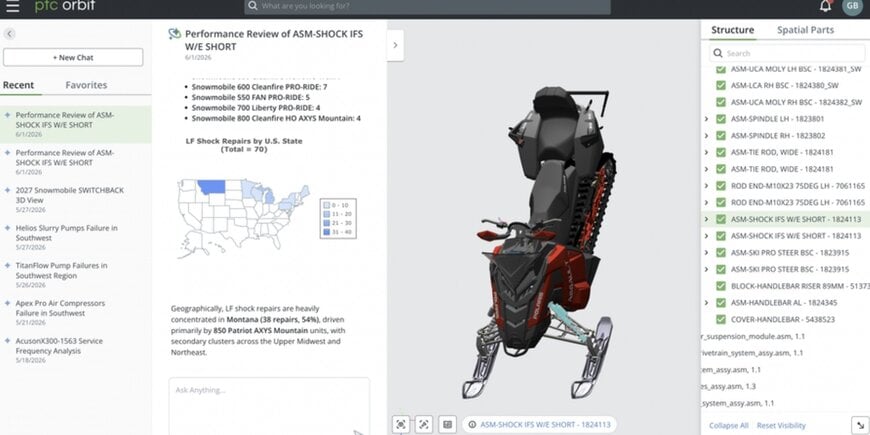
The system architecture integrates artificial intelligence to process the aggregated industrial IoT infrastructure data. The algorithms analyze the behavior of entire asset fleets to detect recurring failure patterns, assess equipment health, and anticipate maintenance requirements based on product category, operational region, or customer usage models. Instead of relying on static dashboards, the user interface dynamically adjusts to the operational context, presenting relevant engineering or quality signals that were previously difficult to isolate within large datasets. Joseph June, General Manager of SLM & AI Strategy at PTC, noted that utilizing AI as the central repository for asset knowledge shifts data management from a reactive process to a proactive operational mechanism across the product lifecycle.
Utility Sector Deployment and Network Reliability
The platform facilitates structural improvements in field operations and capital allocation by addressing blind spots in distributed networks. Southern Water implemented the system to monitor its wastewater infrastructure and mitigate operational risks. According to Andrew Oliver, Head of Operational Technology Platforms at Southern Water, the organization previously operated with over 25 percent of its monitoring devices continually offline. Integrating the new platform provided a consolidated baseline of network conditions, enabling the utility operator to prioritize critical risk areas, optimize field service interventions, and direct infrastructure investments efficiently. The technology was officially presented at the PTC NEXT trade show in Chicago, which occurred on June 9 and 10.
Additional Context
This section details technical specifications and competitive benchmarking not included in the original product announcement.
In the enterprise asset management sector, solutions are typically benchmarked based on data ingestion capabilities, integration architectures, and predictive analytics accuracy. Platforms such as SAP Asset Intelligence Network and IBM Maximo offer comparable digital twin and lifecycle tracking functionalities. IBM Maximo utilizes heavily structured EAM frameworks combined with AI for predictive maintenance, while SAP focuses on deep integration within its proprietary ERP ecosystem. The primary differentiator for systems like PTC Orbit is the native integration with PLM software, which establishes a direct data pathway between original engineering specifications and live IoT telemetry. This closed-loop configuration reduces the latency of engineering change orders and provides a higher fidelity "as maintained" bill of materials compared to standalone EAM platforms that require third-party middleware to synchronize with engineering databases.
Edited by Aishwarya Mambet, Induportals Editor, with AI assistance.
www.ptc.com
