
www.industryemea.com
02
'26
Written on Modified on
Compact Machine Vision with RF Mount Integration
Baumer combines software-controlled optics and high-resolution imaging to simplify automated inspection across multiple industries.
www.baumer.com
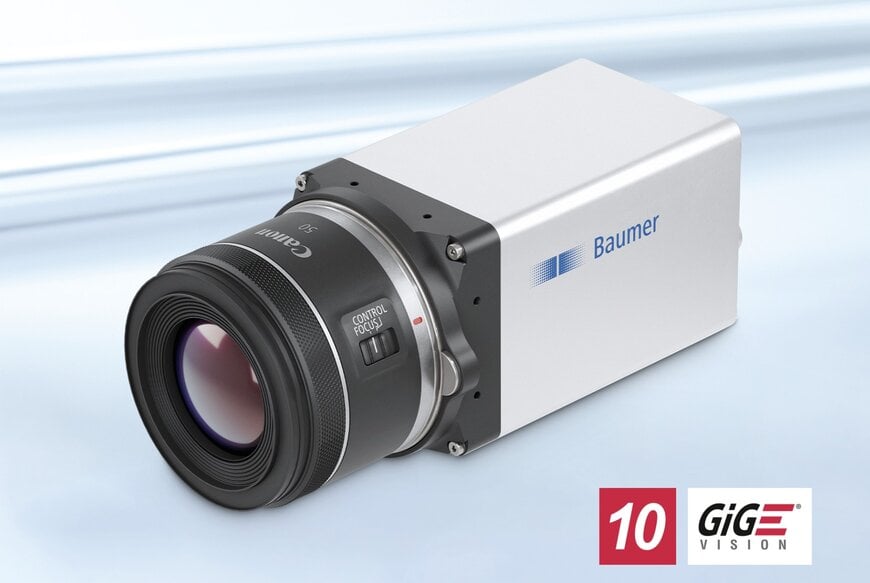
Baumer is releasing the LX series of high-performance cameras equipped with RF mounts to facilitate compact, high-resolution machine vision systems. This hardware integrates software-controlled focus and aperture adjustments directly into the camera body, targeting automated inspection and data aggregation applications within the pharmaceutical, automotive, and sports analytics sectors.
Mechanical Architecture and Optical Integration
By transitioning from traditional industrial mounts to the RF mount architecture established by Canon, the LX series achieves a 20 percent reduction in overall camera depth compared to previous EF mount models. Through specialized licensing, the RF mount is fully integrated both mechanically and electrically. This internal integration powers the lens and facilitates fast focus-by-wire mechanisms directly through the camera connections, eliminating the requirement for external control interfaces, secondary cables, and separate power supplies typically needed for active lens management.
Sensor Capabilities and Data Interface Standards
The LX series features sensor configurations reaching up to 65 megapixels, operating at capture rates of up to 18 frames per second (fps). The camera platform is available in monochrome and color variants, supporting sensor sizes up to full-format to accommodate varying optical demands.
To standardize software communication, the camera's aperture and focus controls comply with the Open Optics Camera Interface (OOCI) standard. OOCI acts as an extension of the existing GenICam standard, adding specific command sets for generic lens control. This allows systems engineers to manage dynamic lens adjustments seamlessly through standard GenICam software environments, enabling direct utilization of standard Canon RF lenses for machine vision deployments.
Industrial Application Workflows
The integration of software-driven focus and high-resolution imaging supports distinct operational workflows across several industries:
- Pharmaceutical Packaging: The high pixel density allows automated systems to perform packaging aggregation, reliably capturing data matrix codes and best-before dates on multiple blister packs or folding boxes within a single wide field-of-view image. The software-based optical adjustments aid in continuous, compliant documentation.
- Automotive Manufacturing: When inspecting manufactured components of varying heights, the automated focus-by-wire system allows the camera to adapt its focal plane via software commands. This eliminates the need for mechanical z-axis actuation of the camera mount, reducing physical wear and inspection downtime.
- Sports Analytics: High-resolution sensors combined with dynamic focus capabilities allow systems to accurately track motion and reaction times across variable distances in highly dynamic environments, generating reliable data for performance analysis.
Additional Context
This section details technical specifications and competitive benchmarking not included in the original news release.
In the high-resolution industrial image processing sector, cameras utilizing 65-megapixel sensors (such as the Gpixel GMAX3265) typically rely on passive industrial mounts like the F-mount, M52, or M72 standard. When variable focus is required on these passive mounts, engineers must install external motorized lens controllers, which increase the system's physical footprint and electrical complexity.
The primary mechanical advantage of the RF mount in machine vision is its short flange focal distance of 20 mm, compared to the 44 mm flange distance of the older EF mount. This reduction allows for the 20 percent decrease in camera depth noted in the LX series. By embedding the control pins directly into this short-flange mount and utilizing the OOCI standard, the LX series competes with existing dynamic-focus machine vision setups by offering a tighter physical envelope and reducing the number of external failure points in vibrating industrial environments.
Edited by Aishwarya Mambet, Induportals Editor, with AI assistance.
www.baumer.com
This section details technical specifications and competitive benchmarking not included in the original news release.
In the high-resolution industrial image processing sector, cameras utilizing 65-megapixel sensors (such as the Gpixel GMAX3265) typically rely on passive industrial mounts like the F-mount, M52, or M72 standard. When variable focus is required on these passive mounts, engineers must install external motorized lens controllers, which increase the system's physical footprint and electrical complexity.
The primary mechanical advantage of the RF mount in machine vision is its short flange focal distance of 20 mm, compared to the 44 mm flange distance of the older EF mount. This reduction allows for the 20 percent decrease in camera depth noted in the LX series. By embedding the control pins directly into this short-flange mount and utilizing the OOCI standard, the LX series competes with existing dynamic-focus machine vision setups by offering a tighter physical envelope and reducing the number of external failure points in vibrating industrial environments.
Edited by Aishwarya Mambet, Induportals Editor, with AI assistance.
www.baumer.com
