
www.industryemea.com
29
'26
Written on Modified on
Fiber Optic Amplifiers with IO-Link Connectivity
ifm launches the OCF series of fiber optic amplifiers designed for restricted industrial environments.
www.ifm.com
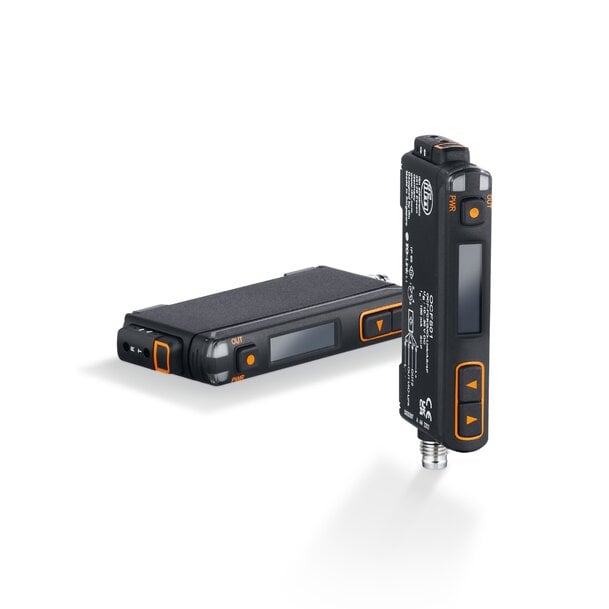
The company ifm has introduced the OCF series, a new generation of fiber optic amplifiers designed for industrial automation applications. This component physically separates the optical detection point from the electronic processing unit, allowing sensors to be positioned in tight spaces while facilitating the integration of diagnostic data via the IO-Link protocol.
Hardware Architecture and Integration
The OCF amplifier module features an IP65 protection rating without requiring an external protective cover, enabling direct mounting on the machine or within an electrical cabinet via a DIN rail clip fastening system. The system integrates the mechanical Fiberlock mechanism for a secure connection of fiber optics without specific tools. The user interface relies on an OLED display that facilitates a two-point teach-in and allows the sensor to be configured in six distinct operating modes. The device is compatible with a range of fiber optics adapted to severe mechanical and thermal constraints, such as drag chains, high-temperature environments, or exposure to aggressive chemical agents.
IO-Link Connectivity and Diagnostics
Signal transmission is carried out either via a fast switching output or via a bidirectional IO-Link communication interface. This latter architecture enables continuous monitoring of the amplifier's hardware status and the fiber's signal quality. The system features onboard diagnostic algorithms, including the "cleanme" function, which alerts the programmable logic controller (PLC) in the event of progressive lens fouling, allowing for maintenance intervention before the actual loss of detection. A "findme" assistance function also makes the optical fiber flash to quickly identify the physical measuring point during installation or troubleshooting phases.
Additional Context: This section details technical specifications not included in the original announcement.
In the field of industrial photoelectric detection, fiber optic systems rely on the physical principle of total internal reflection. Light (generally emitted by a red or infrared LED in the amplifier) propagates along the fiber core due to the difference in refractive index between this core (often made of PMMA polymer or glass) and the surrounding optical cladding. This remote architecture allows only inert materials (glass/plastic) to be placed in areas subjected to extreme electromagnetic interference (EMI) or high temperatures, thereby protecting the amplifier's electronics. Furthermore, the integration of the IO-Link standard (IEC 61131-9) transforms these devices from simple binary sensors (on/off) into analog measuring instruments. The internal microcontrollers of the OCF series quantify in real time the light attenuation caused by particle accumulation on the optics. By measuring the drift in the return signal intensity, the system triggers a pre-alarm diagnostic bit ("cleanme") well before the critical signal loss threshold causes an unplanned production line shutdown.
Edited by Lekshman Ramdas, Induportals editor – adapted by AI.
www.ifm.com
