
www.industryemea.com
15
'26
Written on Modified on
Mobile filtration units expand oil purification margins in severe duty hydraulic systems
Parker Hannifin introduces a portable conditioning trolley with optimized gear pump kinematics to eliminate particulate and moisture contamination.
www.parker.com
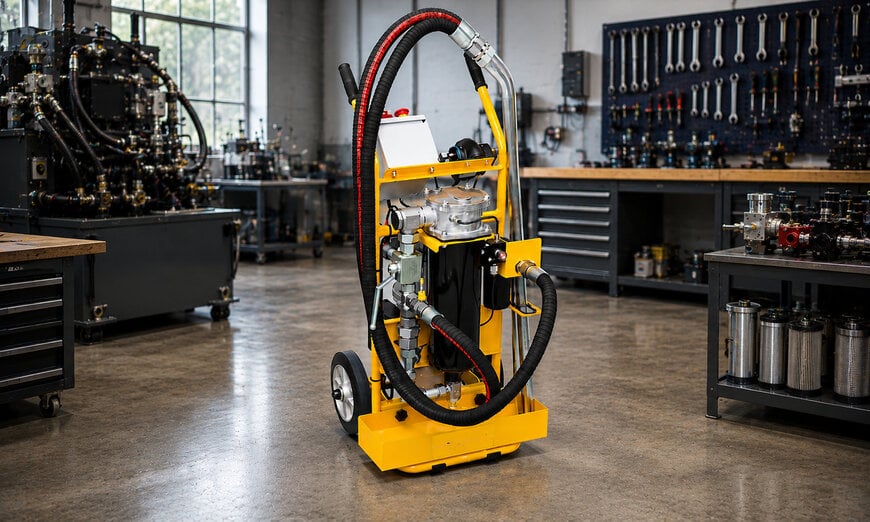
Parker Hannifin has announced the launch of its GLFTrolley portable filtration system designed to optimize fluid cleanliness metrics across high-stress operating environments. This hardware deployment introduces advanced offline conditioning blocks engineered to sustain stationary manufacturing machinery, marine propulsion systems, mining hardware, and forestry utility platforms by isolating free water and particulate matter from hydraulic and lubrication oil lines.
Nominal flow kinematics and multi-stage fluid conditioning
The mechanical infrastructure relies on heavy-duty gear pump configurations to execute constant fluid displacement while minimizing shear stress within the oil matrix. Operating across predefined delivery thresholds of 20 liters per minute and 40 liters per minute, the conditioning loops enable service technicians to execute rapid offline purification on low-capacity sumps or establish permanent bypass filtration loops on large-scale reservoirs. This dual-speed architecture ensures predictable fluid velocity through the internal filter element, maximizing multi-pass particulate capture efficiency under varying oil viscosities.
The fluid drive is powered by a continuous-duty single-phase motor optimized for thermal stabilization during long-cycle operation. By maintaining deterministic flow velocities through the media layers, the filtration circuit removes suspended particles and separates unbound water molecules before the fluid recirculates into the main high-pressure loops. This proactive moisture extraction preserves base oil additive packages and stops hydrolytic degradation without demanding structural alterations to existing machine cabinet configurations.
Field deployment flexibility and localized structural layout
The physical architecture incorporates a high-mobility chassis design to facilitate tactical positioning across congested factory floors or uneven terrain. By integrating flexible hose assemblies and robust coupling interfaces into a compact outer envelope, the stationary or mobile layout limits fluid exposure risks during oil transfer routines and preventive maintenance intervals. This self-contained layout isolates the high-voltage motor controls and pump brackets from external environmental hazards like atmospheric dust and localized water spray.
When integrated into routine service schedules, the auxiliary filtration circuit shortens machine conditioning cycles without requiring system-wide shutdown sequences. The low-profile footprint allows for close-coupled integration adjacent to hydraulic power units, reducing auxiliary hose lengths and minimizing external pressure drops across the bypass line. This high-density layout isolates structural mechanical vibration, stabilizing total conditioning performance across the entire power distribution grid.
Additional Context: This section details technical specifications and competitive benchmarking not included in the original product announcement
Within the high-performance portable fluid conditioning market, this expanded portfolio competes directly with established lines such as the Pall HNP series fluid purifiers or the Hydac OF7 portable filtration units. Objective technical benchmarking indicates that while conventional entry-level transfer carts utilize standard utility pumps that introduce air entrainment and cannot manage high moisture ingress, Parker's smart configuration unifies positive displacement gear pumps with water-absorbing media blocks close to the fluid channel. This design minimizes cavitation-induced foaming and stabilizes total filtration cycles under extreme particulate loading.
Additionally, the development pipeline leverages extensive field infrastructure across marine, mining, and industrial sectors, building on legacy engineering baselines. However, achieving maximum contamination retention coefficients exceeding 99 percent under full volumetric flow rates demands precise synchronization with proper fluid temperature controls; improper element selection during low-temperature cold starts can cause high differential pressure spikes across the filter housing, triggering internal bypass valves and temporarily reducing the total cost advantages compared to dedicated plant-wide vacuum dehydration stations equipped with passive automated drainage systems.
Edited by Sucithra Mani, Induportals editor – adapted by AI.
www.parker.com
