
www.industryemea.com
05
'26
Written on Modified on
SD200 841 offers more power for severe-duty processes
ABB introduces larger NEMA 5000 series frame sizes to its SD200 841 low-voltage motor platform to deliver full IEEE 841-2021 compliant power up to 500 horsepower.
global.abb
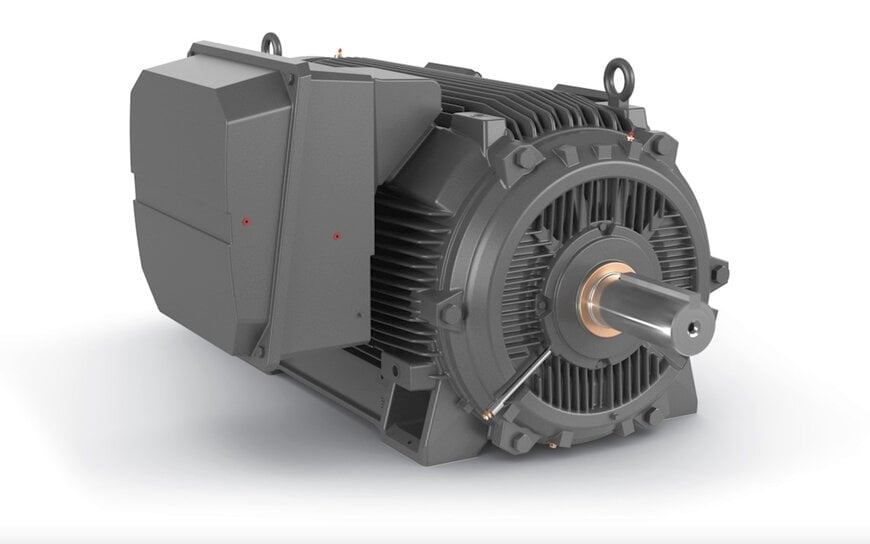
ABB has expanded its SD200 841 severe-duty electric motor family to a maximum output of 500 horsepower. The introduction incorporates larger NEMA 5000 series frame sizes, specifically covering frames 5009 through 5013, extending the product spectrum beyond the previous 449T frame constraint to address high-capacity industrial assets operating in demanding environments. The entire expanded portfolio maintains adherence to the established IEEE 841-2021 engineering standards for premium-efficiency, severe-duty horizontal and vertical squirrel-cage induction machinery.
Environmental Ingress and Thermal Specifications
The mechanical design features IP56-rated environmental protection to safeguard internal assemblies against heavy moisture and particulate contamination in wet or fouled operational settings. Thermal management is supported by a Class H insulation system, which provides elevated thermal capacity to preserve winding integrity during extended operation in high-ambient temperature applications. To minimize unplanned servicing intervals and block external contaminants, bearing isolators are installed on both the drive and non-drive shaft ends.
The dynamic balance configurations limit baseline operation vibration levels to 0.06 inches per second, supporting rotational consistency under high-torque load configurations. ABB validates each unit by shipping it with an official IEEE 841 compliance test report, accompanied by a five-year factory warranty. Safety and hazardous-area deployment compliance is verified through UR component recognition alongside CSA listings certifying safe operation within Class I, Division 2 and Class II, Division 2 explosive atmospheres.
Mechanical Interfacing and Structural Enhancements
Installation, electrical termination, and routine maintenance access are assisted by an oversized conduit box featuring a field-modifiable layout. As a standard engineering feature replacing traditional flying leads, the 5000 series frame motors incorporate factory-installed terminal blocks. This structural change elevates terminal connection reliability, limits installation errors, and establishes more direct hardware access for maintenance personnel.
Target Process Applications and Standardization
The SD200 841 FS500 configuration is developed for process machinery in petroleum and chemical refineries, pulp and paper processing mills, mining and aggregate extractions, cement manufacturing plants, and heavy-duty industrial fluid pumping and materials conveying networks. The increased power window allows operations engineering teams to standardize plant assets around a uniform IEEE 841 equipment platform across wide-ranging machine tiers, stabilizing maintenance reliability protocols and extending operational life as target asset horsepower requirements increase.
Additional Context
This section details technical specifications and competitive benchmarking not included in the original news release.
Industrial induction motors intended for severe-duty petrochemical, chemical, and process industries are governed by the IEEE 841 specification, which defines strict benchmarks for balancing, ingress control, and thermal boundaries. The standard explicitly covers polyphase induction motors up to 500 Hp.
Enclosure Ingress and Environmental Safeguards
The standard baseline for severe-duty motors across the market is an IP55 rating, which protects against dust and low-pressure water streams. The premium IEEE 841 category mandates tighter sealing configurations to handle high-pressure washdowns and external spray. The expanded SD200 841 platform delivers IP56 protection natively across its high-horsepower frames.
When evaluating comparable products on the market, such as the EQP Global 841 series or standard NEMA severe-duty product lines, labyrinth bearing seals are typically used on both shaft ends to achieve equivalent IP56 protection. However, alternative products frequently show variance in standard terminal box structural sealing and internal grounding methodologies once scaled up from standard T-frames into larger NEMA 5000 geometric profiles.
Thermal Engineering and Insulation Performance
Thermal resilience dictates insulation life when motors are driven by Variable Frequency Drives, which cause harmonic heating and transient voltage spikes. The standard configuration for large severe-duty motors relies on a Class F insulation system, providing a 155 degrees Celsius total thermal limit, paired with a Class B temperature rise of 80 degrees Celsius under standard sine-wave operation.
The SD200 841 platform establishes an advantage over these standard products by integrating a full Class H insulation system, which features a higher 180 degrees Celsius thermal boundary. This design choice yields a 25 degrees Celsius premium safety margin over Class F product lines. The additional thermal overhead directly prevents the premature dielectric breakdown of magnet wire coatings under continuous high-temperature operating cycles and demanding inverter-fed configurations.
Vibration Velocity Thresholds
Rotor balancing directly dictates long-term bearing wear and mechanical stability. The IEEE 841 standard mandates that unfiltered vibration velocity must not exceed a maximum limit of 0.08 inches per second (IPS) for 2-pole, 4-pole, and 6-pole machines.
Premium industry benchmarks, such as the EQP Global 841 series, balance their rotors to line up directly with this 0.08 IPS ceiling. By contrast, the SD200 841 features a reduced operational vibration limit constrained to a strict 0.06 IPS maximum threshold. This precision balancing curtails continuous structural stress, limits shaft deflection, and lowers the cyclical fatigue forces transmitted to the internal bearings over extended duty cycles.
Lead Management and Terminal Geometry
In typical NEMA 449T and larger NEMA 5000 series severe-duty motors on the market, electrical connections are managed via flexible flying leads, which are insulated conductor wires protruding directly from the internal stator windings into the conduit box. Field technicians must manually crimp, bolt, and wrap these connections with insulation tape or heat-shrink sleeves during installation.
The expanded SD200 841 platform replaces these loose conductors with rigid, factory-installed terminal blocks as a standard integrated feature on its NEMA 5000 series models. This design provides fixed mechanical contact points that eliminate loose cable routing inside the oversized enclosure, eliminate the risk of phase-to-phase contact shorts caused by cable movement or vibration-induced friction, and remove human variations in field-crimping execution across large industrial installations.
Edited by Romila DSilva, Induportals Editor, with AI assistance.
www.abb.com
