
www.industryemea.com
04
'26
Written on Modified on
High-Temperature Elastomer Couplings for Industrial Drive Systems
R+L Hydraulics manufactures continuous-operation coupling elements designed for extreme thermal environments up to 177 degrees Celsius.
www.rl-hydraulics.com
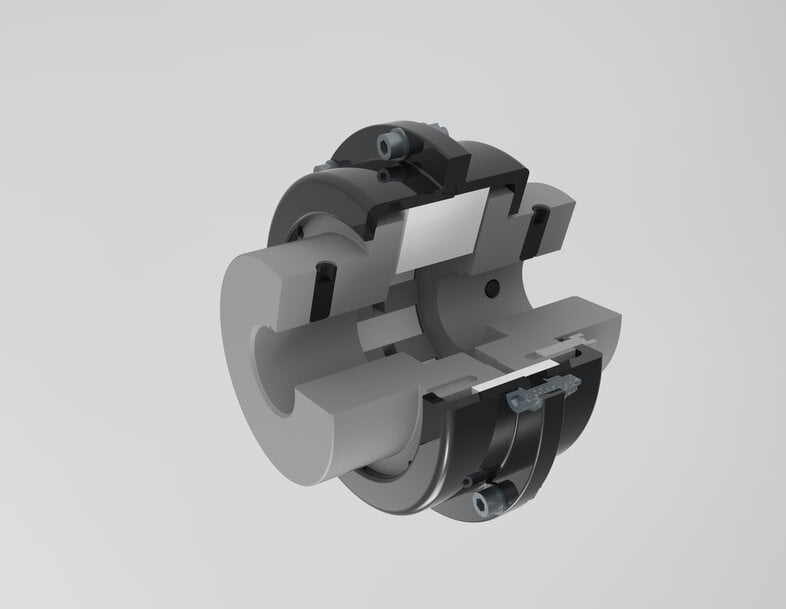
In industrial sectors such as steel production and power generation, mechanical drive components are frequently exposed to extreme thermal stress. Addressing these environmental conditions, high-temperature elastomer couplings provide reliable torque transmission in proximity to ovens, steam plants, and turbines. These coupling systems enable vibration damping and misalignment compensation in settings where standard elastomeric materials typically degrade.
Technical Design and Operational Mechanics
The high-temperature coupling variants feature a specialized white elastomer center element that maintains structural integrity at continuous operating temperatures up to 177 degrees Celsius. The mechanical architecture relies on opposing, non-interlocking teeth between the metallic hubs. This configuration isolates the metal components from direct contact, preventing mechanical wear on the hubs during torque transmission. Because the system operates without metal-to-metal friction, it functions without lubricating oil or grease, eliminating routine relubrication intervals.
Maintenance and Serviceability
Operating machinery in high-heat environments typically requires extensive cooling periods before maintenance personnel can safely access the equipment. By utilizing an accessible central elastomer insert, engineers can replace the functional element without disassembling the entire coupling or moving the connected shafts. This modular replacement capability directly reduces equipment downtime and improves overall machine availability during scheduled maintenance cycles.
Performance Specifications and Modularity
The coupling series accommodates nominal torques ranging from 93 Nm to 601.5 kNm, with the capacity to handle transient torque peaks up to 1200 kNm. Bore diameters are available from 10 mm to 500 mm. For systems with varying structural requirements, the modular architecture permits shaft gap bridging between 25 mm and 3000 mm using specific spacers. Shortened hub variants are manufactured for installations with restricted axial space. Furthermore, the hub configurations allow for the integration of secondary components, including braking mechanisms, auxiliary drives, and rotational sensors.
Additional Context: This section details technical specifications and competitive benchmarking not included in the original product announcement.
Standard polyurethane or standard synthetic rubber elastomer couplings typically exhibit thermal degradation limits between 80 and 90 degrees Celsius, with specialty synthetic compounds extending to approximately 120 degrees Celsius. Operating beyond these thresholds normally requires a transition to all-metal couplings, such as gear or metallic membrane couplings. While all-metal couplings handle extreme temperatures, they often lack the vibration damping characteristics of elastomers and may require continuous lubrication. The utilization of specialized high-temperature elastomers bridges this operational gap, offering both the damping capacity of a flexible insert and the necessary thermal resistance for severe industrial environments.
Edited by an industrial journalist, Lekshman Ramdas, with AI assistance.
www.rl-hydraulics.com
