
www.industryemea.com
27
'26
Written on Modified on
Liquid Cooling Infrastructure Expands for AI Data Centers
Vertiv is extending liquid cooling infrastructure in EMEA as AI compute density increases pressure on thermal management in modern data center design.
www.vertiv.com
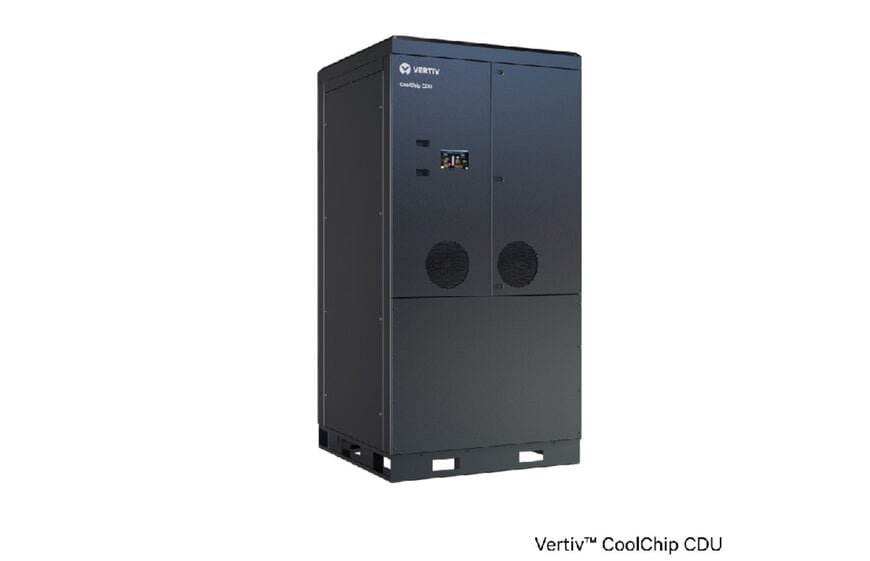
Vertiv has expanded the availability of new liquid cooling infrastructure technologies across Europe, the Middle East, and Africa, targeting AI-ready and high-density computing deployments. The expansion adds higher-capacity coolant distribution and fluid connectivity systems intended to accelerate deployment timelines for hyperscale, colocation, and enterprise data center operators adapting to increasingly demanding AI workloads.
Liquid Cooling as AI Infrastructure Requirement
The rapid increase in AI accelerator deployments is changing data center thermal design assumptions. Traditional air cooling architectures become more difficult to scale as rack power densities rise, particularly in GPU-intensive artificial intelligence and high-performance computing environments.
In this context, Vertiv has expanded its thermal management portfolio in EMEA with the availability of the CoolChip CDU 2300 coolant distribution unit and CoolChip Fluid Network Row Manifolds. These systems are positioned as part of an integrated thermal chain architecture that combines direct-to-chip cooling, immersion cooling, rear-door heat exchangers, coolant distribution, heat rejection systems, intelligent controls, and lifecycle support.
This approach reflects a broader industry shift toward end-to-end thermal infrastructure rather than isolated cooling components, particularly as AI data center operators seek predictable deployment at scale.
High-Capacity Coolant Distribution Architecture
A central component of the announcement is the CoolChip CDU 2300, a liquid-to-liquid coolant distribution unit rated for 2.3 MW of cooling capacity.
At this capacity level, the CDU is intended for large-scale high-density computing environments where concentrated thermal loads require centralized liquid thermal management. The compact cabinet form factor allows deployment either in-row or in adjacent mechanical spaces, providing flexibility depending on facility layout constraints.
Vertiv states that its broader CDU portfolio ranges from 100 kW to 2.3 MW, enabling infrastructure scaling from smaller direct liquid cooling deployments to hyperscale AI clusters.
The CDU supports both direct-to-chip liquid cooling and rear-door heat exchanger architectures. Integrated controller functionality dynamically adjusts coolant temperature and flow according to workload conditions, which is relevant in environments where thermal loads fluctuate significantly depending on AI model training or inference demand.
Operational resilience features include redundancy support, unit-to-unit communication, and remote monitoring, mechanisms intended to improve availability and reduce operational management complexity.
Fluid Distribution Network for Scalable Deployment
Complementing the CDU architecture, the new CoolChip Fluid Network Row Manifolds provide the coolant routing layer between facility cooling systems, server-level thermal hardware, and heat dissipation infrastructure.
In liquid cooling deployments, manifold design directly affects maintainability, pressure stability, contamination control, and deployment speed.
Vertiv states that each manifold assembly is flushed, passivated, pressure-tested, and sealed before deployment. These measures are intended to reduce corrosion risk, maintain coolant cleanliness, and minimize leakage risk in high-density operational environments.
The configurable manifold design supports compatibility with direct-to-chip cooling, immersion cooling, and rear-door heat exchanger systems, allowing operators to adapt infrastructure according to server architecture and cooling strategy.
For retrofit projects, pre-engineered fluid distribution systems can reduce integration complexity compared with custom-built piping installations.
Lifecycle Services and Deployment Strategy
Vertiv has paired the hardware expansion with liquid cooling lifecycle services covering design support, installation, and ongoing maintenance.
This reflects a practical challenge in AI infrastructure deployment: liquid cooling integration often requires facility engineering expertise beyond conventional air-cooled data center operations.
Support services can therefore influence deployment speed, commissioning reliability, and long-term maintenance performance, especially for enterprise operators transitioning into liquid cooling for the first time.
Additional Context
This section details technical specifications and competitive benchmarking not included in the original news release.
Vertiv’s announcement places it within a rapidly expanding AI data center liquid cooling market where vendors increasingly compete on thermal capacity, modularity, and integration depth.
Schneider Electric has expanded its own AI-focused thermal infrastructure capabilities following its acquisition of liquid cooling specialist Motivair, strengthening its integrated cooling and power infrastructure offering for hyperscale and enterprise deployments.
CoolIT Systems represents another relevant benchmark, particularly in direct liquid cooling infrastructure. The company offers coolant distribution units, rack manifolds, and direct-to-chip cooling systems for AI and high-performance computing deployments, with installations reported across more than 300 data centers globally.
Vertiv’s differentiation lies in the combination of high-capacity coolant distribution, configurable manifold connectivity, and integrated lifecycle support within a unified thermal management architecture. The 2.3 MW CDU specification places the solution in the upper segment of infrastructure-scale liquid cooling systems intended for dense AI compute environments rather than isolated rack-level deployments.
Edited by Aishwarya Mambet, Induportals Editor, with AI assistance.
www.vertiv.com
