
Technical Integration of Modular Humanoid Robotics in Diverse Sectors
Phil Zheng of Richtech Robotics details the operational deployment of AI-powered systems for hospitality, logistics, and industrial manufacturing applications.
richtechrobotics.com
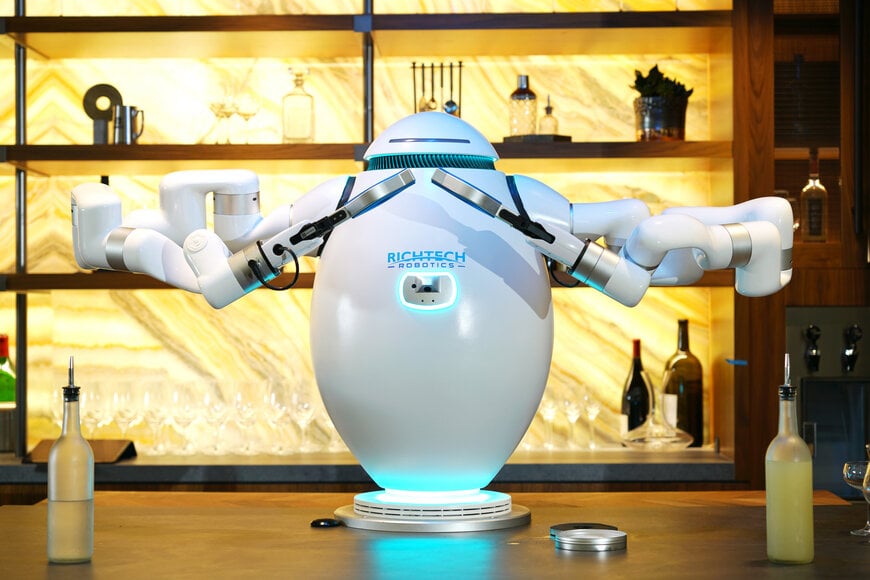
The deployment of robotic systems across hospitality and industrial environments relies on modular, purpose-driven platforms. By utilizing core technologies such as computer vision and modular robotics, systems are adapted to specific sectoral needs without requiring a full system redesign. This modularity allows for the scaling of precision and uptime across different workflows, ranging from high-volume beverage service in stadiums to material handling on a factory floor.
The ADAM dual-armed robot is utilized in high-traffic venues where consistency is required during peak demand. The system employs closed-loop intelligence through AI-driven vision systems. These sensors monitor interactions in real time to adjust pour levels and detect anomalies, such as misplaced containers. This level of technical precision is necessary for maintaining operational efficiency and ensuring accurate volume measurement in dynamic environments. The presence of the system also functions to increase foot traffic and engagement within the venue.
The DEX humanoid robot is engineered for tasks such as machine operation, sorting, and quality inspection. A significant technical challenge in industrial humanoid robotics is balancing human-like dexterity with mechanical reliability. Richtech Robotics utilizes a Sim2Real approach, where the robot learns tasks within a simulated environment using NVIDIA Isaac Sim before fine-tuning in physical settings. This method accelerates deployment and ensures safe operation alongside existing machinery. The hardware configuration uses a wheeled platform for stability and speed, paired with modular end-effectors for diverse industrial tasks.
AI and computer vision serve as the primary sensory inputs for robotic autonomy. These technologies allow systems to interpret complex environments, track motion, and adapt to changing conditions without extensive manual programming. Continuous data collection from real-world interactions improves the ability of the systems to handle edge cases, which increases overall reliability and reduces operational errors. Advanced features currently under development include voice ordering and facial recognition to enhance contextual awareness.
The implementation of robotics is focused on the automation of repetitive, low-variability tasks. In service environments, this includes transporting items or pouring drinks, while in healthcare, it involves inventory management and supply delivery. By automating these specific functions, human workers are redirected toward tasks requiring higher-level cognitive input or interpersonal interaction. The design of these systems emphasizes predictable movement and approachable forms to facilitate safe integration into shared workspaces.
The sectors showing the fastest adoption rates for AI-powered robotics include hospitality, logistics, and manufacturing. These industries utilize robotics to address labor availability and the requirement for consistent output. Growth in these areas is supported by a data-driven approach where operational data is used to train AI models, shortening the ramp-up time for new deployments and ensuring reliability from the initial implementation.
About the Speaker
Phil Zheng is the Chief Operating Officer of Richtech Robotics, where he oversees sales, operations, and customer success for the company’s AI-powered robotics solutions. Since joining the company in its early stages, he has played a key role in scaling service and industrial robotics platforms such as ADAM and DEX across sectors including hospitality, manufacturing, and automation. He holds a BA from UCLA and a JD from UC Irvine School of Law and frequently speaks on robotics adoption, physical AI, and operational efficiency.
Edited by an industrial journalist, Lekshman Ramdas, with AI assistance.
www.richtechrobotics.com
