
www.industryemea.com
06
'26
Written on Modified on
Motion control integration for smart industrial manufacturing systems
RS offers technical components and expertise to implement closed-loop motion control architectures for discrete and process manufacturing applications.
www.rs-online.com
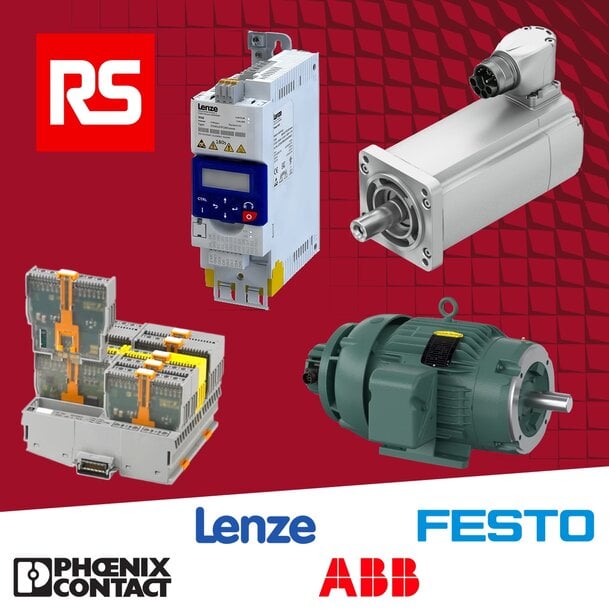
Industrial operations require precise coordination between motors, drives, and feedback devices to maintain data-driven Industry 4.0 standards. In discrete and process manufacturing, as well as material handling and logistics, the transition from open-loop to closed-loop systems addresses specific operational risks. Open-loop systems function without feedback, which often results in mechanical drift and variable performance. Furthermore, mismatched power ratings and electrical characteristics between motors and drives can lead to energy loss and premature mechanical failure in bearings and related equipment. Smart closed-loop systems with integrated motors and encoders provide a method for manufacturers to stabilize these variables and improve system visibility.
Motor and encoder specifications for precision applications
The integration of absolute encoders and synchronous motors facilitates higher path fidelity and tracking accuracy. Synchronous AC brushless motors, such as the Festo EMMT-AS series, utilize a single-cable design to consolidate power and encoder signals into a single connection. This configuration reduces installation space and wiring complexity while maintaining IP67-rated protection for harsh environments. These motors include integrated temperature sensors to monitor thermal conditions and provide low cogging torque, which is necessary for maintaining accuracy at low rotational speeds in robotics and assembly lines.
For heavy-duty applications such as extruders and conveyors, inverter-duty AC motors provide regulated torque across a wide speed range. The ABB Baldor-Reliance V*S Master AC motors utilize Class F insulation to protect against corona discharge and voltage stress during variable-speed operation, which extends the operational life of the equipment. These units support a 1,000:1 continuous torque range from zero to base speed and are compatible with both open- and closed-loop control architectures, supporting power requirements up to 500hp and 200% overload torque.
Inverter and I/O architectures in control systems
Drive technology must offer scalability and broad communication compatibility to function within modern control cabinets. The Lenze i550 frequency inverters utilize an IP20 form factor to minimize the footprint in crowded cabinets. These drives comply with Ecodesign Energy Efficiency standards and support multiple protocols including EtherCAT, PROFINET, and Modbus TCP, allowing for integration into diverse automation environments. The inclusion of Safe Torque Off functionality at the SIL 3 level ensures safety compliance without requiring extensive external components.
To manage signal transmission between field devices and central programmable logic controllers, remote I/O systems like the Phoenix Contact Axioline F are utilized. These systems employ push-in connections for rapid assembly and are designed to withstand mechanical stress, including vibration up to 5g and shock up to 30g. By facilitating fast signal acquisition, these modules enable real-time process visibility and support predictive maintenance strategies through early fault detection and faster troubleshooting. This infrastructure allows for the transmission of data from motors and encoders to a central controller, which is essential for reducing unplanned downtime.
Edited by an industrial journalist, Lekshman Ramdas, with AI assistance.
www.rsdelivers.com
