
www.industryemea.com
22
'25
Written on Modified on
PANDA Fibre Connectors for Polarization-Critical Networks
Rosenberger OSI introduces assembled polarization-maintaining connector solutions based on PANDA fibre to support stable signal transmission in telecom, quantum communication, and data-centre infrastructures.
osi.rosenberger.com
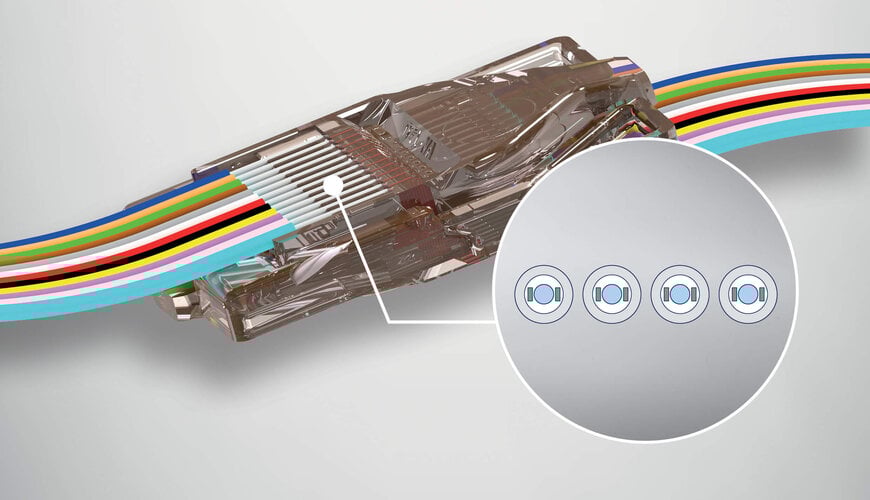
Rosenberger Optical Solutions & Infrastructure has launched its first assembled products incorporating PANDA polarization-maintaining (PM) fibre, extending its portfolio for applications where long-term polarization stability is a functional requirement. The products target telecommunications systems, quantum communication environments, and data-centre networks that rely on controlled optical states rather than intensity alone.
Why polarization-maintaining fibre matters
In conventional single-mode fibre, mechanical stress, temperature variation, or bending can alter the polarization state of transmitted light. This variability limits performance in applications such as coherent transmission, quantum key distribution, and precision timing, where polarization drift directly affects signal integrity.
PANDA fibre addresses this limitation by integrating stress-applying elements within the fibre cladding. These elements create a defined birefringence that preserves linear polarization along two orthogonal axes, commonly referred to as the fast and slow axes. As a result, the polarization state remains stable even under external mechanical or thermal influence.
Assembly precision as a key technical challenge
While PM fibre technology is established at the fibre level, connectorization introduces a significant engineering challenge. The stress elements of mating fibres must be aligned with extremely high angular accuracy. Minor misalignment can lead to increased insertion loss, polarization crosstalk, and degradation of extinction ratio.
Rosenberger OSI has developed dedicated assembly processes and tooling to enable precise alignment of PANDA fibres in both single-fibre and multi-fibre connectors, including expanded beam optical (EBO) interfaces. According to the company, this capability enables the delivery of assembled PM connectors with low optical loss and stable polarization characteristics across multiple fibres.
Functional benefits for system designers
The assembled PANDA fibre products are designed to provide predictable polarization behaviour across the connector interface, supporting system-level stability rather than relying on compensation at higher protocol layers. Optimised assembly processes also reduce integration effort for equipment manufacturers by providing ready-to-deploy connector solutions instead of requiring in-house PM fibre termination.
The availability of both single- and multi-fibre configurations allows deployment across a range of architectures, from point-to-point optical links to high-density interconnects.
Application domains and use cases
In telecommunications, PM connectors support polarization multiplexing and coherent transmission schemes, where stable polarization states improve signal demodulation accuracy. In quantum communication, particularly quantum key distribution and experiments involving entangled photons, polarization stability is fundamental to maintaining quantum states over fibre links.
Within data centres, PANDA fibre connectors are relevant for applications such as precision clock distribution and specialised high-performance optical interconnects. Beyond stationary infrastructure, polarization-maintaining fibres are also used in transportation and navigation systems, including fibre-optic gyroscopes, where phase and polarization stability directly influence measurement accuracy.
Market context and technological relevance
By introducing assembled PANDA fibre connector products, Rosenberger OSI is addressing a growing demand for polarization-controlled optical infrastructure driven by quantum communication research, emerging quantum networks, and advanced coherent optical systems. Rather than positioning PM fibre as a future concept, the launch reflects a shift toward practical deployment of polarization-critical links within today’s high-performance network environments.
The availability of factory-assembled PM connectors lowers the barrier to adoption and supports more consistent implementation of polarization-sensitive technologies across telecommunications, data-centre, and quantum communication systems.
www.rosenberger.com
